

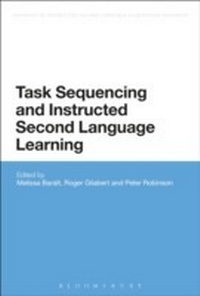
Task Sequencing and Instructed Second Language Learning
1st Edition
Published on 31. July 2014
256 pages
978-1-62356-408-7 (ISBN)
Description

Task Sequencing and Instructed Second Language Learning provides theoretical rationales for, and empirical studies of, the effects of sequencing language learning tasks to maximize second language learning. Examples of task sequences, and both laboratory and classroom-based research into them, are presented.
This is the first collection of so far under-researched studies on the effects of task sequencing, framed within the Cognition Hypothesis of Task-based Language Teaching (TBLT) and the SSARC model for task sequencing.
Perspectives include
-- laboratory-based and classroom-based research designs
-- implications for teacher training
-- laboratory and classroom research methods
-- conversational interaction
-- task sequencing and Task Based Language Teaching syllabus design
This is the first collection of so far under-researched studies on the effects of task sequencing, framed within the Cognition Hypothesis of Task-based Language Teaching (TBLT) and the SSARC model for task sequencing.
Perspectives include
-- laboratory-based and classroom-based research designs
-- implications for teacher training
-- laboratory and classroom research methods
-- conversational interaction
-- task sequencing and Task Based Language Teaching syllabus design
Reviews / Votes
[Task Sequencing and Instructed Second Language Learning] provides a welcome contribution to the current discussion. ... [T]he volume gives much food for thought ... [and] makes an interesting starting point for anyone looking for a challenging research topic. * Journal of Linguistics and Language Teaching * Task Sequencing and Instructed Second Language Learning is an important contribution to our understanding of the effects of task design in second language pedagogy. Analysing a wide range of instructional contexts, the editors have brought together a collection of carefully designed studies conducted in experimentally controlled and classroom environments. An innovative piece of work for both researchers and language teachers and anyone who is interested in using language learning tasks in order to promote L2 learning.More details
Series
Edition
1. Auflage
Language
English
Place of publication
New York
United States
Publishing group
Bloomsbury Publishing PLC (Digital)
Target group
Professional and scholarly
ISBN-13
978-1-62356-408-7 (9781623564087)
Copyright in bibliographic data and cover images is held by Nielsen Book Services Limited or by the publishers or by their respective licensors: all rights reserved.
Schweitzer Classification
Other editions
Additional editions
Melissa Baralt | Roger Gilabert | Peter Robinson
Task Sequencing and Instructed Second Language Learning
Book
01/2016
Bloomsbury Academic
€56.20
Shipment within 15-20 days
Melissa Baralt | Roger Gilabert | Peter Robinson
Task Sequencing and Instructed Second Language Learning
Book
07/2014
Bloomsbury Academic USA
€222.60
Shipment within 3-4 weeks
Persons
Melissa Baralt is Assistant Professor of Spanish Applied Linguistics at Florida International University, USA.
Roger Gilabert is Lecturer in Applied Linguistics at Universitat de Barcelona, Spain.
Peter Robinson is Professor of Linguistics and Second Language Acquisition at Aoyama Gakuin University, Japan.
Roger Gilabert is Lecturer in Applied Linguistics at Universitat de Barcelona, Spain.
Peter Robinson is Professor of Linguistics and Second Language Acquisition at Aoyama Gakuin University, Japan.
Content
List of contributors
Acknowledgements
Chapter 1. An introduction to theory and research in task sequencing and instructed second language learning, Melissa Baralt, Roger Gilabert & Peter Robinson
Section I. Experimental studies of task sequencing
Chapter 2. Task sequencing in the L2 development of spatial expressions, Mayya Levkina & Roger Gilabert
Chapter 3. The role of task sequencing in monologic oral production, Aleksandra Malicka
Chapter 4. Task complexity and task sequencing in traditional versus online language classes, Melissa Baralt
Chapter 5. The effects of guided planning, task complexity and task sequencing on L2 oral production, Colin Thompson
Section II. Educationally situated studies of task sequencing in natural classroom contexts
Chapter 6. A pedagogical proposal for task sequencing: An exploration of task repetition and task complexity on learning opportunities, YouJin Kim & Caroline Payant
Chapter 7. Teachers` application of the Cognition Hypothesis when lesson planning: A case study, Melissa Baralt, Simone Harmath-de Lemmos & Sawsan Werfelli
Chapter 8. Learning to perform narrative tasks: A semester-long classroom study of task sequencing effects, Craig Lambert & Peter Robinson
Subject index
Acknowledgements
Chapter 1. An introduction to theory and research in task sequencing and instructed second language learning, Melissa Baralt, Roger Gilabert & Peter Robinson
Section I. Experimental studies of task sequencing
Chapter 2. Task sequencing in the L2 development of spatial expressions, Mayya Levkina & Roger Gilabert
Chapter 3. The role of task sequencing in monologic oral production, Aleksandra Malicka
Chapter 4. Task complexity and task sequencing in traditional versus online language classes, Melissa Baralt
Chapter 5. The effects of guided planning, task complexity and task sequencing on L2 oral production, Colin Thompson
Section II. Educationally situated studies of task sequencing in natural classroom contexts
Chapter 6. A pedagogical proposal for task sequencing: An exploration of task repetition and task complexity on learning opportunities, YouJin Kim & Caroline Payant
Chapter 7. Teachers` application of the Cognition Hypothesis when lesson planning: A case study, Melissa Baralt, Simone Harmath-de Lemmos & Sawsan Werfelli
Chapter 8. Learning to perform narrative tasks: A semester-long classroom study of task sequencing effects, Craig Lambert & Peter Robinson
Subject index
