

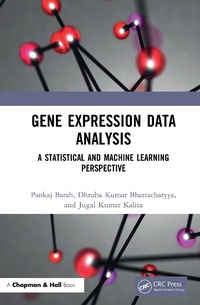
Gene Expression Data Analysis
A Statistical and Machine Learning Perspective
1st Edition
Published on 21. November 2021
378 pages
978-1-000-42573-4 (ISBN)
Description

Development of high-throughput technologies in molecular biology during the last two decades has contributed to the production of tremendous amounts of data. Microarray and RNA sequencing are two such widely used high-throughput technologies for simultaneously monitoring the expression patterns of thousands of genes. Data produced from such experiments are voluminous (both in dimensionality and numbers of instances) and evolving in nature. Analysis of huge amounts of data toward the identification of interesting patterns that are relevant for a given biological question requires high-performance computational infrastructure as well as efficient machine learning algorithms. Cross-communication of ideas between biologists and computer scientists remains a big challenge.
Gene Expression Data Analysis: A Statistical and Machine Learning Perspective has been written with a multidisciplinary audience in mind. The book discusses gene expression data analysis from molecular biology, machine learning, and statistical perspectives. Readers will be able to acquire both theoretical and practical knowledge of methods for identifying novel patterns of high biological significance. To measure the effectiveness of such algorithms, we discuss statistical and biological performance metrics that can be used in real life or in a simulated environment. This book discusses a large number of benchmark algorithms, tools, systems, and repositories that are commonly used in analyzing gene expression data and validating results. This book will benefit students, researchers, and practitioners in biology, medicine, and computer science by enabling them to acquire in-depth knowledge in statistical and machine-learning-based methods for analyzing gene expression data.
Key Features:
An introduction to the Central Dogma of molecular biology and information flow in biological systems
A systematic overview of the methods for generating gene expression data
Background knowledge on statistical modeling and machine learning techniques
Detailed methodology of analyzing gene expression data with an example case study
Clustering methods for finding co-expression patterns from microarray, bulkRNA, and scRNA data
A large number of practical tools, systems, and repositories that are useful for computational biologists to create, analyze, and validate biologically relevant gene expression patterns
Suitable for multidisciplinary researchers and practitioners in computer science and biological sciences
Gene Expression Data Analysis: A Statistical and Machine Learning Perspective has been written with a multidisciplinary audience in mind. The book discusses gene expression data analysis from molecular biology, machine learning, and statistical perspectives. Readers will be able to acquire both theoretical and practical knowledge of methods for identifying novel patterns of high biological significance. To measure the effectiveness of such algorithms, we discuss statistical and biological performance metrics that can be used in real life or in a simulated environment. This book discusses a large number of benchmark algorithms, tools, systems, and repositories that are commonly used in analyzing gene expression data and validating results. This book will benefit students, researchers, and practitioners in biology, medicine, and computer science by enabling them to acquire in-depth knowledge in statistical and machine-learning-based methods for analyzing gene expression data.
Key Features:
An introduction to the Central Dogma of molecular biology and information flow in biological systems
A systematic overview of the methods for generating gene expression data
Background knowledge on statistical modeling and machine learning techniques
Detailed methodology of analyzing gene expression data with an example case study
Clustering methods for finding co-expression patterns from microarray, bulkRNA, and scRNA data
A large number of practical tools, systems, and repositories that are useful for computational biologists to create, analyze, and validate biologically relevant gene expression patterns
Suitable for multidisciplinary researchers and practitioners in computer science and biological sciences
More details
Edition
1. Auflage
Language
English
Place of publication
London
United Kingdom
Publishing group
Taylor & Francis Ltd
Target group
College/higher education
Professional and scholarly
Illustrations
42 Tables, black and white; 68 Line drawings, black and white; 2 Halftones, black and white; 70 Illustrations, black and white
ISBN-13
978-1-000-42573-4 (9781000425734)
Copyright in bibliographic data and cover images is held by Nielsen Book Services Limited or by the publishers or by their respective licensors: all rights reserved.
Schweitzer Classification
Other editions
Additional editions
Pankaj Barah | Dhruba Kumar Bhattacharyya | Jugal Kumar Kalita
Gene Expression Data Analysis
A Statistical and Machine Learning Perspective
Book
10/2024
1st Edition
Chapman & Hall/CRC
€84.00
Shipment within 10-20 days
Pankaj Barah | Dhruba Kumar Bhattacharyya | Jugal Kumar Kalita
Gene Expression Data Analysis
A Statistical and Machine Learning Perspective
Book
11/2021
1st Edition
Chapman & Hall/CRC
€207.30
Shipment within 15-20 days
Persons
Pankaj Barah is an Assistant professor in Molecular Biology and Biotechnology at Tezpur University. He has received his M.Sc. degree in Bioinformatics (2006) from University of Madras in India and PhD in Computational Systems Biology (2013) from the Norwegian University of Science and Technology (NTNU), Trondheim, Norway. He has worked as Bioinformatics scientist in the division of Theoretical Bioinformatics at German Cancer Research Center (DKFZ) in Heidelberg, Germany during 2015-2017. His research areas include- computational systems biology, bioinformatics, evolutionary systems biology, Next Generation Sequencing (NGS), Big data analytics and biological networks. He has authored 20 research articles, edited two books and written 5 book chapters. He is recipient of Ramalingaswami Re-entry Fellowship from the Department of Biotechnology, Government of India. Dr. Barah is currently a member of the Indian National Young Academy of Sciences.
Dhruba Kumar Bhattacharyya is a professor in Computer Science and Engineering at Tezpur University. He teaches machine learning, network security, cryptography and computational biology in UG, PG and PhD classes at Tezpur University. Professor Bhattacharyya's research areas include machine learning, network security, and bioinformatics. He has published more than 280 research articles in leading international journals and peer-reviewed conference proceedings. Dr. Bhattacharyya has authored 5 technical reference books and edited 9 technical volumes. Under his guidance, twenty students have successfully completed Ph.D. in the areas of machine learning, bioinformatics and network security. He is PI of several major research grants, including the Centre of Excellence of Ministry of HRD of Government of India under FAST instituted at Tezpur University. Professor Bhattacharyya is a Fellow of IETE and IE, India. He is also a Senior Member of IEEE. More details about Dr Bhattacharyya can be found at http://agnigarh.tezu.ernet.in/_dkb/index.html.
Jugal Kumar Kalita teaches computer science at the University of Colorado, Colorado Springs. He received M.S. and Ph.D. degrees in computer and information science from the University of Pennsylvania in Philadelphia in 1988 and 1990, respectively. Prior to that he had received an M.Sc. from the University of Saskatchewan in Saskatoon, Canada in 1984 and a B.Tech. from the Indian Institute of Technology, Kharagpur in 1982. His expertise is in the areas of artificial intelligence and machine learning, and the application of techniques in machine learning to network security, natural language processing and bioinformatics. He has published 130 papers in journals and refereed conferences. He is the author of a book on Perl titled "On Perl: Perl for Students and Professionals". He is also a coauthor of a book titled "Network Anomaly Detection: A Machine Learning Perspective" with Dr Dhruba K Bhattacharyya. He received the Chancellor's Award at the University of Colorado, Colorado Springs, in 2011, in recognition of lifelong excellence in teaching, research and service. More details about Dr. Kalita can be found at http://www.cs.uccs.edu/_kalita.
Dhruba Kumar Bhattacharyya is a professor in Computer Science and Engineering at Tezpur University. He teaches machine learning, network security, cryptography and computational biology in UG, PG and PhD classes at Tezpur University. Professor Bhattacharyya's research areas include machine learning, network security, and bioinformatics. He has published more than 280 research articles in leading international journals and peer-reviewed conference proceedings. Dr. Bhattacharyya has authored 5 technical reference books and edited 9 technical volumes. Under his guidance, twenty students have successfully completed Ph.D. in the areas of machine learning, bioinformatics and network security. He is PI of several major research grants, including the Centre of Excellence of Ministry of HRD of Government of India under FAST instituted at Tezpur University. Professor Bhattacharyya is a Fellow of IETE and IE, India. He is also a Senior Member of IEEE. More details about Dr Bhattacharyya can be found at http://agnigarh.tezu.ernet.in/_dkb/index.html.
Jugal Kumar Kalita teaches computer science at the University of Colorado, Colorado Springs. He received M.S. and Ph.D. degrees in computer and information science from the University of Pennsylvania in Philadelphia in 1988 and 1990, respectively. Prior to that he had received an M.Sc. from the University of Saskatchewan in Saskatoon, Canada in 1984 and a B.Tech. from the Indian Institute of Technology, Kharagpur in 1982. His expertise is in the areas of artificial intelligence and machine learning, and the application of techniques in machine learning to network security, natural language processing and bioinformatics. He has published 130 papers in journals and refereed conferences. He is the author of a book on Perl titled "On Perl: Perl for Students and Professionals". He is also a coauthor of a book titled "Network Anomaly Detection: A Machine Learning Perspective" with Dr Dhruba K Bhattacharyya. He received the Chancellor's Award at the University of Colorado, Colorado Springs, in 2011, in recognition of lifelong excellence in teaching, research and service. More details about Dr. Kalita can be found at http://www.cs.uccs.edu/_kalita.
Content
Preface. Acknowledgements. Abstract. Authors. Introduction. Information Flow in Biological Systems. Gene Expression Data Generation. Statistical Foundations and Machine Learning. Co-expression Analysis. Differential Expression Analysis. Tools and Systems. Concluding Remarks and Research Challenges. Index. Glossary.
