

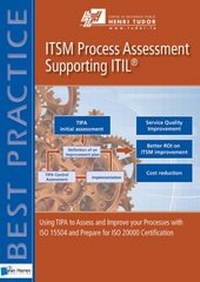
ITSM Process Assessment Supporting ITIL (TIPA)
1st Edition
Published on 12. December 2009
234 pages
978-90-8753-566-7 (ISBN)
Description

The key to any successful IT Service Management solution are strong, clear processes that are fit for purpose. The continual cycle of service improvements must therefore look at the existing processes and assess how effective they are within changing business requirements.
This innovative title not only looks at this fundamental process assessment, it does it using the key ISO/IEC standard in this area. In brief, this title explains the meeting between two standards:
ITIL: the de facto standard in IT Service Management.
ISO/IEC 15504 Information technology - Process assessment
Readers can therefore be confident of a strong, well-thought out and solid approach which will help identify:
The concepts of process assessment and process maturity
How to plan and perform a process assessment
How to use the approach
How to launch an improvement process starting with an assessment project
Because it focuses on 10 key processes the TIPA framework can be applied with equal success to ITILv2, ITIL v3 or to the ISO/IEC 20000. This manual will also convey valuable information for understanding the roles and differences between: process assessment, traditional conformity assessment, audit and self-assessment suite. Finally, it is illustrated with real-life case studies, which highlight what should be done and what should be avoided. The reader will thus learn process assessment based on genuine experiences.
More details
Other editions
Additional editions
Barafort Beatrix | Valerie Betry | Stephane Cortina
ITSM Process Assessment Supporting ITIL
Book
12/2009
Van Haren Publishing BV
€65.79
Shipment within 10-15 days
Content
1 - Foreword [Seite 6]
2 - About the authors [Seite 9]
3 - Acknowledgements [Seite 10]
4 - Chapter 1 Introduction [Seite 14]
4.1 - 1.1 Why reliable IT processes are critically important [Seite 14]
4.2 - 1.2 Why is it important to assess and improve your IT process? [Seite 15]
4.3 - 1.3 About this guide [Seite 16]
4.4 - 1.4 About Tudor IT Service Management Process Assessment (TIPA) [Seite 16]
4.5 - 1.5 Structure of this guide [Seite 17]
5 - Chapter 2 Basic concepts: process assessment [Seite 20]
5.1 - 2.1 Background [Seite 20]
5.2 - 2.2 Reference process and models [Seite 22]
5.3 - 2.3 Process maturity [Seite 29]
5.4 - 2.4 Assessment of process maturity [Seite 38]
6 - Chapter 3 TIPA: Assessment of IT Service Management processes [Seite 44]
6.1 - 3.1 TIPA interface to standards and best practices [Seite 45]
6.2 - 3.2 IT Service Management best practices [Seite 46]
6.3 - 3.3 ISO/IEC 20000 series [Seite 51]
6.4 - 3.4 Assessment of IT Service Management activities [Seite 53]
6.5 - 3.5 IT Service Management PAM for assessment [Seite 56]
6.6 - 3.6 Costs and benefits of a TIPA assessment [Seite 60]
6.7 - 3.7 TIPA: Framework for IT Service Management assessment [Seite 63]
7 - Chapter 4 TIPA method step by step [Seite 102]
7.1 - 4.1 Introduction [Seite 102]
7.2 - 4.2 Key success factors [Seite 103]
7.3 - 4.3 Overview of the phases of a TIPA assessment project [Seite 105]
7.4 - 4.4 Definition Phase (DEF) [Seite 108]
7.5 - 4.5 Preparation Phase (PREP) [Seite 121]
7.6 - 4.6 Assessment Phase (ASMT) [Seite 133]
7.7 - 4.7 Analysis Phase (ANA) [Seite 147]
7.8 - 4.8 Results Presentation Phase (RES) [Seite 154]
7.9 - 4.9 Assessment Closure Phase (CLO) [Seite 163]
7.10 - 4.10 Starting the improvement cycle [Seite 170]
8 - Chapter 5 Case studies [Seite 174]
8.1 - 5.1 Introduction [Seite 174]
8.2 - 5.2 Case study 1: Dimension Data [Seite 175]
8.3 - 5.3 Case study: Sogeti [Seite 193]
8.4 - 5.4 Case study: Fujitsu Services Oy [Seite 205]
8.5 - 5.5 Conclusions and lessons learned [Seite 212]
9 - Glossary [Seite 214]
9.1 - 6.1 Acronyms [Seite 214]
9.2 - 6.2 Definitions [Seite 215]
10 - References [Seite 228]
10.1 - 7.1 TIPA's related publications [Seite 228]
10.2 - 7.2 Books [Seite 228]
10.3 - 7.3 International standards [Seite 229]
10.4 - 7.4 Other publications [Seite 230]
10.5 - 7.5 Websites [Seite 230]
2 - About the authors [Seite 9]
3 - Acknowledgements [Seite 10]
4 - Chapter 1 Introduction [Seite 14]
4.1 - 1.1 Why reliable IT processes are critically important [Seite 14]
4.2 - 1.2 Why is it important to assess and improve your IT process? [Seite 15]
4.3 - 1.3 About this guide [Seite 16]
4.4 - 1.4 About Tudor IT Service Management Process Assessment (TIPA) [Seite 16]
4.5 - 1.5 Structure of this guide [Seite 17]
5 - Chapter 2 Basic concepts: process assessment [Seite 20]
5.1 - 2.1 Background [Seite 20]
5.2 - 2.2 Reference process and models [Seite 22]
5.3 - 2.3 Process maturity [Seite 29]
5.4 - 2.4 Assessment of process maturity [Seite 38]
6 - Chapter 3 TIPA: Assessment of IT Service Management processes [Seite 44]
6.1 - 3.1 TIPA interface to standards and best practices [Seite 45]
6.2 - 3.2 IT Service Management best practices [Seite 46]
6.3 - 3.3 ISO/IEC 20000 series [Seite 51]
6.4 - 3.4 Assessment of IT Service Management activities [Seite 53]
6.5 - 3.5 IT Service Management PAM for assessment [Seite 56]
6.6 - 3.6 Costs and benefits of a TIPA assessment [Seite 60]
6.7 - 3.7 TIPA: Framework for IT Service Management assessment [Seite 63]
7 - Chapter 4 TIPA method step by step [Seite 102]
7.1 - 4.1 Introduction [Seite 102]
7.2 - 4.2 Key success factors [Seite 103]
7.3 - 4.3 Overview of the phases of a TIPA assessment project [Seite 105]
7.4 - 4.4 Definition Phase (DEF) [Seite 108]
7.5 - 4.5 Preparation Phase (PREP) [Seite 121]
7.6 - 4.6 Assessment Phase (ASMT) [Seite 133]
7.7 - 4.7 Analysis Phase (ANA) [Seite 147]
7.8 - 4.8 Results Presentation Phase (RES) [Seite 154]
7.9 - 4.9 Assessment Closure Phase (CLO) [Seite 163]
7.10 - 4.10 Starting the improvement cycle [Seite 170]
8 - Chapter 5 Case studies [Seite 174]
8.1 - 5.1 Introduction [Seite 174]
8.2 - 5.2 Case study 1: Dimension Data [Seite 175]
8.3 - 5.3 Case study: Sogeti [Seite 193]
8.4 - 5.4 Case study: Fujitsu Services Oy [Seite 205]
8.5 - 5.5 Conclusions and lessons learned [Seite 212]
9 - Glossary [Seite 214]
9.1 - 6.1 Acronyms [Seite 214]
9.2 - 6.2 Definitions [Seite 215]
10 - References [Seite 228]
10.1 - 7.1 TIPA's related publications [Seite 228]
10.2 - 7.2 Books [Seite 228]
10.3 - 7.3 International standards [Seite 229]
10.4 - 7.4 Other publications [Seite 230]
10.5 - 7.5 Websites [Seite 230]
