

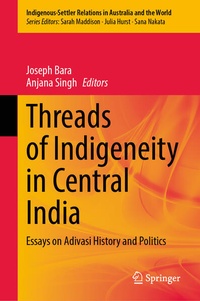
Threads of Indigeneity in Central India
Description

This edited collection discusses conceptual ambiguities related indigenous groups in India, known as Adivasis (original inhabitants), and focuses particularly on Central Indian indigenous groups. The chapters review and discuss colonial conceptions of primitive tribes in academic and policy literature from the West and from Indian scholars, and their continuing influence in the postcolonial India. The book analyses historical and contemporary academic and policy views on Adivasis, writings from indigenous scholar themselves, and looks at how indigenous groups have negotiated the Indian socio-political-economic space as subjects and objects of custom, forest, land, religion and art in the past two centuries. It discusses the various ways in which Adivasi cultural and political protest movements have redefined their spaces of existence, but also that much more reimagining is needed to situate Adivasi groups as diverse and distinct but as an integral part of the Indian mindscape.
More details
Other editions
Additional editions
Persons
Joseph Bara is Senior Research Associate with the Centre for World Environmental History of Sussex University, UK. He has an MA in history and PhD in education from Jawaharlal Nehru University (JNU) and the University of Delhi, respectively. Bara was previously Professorial Scholar-in-Residence with the Faculty of Tribal Studies, Indira Gandhi National Tribal University, Amarkantak, Madhya Pradesh. Since 1985, he has coordinated a research programme on the history of education in modern India at the School of Social Sciences, JNU. His areas of interest range from the past and present problems of the Adivasis of India, Christian missions, educational developments in India, Gandhian educational ideas to Indian nationalist educational thinking and policies. Besides editing four books, Dr. Bara has published articles in leading professional journals in India and abroad. He was on the international editorial board of the journal, History of Education (Taylor & Francis) (2006-2016). A regular participant in the national and international academic forums, he has been a visiting scholar with the Zentrum Moderner Oriental, Berlin (2008), a Fellow of the Indian Institute of Advanced Study, Shimla (2007-2009), and a Fulbright Visiting Senior Scholar at Columbia University, New York (2015). He has been a member of academic or executive bodies of the Indian Institute of Advanced Study, Indira Gandhi National Tribal University (Amarkantak) and the Indian Social Institute, New Delhi. He is a former Member of the Court, Tripura University and Trustee of the Bhasha Research and Publication Centre, Vadodara.
In 2013-14, Dr. Bara was appointed a member of the Prime Minister of India's High Level Committee on Socio-Economic, Health and Educational Status of Tribal Communities.
Anjana Singh taught History Ranchi University, Jharkhand, India, and is an Associate Editor of the Journal of Adivasi and Indigenous Studies (JAIS) . Most of her research and publications are on two broad themes: historiography on Jharkhand, and the impact of demographic, social and political changes relating to Adivasi culture and language. Her research interests include regional language movements among the indigenous groups Mundas and Uraons of Chotanagpur, oral history, gender issues, popular protest, ecological movements, and cultural movements. Her articles have appeared in leading national and international journals as The International Journal of Human Rights, Economic and Political Weekly, Journal of Adivasi and Indigenous Studies (JAIS) and others. She has also published chapters in edited volume books: Kalpana Kannabiran ed. Routledge Readings on Law, Development and Legal Pluralism: Ecology, Families, Governance (Routledge); Rahul Ranjan ed. At the Crossroads of Rights: Forest Struggles and Human Rights in Postcolonial India (Routledge); Varsha Ganguly-Bhagat and Sujit Kumar eds. India's Scheduled Areas: Untangling Governance, Law and Politics (Routledge); and Rekha Pande eds. Gender and History (Rawat publications). She was Principal Investigator of a major project on "Understanding the Impact of Hinduism and Christianity on Tribal Language and Culture in Jharkhand: With Special Reference to Mundas and Oraons", funded by the University Grants Commission under its STRIDE scheme (2020-2023).
