

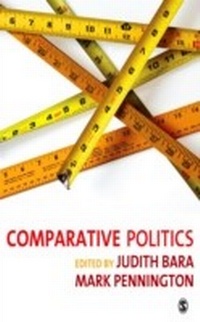
Comparative Politics
1st Edition
Published on 19. March 2009
344 pages
978-1-4462-4182-0 (ISBN)
Description

'Bara and Pennington's edited volume successfully fills a huge void in the market for introductory textbooks to comparative politics which previously offered either descriptions of political processes and systems or overviews of the methodology of comparative analysis. By applying major political science theories to overviews of the core elements of political systems, the authors both enhance our understanding of these elements and provide readers an excellent introduction to comparative explanation' - Dr David Howarth, University of Edinburgh
'What is distinctive about this authoritative and comprehensive book on comparative politics is the way in which it is underpinned throughout by a theoretical analysis centred on a new institutionalist approach' - Professor Wyn Grant, University of Warwick
'Comparative Politics takes a fresh and original approach to the field... it examines the role of structures, rules and norms in regulating the individual and collective behaviour of political actors. Each chapter provides a critical bibliography and key questions which will be particularly useful for students approaching Comparative Politics for the first time. Altogether this is a comprehensive and useful read which I warmly recommend' - Ian Budge, Professor Emiritus Professor of Government, University of Essex
'This is a most useful book. Teachers of comparative politics often scramble around, with out-of-date textbooks and photocopies of more or less compatible articles. Here is a new book that gives an up-to-date, comprehensive and systematic introduction to the major strands of institutional thought and applies these to the major institutions, processes and policy areas. It will be a great help for many of us, academics and students alike' - Peter Kurrild-Klitgaard, Professor of Comparative Politics, University of Copenhagen
This book provides a distinctive new introduction to the study of comparative politics at undergraduate level. Rich in case study material and global in coverage, Comparative Politics sets out the basic theoretical and methodological foundations for studying different political systems as well as the key structures and actors of which they are comprised.
Part One explores the nature of comparative methodology and introduces students to the major theoretical paradigms that seek to explain the operation of institutions in democratic states and facilitate comparison across different political systems.
Part Two examines the institutional structures of the modern state, outlining the key features such as the electoral systems and territorial and functional divisions of government across a range of modern states.
Part Three analyzes the role of key actors, such as voters and parties, interest groups and social movements, the bureaucracy and the judiciary.
This book will be an essential primer for students on first-year courses in comparative government and politics as well as introductory courses in political science concepts and methods.
Judith Bara is Senior Lecturer in Politics at Queen Mary, University of London and Research Fellow in Government, University of Essex.
David S. Bell is Professor of French Government and Politics and Head of Social Studies and Law at the University of Leeds.
Jocelyn Evans is Reader in Politics at the European Studies Research Institute, University of Salford.
Catherine Needham is Lecturer in Politics at Queen Mary, University of London.
Brendan O'Duffy is Senior Lecturer in Politics at Queen Mary, University of London.
Mark Pennington is Senior Lecturer in Politics at Queen Mary, University of London.
David Robertson is Professor of Politics, University of Oxford and Vice Principal, St Hugh's College, Oxford.
'What is distinctive about this authoritative and comprehensive book on comparative politics is the way in which it is underpinned throughout by a theoretical analysis centred on a new institutionalist approach' - Professor Wyn Grant, University of Warwick
'Comparative Politics takes a fresh and original approach to the field... it examines the role of structures, rules and norms in regulating the individual and collective behaviour of political actors. Each chapter provides a critical bibliography and key questions which will be particularly useful for students approaching Comparative Politics for the first time. Altogether this is a comprehensive and useful read which I warmly recommend' - Ian Budge, Professor Emiritus Professor of Government, University of Essex
'This is a most useful book. Teachers of comparative politics often scramble around, with out-of-date textbooks and photocopies of more or less compatible articles. Here is a new book that gives an up-to-date, comprehensive and systematic introduction to the major strands of institutional thought and applies these to the major institutions, processes and policy areas. It will be a great help for many of us, academics and students alike' - Peter Kurrild-Klitgaard, Professor of Comparative Politics, University of Copenhagen
This book provides a distinctive new introduction to the study of comparative politics at undergraduate level. Rich in case study material and global in coverage, Comparative Politics sets out the basic theoretical and methodological foundations for studying different political systems as well as the key structures and actors of which they are comprised.
Part One explores the nature of comparative methodology and introduces students to the major theoretical paradigms that seek to explain the operation of institutions in democratic states and facilitate comparison across different political systems.
Part Two examines the institutional structures of the modern state, outlining the key features such as the electoral systems and territorial and functional divisions of government across a range of modern states.
Part Three analyzes the role of key actors, such as voters and parties, interest groups and social movements, the bureaucracy and the judiciary.
This book will be an essential primer for students on first-year courses in comparative government and politics as well as introductory courses in political science concepts and methods.
Judith Bara is Senior Lecturer in Politics at Queen Mary, University of London and Research Fellow in Government, University of Essex.
David S. Bell is Professor of French Government and Politics and Head of Social Studies and Law at the University of Leeds.
Jocelyn Evans is Reader in Politics at the European Studies Research Institute, University of Salford.
Catherine Needham is Lecturer in Politics at Queen Mary, University of London.
Brendan O'Duffy is Senior Lecturer in Politics at Queen Mary, University of London.
Mark Pennington is Senior Lecturer in Politics at Queen Mary, University of London.
David Robertson is Professor of Politics, University of Oxford and Vice Principal, St Hugh's College, Oxford.
Reviews / Votes
'Bara and Pennington's edited volume successfully fills a huge void in the market for introductory textbooks to comparative politics which previously offered either descriptions of political processes and systems or overviews of the methodology of comparative analysis. By applying major political science theories to overviews of the core elements of political systems, the authors both enhance our understanding of these elements and provide readers an excellent introduction to comparative explanation' - Dr David Howarth, University of Edinburgh'What is distinctive about this authoritative and comprehensive book on comparative politics is the way in which it is underpinned throughout by a theoretical analysis centred on a new institutionalist approach' - Professor Wyn Grant, University of Warwick
'Comparative Politics takes a fresh and original approach to the field... it examines the role of structures, rules and norms in regulating the individual and collective behaviour of political actors. Each chapter provides a critical bibliography and key questions which will be particularly useful for students approaching Comparative Politics for the first time. Altogether this is a comprehensive and useful read which I warmly recommend' - Ian Budge, Professor Emiritus Professor of Government, University of Essex
'This is a most useful book. Teachers of comparative politics often scramble around, with out-of-date textbooks and photocopies of more or less compatible articles. Here is a new book that gives an up-to-date, comprehensive and systematic introduction to the major strands of institutional thought and applies these to the major institutions, processes and policy areas. It will be a great help for many of us, academics and students alike' - Peter Kurrild-Klitgaard, Professor of Comparative Politics, University of Copenhagen
More details
Edition
1. Auflage
Language
English
Place of publication
London
United Kingdom
Target group
College/higher education
Product notice
Reflowable
ISBN-13
978-1-4462-4182-0 (9781446241820)
Copyright in bibliographic data and cover images is held by Nielsen Book Services Limited or by the publishers or by their respective licensors: all rights reserved.
Schweitzer Classification
Other editions
Additional editions
Judith Linda Bara | Mark Pennington
Comparative Politics
Book
03/2009
1st Edition
SAGE Publications Inc
€202.80
Shipment within 15-20 days
Judith Linda Bara | Mark Pennington
Comparative Politics
Book
03/2009
1st Edition
SAGE Publications Inc
€112.90
Shipment within 15-20 days
Persons
My main research interest relates to the study of changing orientations of political parties, with particular reference to ideology and policy. Much of this is based on the content analysis of official party documentation, notably manifestos and platforms from both British and comparative perspectives. I am a principal researcher in the Comparative Manifestos Project and hold an honorary Research Fellowship in Government at the University of Essex Mark's research interests lie at the intersection of politics, philosophy and economics with an emphasis on the implications of bounded rationality and imperfect knowledge for institutional design. He has a particular interest in the works of Hayek, public choice theory and related elements of the classical liberal tradition. His earlier work focussed on the political economy of environmental planning and regulation and explored the potential for property rights approaches to environmental problems. His more recent work has explored the implications of bounded rationality in the context of contemporary theories of deliberative democracy.
His latest book is called Robust Political Economy: Classical Liberalism and the Future of Public Policy, Cheltenham: Edward Elgar (2011). This work examines challenges to market liberal theory derived from neo-classical economics, communitarian political theory and egalitarian ethical theory and applies the lessons learned in the context of the welfare state, international development and environmental protection.
His latest book is called Robust Political Economy: Classical Liberalism and the Future of Public Policy, Cheltenham: Edward Elgar (2011). This work examines challenges to market liberal theory derived from neo-classical economics, communitarian political theory and egalitarian ethical theory and applies the lessons learned in the context of the welfare state, international development and environmental protection.
Content
Introduction - Judith Bara
Part 1: Theories and Methods
1. Theories, Institutions and Comparative Politics - Mark Pennington
2. Methodologies for Comparative Politics - Judith Bara
Part 2: Institutions
3. The Nation State - Brendan O'Duffy
4. Electoral Systems - Jocelyn A. J. Evans
5. Legislatures and Executives - Catherine Needham
6. The Bureaucracy - Mark Pennington
7. The Courts - David Robertson
8. The Territorial Dimension - Brendan O'Duffy
Part 3: Actors
9. Voters, Parties and Participation - Judith Bara
10. Interest Groups - Mark Pennington
11. Leadership: The Long Road to Theory - David S. Bell
Afterword
Part 1: Theories and Methods
1. Theories, Institutions and Comparative Politics - Mark Pennington
2. Methodologies for Comparative Politics - Judith Bara
Part 2: Institutions
3. The Nation State - Brendan O'Duffy
4. Electoral Systems - Jocelyn A. J. Evans
5. Legislatures and Executives - Catherine Needham
6. The Bureaucracy - Mark Pennington
7. The Courts - David Robertson
8. The Territorial Dimension - Brendan O'Duffy
Part 3: Actors
9. Voters, Parties and Participation - Judith Bara
10. Interest Groups - Mark Pennington
11. Leadership: The Long Road to Theory - David S. Bell
Afterword
