

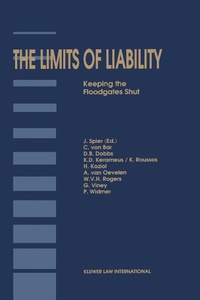
The Limits of Liability
Keeping the Floodgates Shut
Published on 1. June 2000
178 pages
978-90-411-7930-2 (ISBN)
Description

Liability law is clearly expanding through an increasing number of strict liabilities, increasing claim-consciousness and higher amounts awarded. This book puts forward a number of views on how modern tort law copes and should cope with these changes. It provides a brief overview of a broad range of legal systems. It describes the tools used to prevent the burden of liability law from becoming too heavy, such as causation, duty of care, caps and ceilings and ad hoc moderation. Such an overview has never been available previously. Moreover, the authors not only elaborate on the law as it stands, but establish views on how to keep the floodgates shut in the future.
More details
Other editions
Additional editions
Book
06/2000
1st Edition
Kluwer Law International
€60.99
Shipment within 10-20 days
Content
- Cover
- Half Title Page
- Title Page
- Copyright Page
- Preface
- Table of Contents
- Preliminary observations
- 1. Introduction
- 2 Is liability law (heavily) expanding?
- 3 The principle of full compensation
- 4 The tools to keep liability within reasonable limits
- 4.1 Preliminary observations
- 4.2 Duty of care and "Schutznorm
- 4.3 Causation
- 4.4 Various heads of damages
- 4.4.1 Personal injury
- 4.4.2 Damage to property
- 4.4.3 Economic loss
- 4.5 Ceilings and caps
- 4.6 Modification
- 4.7 The degree of negligence
- 4.8 The financial capacity of tortfeasor and victim
- 4.9 Liability covered by insurance
- 4.10 Miscellaneous
- 5 How to keep liability within reasonable limits in the future?
- 5.1 Introduction
- 5.2 Global limits and ceilings
- 5.3 Strict or fault liability
- 5.4 Financial position of the parties
- 5.5 Different heads of damages
- 5.6 Causation
- 5.7 Ad hoc control
- 6 Final observation
- Limitation and Mitigation in German Tort Law
- I Areas of German law in which the principle of full compensation is felt to be inappropriate
- 1 Strict liability cases
- 2 Employment relations
- II General principles of mitigation in German law
- 1 Causation and remoteness of damage
- 2 Scope of the protected interests.
- 3 Restrictive interpretation of the duty of care principle
- III Preference of certain systems
- Direct and general limits on tort damages in the United States
- I General Principles
- II Limiting Compensatory Damages
- A Arguments for General Limitations
- B Types of Limits Proposed and Enacted in the United States
- III Conclusion
- Appendix
- Reductions and Apportionments Possibly Made to Achieve Corrective Justice
- Reductions to Achieve a Collateral Policy Goal
- Reductions Indirectly Imposed by Rules of Trial Convenience or Proof
- Limits Based on Direct, Formal, and General Rules
- Substantive Rules Eliminating a Claim for Specified Damages
- A Miscellany of related material
- European tort law Hellenic National Report
- I Introduction
- 1 Illegal behaviour and negligence
- 2 Distinguishing contractual from delictual liability
- II Limitation of damages
- 1 Statutory limitation
- 2 Restraints developed by case law
- 2.1 Scope of protected interests
- 2.2 Adequate causation
- 2.3 Computation of damages
- 3 Unknown limits to damages
- Mitigation of Damages under Austrian Law and Ideas for Future Regulations
- Introduction
- 1 The System of Austrian Law of Tort
- 2 Critical Presentation of Mitigation of Damages under Austrian Law
- 3 Trends and Suggestions for Future Regulations
- Tools to Control the Scope and Extent of Liability
- 1 Ceilings
- 2 Ad hoc mitigation
- 3 Circumstances to be imputed to the victim
- 4 Heads of non recoverable damages
- 5 Funds established either by industry or government
- 6 Schutzzweck
- 7 Duty of care
- 8 Apportionment
- 9 Schedules, scales and matrices
- 10 Thresholds
- 11 Adequate causation
- 12 The access to justice
- 13 Insurance provided by government and/or payment by treasury
- La modération de la réparation du dommage dans le droit belge de la responsabilité civile extra-contractuelle
- I Introduction
- II Le principe de la réparation intégrale du dommage
- III Les conséquences du principe de la réparation intégrale du dommage
- IV Exceptions au principe de la réparation integrale du dommage
- VI L'interprétation large de la notion de dommage
- VII Modération indirecte de l'étendue de l'indemnisation par l'application des règles concernant le lien de causalité?
- VIII Conclusion
- Keeping the Floodgates Shut: 'Mitigation' and 'Limitation' of Tort Liability in the English Common Law
- Terminology
- Is there a principle or goal of full compensation?
- Formal Limitations upon Levels of Damages
- Ad hoc mitigation?
- Joint and several liability
- The assessment of damages
- Controlling the scope liability
- The duty of care
- Other control devices in the substantive law
- How to keep liability within reasonable limits? A brief outline of Dutch law
- 1 Background in formation about Dutch liability law
- 2 The changing scene of liability law
- 3 A Dutch tort crisis?
- 4 Piercing the corporate veil
- II How to keep liability within reasonable limits? A brief outline of Dutch law.
- A Causation
- B Non-recoverable damages
- C Ad hoc control/modification
- D Caps and ceilings
- E "Egalité devant les charges publiques" [Equality before public burdens]
- F Duty of care towards whom? (Schutznorm)
- G Contributory negligence
- H Exoneration
- III How to keep liability law within reasonable limits: observations.
- Appendix
- 1 Liability for dangerous substances
- 2 Joint and several liability
- 3 Uncertainty about causation
- 4 Insurability
- Modération et limitation des responsabilités et des indemnisations
- I Les tendances du droit français quant au problème de la limitation des responsabilités et des indemnisations
- II Les orientations à envisager
- Détermination et réduction de la réparation en droit suisse
- I Le soi-disant principe de la réparation intégrale
- II Facteurs d'exonération et de réduction de lege lata et de lege ferenda
- III Autres aspects de la limitation de la réparation
- Back Cover
