

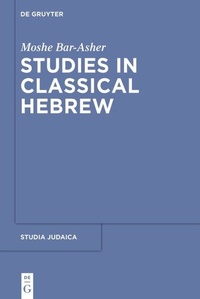
Studies in Classical Hebrew
Description

Professor Moshe Bar-Asher, Professor Emeritus at the Hebrew University and long-time president of the Academy of the Hebrew Language, has published more than 200 articles and sixteen books and edited aboout 90 books and collections. The vast majority of his work has been accessible, however, only to specialists who read modern Hebrew or French. Bar-Asher's groundbreaking articles on the dialects of rabbinic literature are classics. In more recent years he has brought the same breadth and depth of grammatical knowledge, and philological acumen, to the study of older classical Hebrew texts, including literary and epigraphic texts.
This volume presents studies of individual words and verses within the Bible, as well as broader thematic discussions of biblical language and its long reception-history, down through medieval scribes and modern lexicographers. Also represented are Bar-Asher's penetrating studies of Qumran texts and languages, which illuminate both the linguistic traditions reflected in these texts and the scribal culture from which they emerged. The third section contains studies of Mishnaic Hebrew. There are both sweeping surveys of the field and its accomplishments and challenges, and studies of specific phonological, morphological, syntactic and lexical features.
Reviews / Votes
"Cet ouvrage qui réunit des articles de genres très différents s'adresse à un public de spécialistes et d'étudiants, qui y trouveront à la fois des articles introductifs mais aussi des analyses détaillées des différentes strates de l'hébreu classique."
Judith Kogel in: Revue des études juives, 177 (3-4) (2018), 433-435
More details
Other editions
Additional editions
Person
Content
2 - Introduction [Seite 15]
2.1 - A [Seite 15]
2.2 - B [Seite 15]
2.3 - C [Seite 18]
3 - A Biblical Hebrew [Seite 21]
3.1 - 1 The Qal Passive Participle of Geminate Verbs in Biblical Hebrew [Seite 23]
3.1.1 - 1.1 Introduction [Seite 23]
3.1.2 - 1.2 ...... and ...... [Seite 23]
3.1.2.1 - 1.1. 2. ......'menstrual impurity' / ...... 'sprinkling' [Seite 23]
3.1.2.2 - 1.2.2 ......(abstract noun) / ...... (designating a female) [Seite 25]
3.1.3 - 1.3 Qal Passive Participle of Geminate Verbs [Seite 30]
3.1.4 - 1.4 Conclusion [Seite 34]
3.2 - 2. ........... - ... .......:The morphology and meaning of the word .... [Seite 37]
3.2.1 - 2.1 Background Notes [Seite 37]
3.2.2 - 2.2 On the Meaning of the Word [Seite 38]
3.2.3 - 2.3 On the Morphology of the Word [Seite 53]
3.2.4 - 2.4 Concluding Remarks [Seite 59]
3.3 - 3 The Bible Interpreting Itself [Seite 61]
3.3.1 - 3.1 Introduction [Seite 61]
3.3.2 - 3.2 Words that Explain and Words that are Explained [Seite 62]
3.3.2.1 - 3.2.1 Parallelism and Parallel Verses [Seite 62]
3.3.2.2 - 3.2.2 The Explicit Suggestion of the Explanation [Seite 66]
3.3.2.3 - 3.2.3 The Use of an Explanatory Word or Expression [Seite 68]
3.3.2.4 - 3.2.4 Explanatory Words in Similar Structures [Seite 70]
3.3.3 - 3.3 Conclusion [Seite 73]
3.4 - 4 Gesenius' Thesaurus and Mishnaic Hebrew Studies [Seite 77]
3.4.1 - 4.1 Introductory Remarks [Seite 77]
3.4.2 - 4.2 Data in need of correction [Seite 79]
3.4.3 - 4.3 Augmentation of incomplete data [Seite 82]
3.4.4 - 4.4 Early signs of MH scholarship [Seite 84]
3.4.5 - 4.5 Summary remarks [Seite 88]
3.5 - 5 ... ..... ..... .....:When did ..... Come to Denote 'Jew'? [Seite 89]
3.6 - 6 Biblical Language in Mishnaic Texts [Seite 95]
3.6.1 - 6.1 Introductory comments [Seite 95]
3.6.2 - 6.2 Relationship of the Mishna to Biblical Hebrew [Seite 96]
3.6.3 - 6.3 Substantive changes due to biblical influence [Seite 100]
3.6.3.1 - 6.3.1 ... ..... ...... [Seite 100]
3.6.3.2 - 6.3.2 .... ..... ...... [Seite 103]
3.6.4 - 6.4 Concluding comment [Seite 107]
3.7 - 7. ........... ... ........ .......:Regarding One Sentence from the Letter to Pelatyahu [Seite 109]
3.8 - 8. The verse .... ......... ('Hear, O Israel') in Greek transcription on an ancient amulet [Seite 117]
3.8.1 - 8.1 The text [Seite 118]
3.8.2 - 8.2 Linguistic comments [Seite 118]
3.8.3 - 8.3 Summary [Seite 122]
4 - B Qumran Hebrew [Seite 123]
4.1 - 9 A Few Remarks on Mishnaic Hebrew and Aramaic in Qumran Hebrew [Seite 125]
4.1.1 - 9.1 Mishnaic Hebrew and Qumran Hebrew [Seite 125]
4.1.1.1 - 9.1.1 Example 1 [Seite 125]
4.1.1.2 - 9.1.2 Example 2 [Seite 127]
4.1.2 - 9.2 Aramaic at Qumran [Seite 128]
4.1.2.1 - 9.2.1 Example 1 [Seite 129]
4.1.2.2 - 9.2.2 Example 2 [Seite 130]
4.1.3 - 9.3 Summary [Seite 132]
4.2 - 10 On Several Linguistic Features of Qumran Hebrew [Seite 133]
4.2.1 - 10.1 ..... [Seite 133]
4.2.2 - 10.2 .... [Seite 141]
4.2.3 - 10.3 .. ..... [Seite 143]
4.2.4 - 10.4 ...... [Seite 145]
4.2.4.1 - 10.4.1 .. = ...... [Seite 145]
4.2.4.2 - 10.4.2 ...... = ...... [Seite 149]
4.2.5 - 10.5 Concluding remarks [Seite 151]
4.3 - 11 Qumran Hebrew Between Biblical and Mishnaic Hebrews: A Morphological Study [Seite 153]
4.3.1 - 11.1 Introductory Comments [Seite 153]
4.3.2 - 11.2 Third-person Pronominal Suffixes on Plural Nouns with the Ending ... [Seite 154]
4.3.2.1 - 11.2.1 Biblical Hebrew [Seite 154]
4.3.2.1.1 - 11.2.1.1 Distribution patterns in some biblical books [Seite 156]
4.3.2.1.2 - 11.2.2.1 Analysis of one late biblical text [Seite 156]
4.3.2.2 - 11.2.2 Mishnaic Hebrew [Seite 157]
4.3.3 - 11.3 A note on the Samaritan Pentateuch [Seite 159]
4.3.4 - 11.4 QH and Ben Sira [Seite 160]
4.3.5 - 11.5 Summary of the findings within Hebrew [Seite 163]
4.3.6 - 11.6 Concluding comments [Seite 164]
4.4 - 12 Mistaken Repetitions or Double Readings? [Seite 167]
4.4.1 - 12.1 The Data and the Interpretations Current in the Scholarly Literature [Seite 167]
4.4.2 - 12.2 A Proposal for a New Explanation of the Phenomenon [Seite 170]
4.4.3 - 12.3 Conclusion [Seite 178]
4.5 - 13 Two Issues in Qumran Hebrew: Synchronic and Diachronic Perspectives [Seite 179]
4.5.1 - 13.1 Introductory Comments [Seite 179]
4.5.2 - 13.2 ....../...... (........) [Seite 181]
4.5.3 - 13.3 ....... (........) and ..... [Seite 188]
4.5.4 - 13.4 Concluding Comments [Seite 193]
4.6 - 14 Grammatical and Lexicographic Notes on a Qumran Fragment 4Q374 ii) [Seite 195]
4.6.1 - 14.1 Introductory Remarks [Seite 195]
4.6.2 - 14.2 ... ..... .. ...... [Seite 196]
4.6.3 - 14.3 ..... [Seite 201]
4.6.4 - 14.4 Conclusion [Seite 209]
4.7 - 15. .... ...... / ..... ...... [Seite 211]
4.7.1 - 15.1 Introductory Remarks [Seite 211]
4.7.2 - 15.2 A biblical expression in the Damascus Covenant and its pesher [Seite 212]
4.7.3 - 15.3 Concluding Statements [Seite 219]
4.8 - 16 The Patterns Pe'ila and Pi''ul in Qumran Hebrew [Seite 221]
4.8.1 - 16.1 Introductory Comments [Seite 221]
4.8.2 - 16.2 Specifics and Generalities in the relationship of Qumran Hebrew to Mishnaic Hebrew [Seite 224]
4.8.3 - 16.3 The Pattern Pe'ila [Seite 225]
4.8.4 - 16.4 The Pattern Pi''ul [Seite 231]
4.8.5 - 16.5 Concluding Remarks [Seite 237]
5 - C. Mishnaic Hebrew and Aramaic [Seite 241]
5.1 - 17 Mishnaic Hebrew: An Introductory Survey [Seite 243]
5.1.1 - 17.1 Mishnaic Hebrew and Rabbinic literature [Seite 243]
5.1.2 - 17.2 The Origin of Mishnaic Hebrew [Seite 245]
5.1.3 - 17.3 Biblical Hebrew and Mishnaic Hebrew [Seite 246]
5.1.3.1 - 17.3.1 Common and Contrasting Features [Seite 246]
5.1.3.2 - 17.3.2 Diachronic Differences [Seite 247]
5.1.3.3 - 17.3.3 Dialectal differences [Seite 248]
5.1.3.4 - 17.3.4 Difference of Tradition [Seite 250]
5.1.3.5 - 17.3.5 Literary Influence of Biblical Hebrew upon Mishnaic Hebrew [Seite 251]
5.1.4 - 17.4 Unity and Diversity in Mishnaic Hebrew [Seite 253]
5.1.4.1 - 17.4.1 The assumption of uniformity re-examined [Seite 253]
5.1.4.2 - 17.4.2 Contrasts between the language of the Tannaim and the language of the Amoraim [Seite 254]
5.1.4.3 - 17.4.3 Mishnaic Hebrew and its different dialects [Seite 255]
5.1.4.4 - 17.4.4 Linguistic differences within the Mishnah [Seite 257]
5.1.4.5 - 17.4.5 Editions and manuscripts [Seite 258]
5.1.4.6 - 17.4.6 Linguistic types in the manuscripts of the Mishnah [Seite 260]
5.1.4.7 - 17.4.7 Special traditions [Seite 261]
5.1.4.8 - 17.4.8 Written and Oral Traditions [Seite 262]
5.1.5 - 17.5 Mishnaic Hebrew and Other Languages [Seite 263]
5.1.5.1 - 17.5.1 The situation of multi-lingualism [Seite 263]
5.1.5.2 - 17.5.2 Mishnaic Hebrew and Aramaic [Seite 264]
5.1.5.3 - 17.5.3 Borrowings from Greek and Latin [Seite 267]
5.1.6 - 17.6 Mishnaic Hebrew from indirect sources [Seite 268]
5.1.6.1 - 17.6.1 Direct and indirect sources [Seite 268]
5.1.6.2 - 17.6.2 Documents from the Judean Desert [Seite 270]
5.1.6.3 - 17.6.3 The Samaritan tradition [Seite 271]
5.1.6.4 - 17.6.4 Greek and Latin Transcriptions [Seite 273]
5.1.6.5 - 17.6.5 The language of Liturgy and the Piyyut [Seite 274]
5.1.7 - 17.7 Conclusion [Seite 274]
5.2 - 18 The Study of Mishnaic Hebrew Grammar Based on Written Sources: Achievements, Problems, and Tasks [Seite 277]
5.2.1 - 18.1 Introductory Remarks [Seite 277]
5.2.2 - 18.2 Research and Achievements [Seite 278]
5.2.2.1 - 18.2.1 Description of Mishnaic Hebrew Studies [Seite 278]
5.2.2.2 - 18.2.2 Some Central Questions in the Study of Mishnaic Hebrew [Seite 278]
5.2.2.3 - 18.2.3 Results of Mishnaic Hebrew Research [Seite 286]
5.2.2.4 - 18.2.4 Unity of Mishnaic Hebrew [Seite 289]
5.2.3 - 18.3 Problems and Tasks [Seite 294]
5.2.3.1 - 18.3.1 Investigations of Reliable Manuscripts and other Manuscripts [Seite 294]
5.2.3.2 - 18.3.1 Strata versus Traditions [Seite 296]
5.2.3.3 - 18.3.3 Reliable Traditions and Scribal Corrections [Seite 298]
5.2.3.4 - 18.3.4 Expanding the Fields of Research [Seite 299]
5.2.3.4.1 - 18.3.4.1 Investigation of the Different Periods of Mishnaic Hebrew [Seite 299]
5.2.3.4.2 - 18.3.4.2 Investigation of Traditions and Other Manuscripts [Seite 300]
5.2.3.4.3 - 18.3.4.3 Investigation of Traditions and Examination of General Grammatical Topics [Seite 301]
5.2.3.4.4 - 18.3.4.5 Proportions between Research Fields [Seite 302]
5.2.3.5 - 18.3.5 Preparing a New Grammar of Mishnaic Hebrew [Seite 303]
5.2.4 - 18.4 Concluding Remarks [Seite 304]
5.3 - 19 The Different Traditions of Mishnaic Hebrew [Seite 307]
5.3.1 - 19.1 Introduction [Seite 307]
5.3.2 - 19.2 The Division of Mishnaic Hebrew into Different Traditions [Seite 308]
5.3.3 - 19.3 The Western tradition vis-à-vis the Eastern tradition within the Palestinian branch [Seite 310]
5.3.4 - 19.4 The Palestinian branch vis-à-vis the Babylonian branch [Seite 312]
5.3.5 - 19.5 Comments on the Proposed Divisions [Seite 314]
5.3.6 - 19.6 The Western and Eastern traditions of the Palestinian branch [Seite 318]
5.3.6.1 - 19.6.1 Gemination of res [Seite 318]
5.3.6.2 - 19.6.2 The relative sîn with s.wa [Seite 320]
5.3.6.3 - 19.6.3 The realization of the short vowel [u] [Seite 320]
5.3.6.4 - 19.6.4 The Final Vowel in the Qatt and Related Noun Patterns [Seite 323]
5.3.6.5 - 19.6.5 The Definite Article with segol before 'aleph with qame? [Seite 323]
5.3.6.6 - 19.6.6 Noun Pattern po'lan/pa'lan [Seite 324]
5.3.6.6.1 - 19.6.6.1 ......./....... [Seite 326]
5.3.6.6.2 - 19.6.6.2 The plural ........./........ [Seite 325]
5.3.7 - 19.7 The Nature of the Differences between the Western and Eastern Traditions [Seite 326]
5.3.8 - 19.8 The Historical Background of the Different Traditions of the Western Branch [Seite 327]
5.3.9 - 19.9 The Palestinian Branch and the Babylonian Branch [Seite 331]
5.3.10 - 19.10 Background of the Linguistic Differences between the Two Branches [Seite 332]
5.3.11 - 19.11 Conclusion [Seite 339]
5.4 - 20 The System of binyanim in Mishnaic Hebrew (A Morphological Study) [Seite 343]
5.4.1 - 20.1 The binyanim in general [Seite 343]
5.4.2 - 20.2 Comments on the common binyanim [Seite 344]
5.4.3 - 20.3 Comments on the uncommon binyanim [Seite 346]
5.4.3.1 - 20.3.1 Pu'al [Seite 346]
5.4.3.2 - 20.3.2 Nuf'al [Seite 349]
5.4.3.3 - 20.3.3 Nipp.'al [Seite 353]
5.4.3.4 - 20.3.4 Pe'el (pa''el), po'al (m?fo''al), ni?pa''al [Seite 355]
5.4.3.5 - 20.3.5 Pe'el [Seite 356]
5.4.3.6 - 20.3.6 Po'al [Seite 358]
5.4.3.7 - 20.3.7 Ni.pa'al [Seite 358]
5.4.4 - 20.4 Comments on these three binyanim [Seite 359]
5.4.4.1 - 20.4.1 Po'el, Ni.po'el [Seite 362]
5.4.4.2 - 20.4.2 Po'el [Seite 363]
5.4.4.3 - 20.4.3 Ni.po'al [Seite 363]
5.4.4.4 - 20.4.4 Ni..ap¯ 'al [Seite 366]
5.4.5 - 20.5 Other binyanim? [Seite 368]
5.4.6 - 20.6 Conclusion [Seite 368]
5.5 - 21 The Formation of the Nif'al III-yod Participle in Mishnaic Hebrew [Seite 373]
5.5.1 - 21.1 The Readings Traditions in the Bible [Seite 373]
5.5.2 - 21.2 The Mishnaic Hebrew Traditions that have been Studied [Seite 374]
5.5.3 - 21.3 Other Traditions of Mishnaic Hebrew [Seite 375]
5.5.4 - 21.4 MS Antonin [Seite 376]
5.5.5 - 21.5 MS Parma B [Seite 376]
5.5.6 - 21.6 MS Kaufmann, MS Paris, and the Livorno Edition [Seite 378]
5.5.7 - 21.7 Summary [Seite 382]
5.5.8 - 21.8 Appendix [Seite 386]
5.6 - 22 Comments on the Morphology of Nouns in Mishnaic Hebrew: Nouns Attested and Unattested in Biblical Hebrew [Seite 389]
5.6.1 - 22.1 Introduction [Seite 389]
5.6.2 - 22.2 Nouns Attested in BH [Seite 390]
5.6.3 - 22.3 Nouns Not in BH [Seite 394]
5.6.4 - 22.4 Summary [Seite 395]
5.7 - 23 Mishnaic Hebrew and Biblical Hebrew [Seite 397]
5.7.1 - 23.1 Introductory Remarks [Seite 397]
5.7.2 - 23.2 Rabbinic Hebrew vis-à-vis Biblical Hebrew in Nominal Morphology [Seite 400]
5.7.2.1 - 23.2.1 Nouns borrowed from the Bible [Seite 401]
5.7.2.2 - 23.2.2 Nouns Common to the Languages of the Bible and the Mishnah [Seite 404]
5.7.3 - 23.3 Conclusion [Seite 406]
5.8 - 24 On the Language of the Beit 'Amar Papyrus [Seite 409]
5.8.1 - 24.1 Preliminary Notes [Seite 409]
5.8.2 - 24.2 On the General Nature of the Language in the Document [Seite 410]
5.8.3 - 24.3 Orthography [Seite 411]
5.8.4 - 24.4 Orthography and phonology [Seite 413]
5.8.5 - 24.5 Minor items in Configuration and Syntax [Seite 418]
5.8.6 - 24.6 Concluding note [Seite 419]
5.9 - 25 From Oral Transmission to Written Transmission (Concerning the meaning of some orthographic forms in the manuscripts of the Mishnah and of Rabbinic Literature) [Seite 421]
5.9.1 - 25.1 Introductory Comments [Seite 421]
5.9.2 - 25.2 Unusual orthographic forms and their meanings [Seite 422]
5.9.2.1 - 25.2.1 ... ...../... ..... -a quarter-qab of bones [Seite 422]
5.9.2.2 - 25.2.2 ....../...... - has arisen [Seite 422]
5.9.2.3 - 25.2.3 ....../....... [Seite 423]
5.9.2.4 - 25.2.4 ..../..... [Seite 425]
5.9.3 - 25.3 Additions [Seite 427]
5.9.3.1 - 25.3.1 .. . >.... ,as in ....>..... [Seite 427]
5.9.3.2 - 25.3.2 ...> .. [Seite 429]
5.9.3.3 - 25.3.3 The spelling of short words [Seite 430]
5.9.4 - 25.4 Summary [Seite 430]
6 - Bibliography [Seite 433]
7 - Indexes [Seite 451]
