

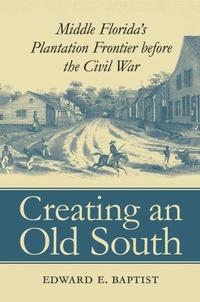
Creating an Old South
Middle Florida's Plantation Frontier before the Civil War
Published on 3. April 2003
408 pages
978-0-8078-6003-8 (ISBN)
Description

Set on the antebellum southern frontier, this book uses the history of two counties in Florida’s panhandle to tell the story of the migrations, disruptions, and settlements that made the plantation South.
Soon after the United States acquired Florida from Spain in 1821, migrants from older southern states began settling the land that became Jackson and Leon Counties. Slaves, torn from family and community, were forced to carve plantations from the woods of Middle Florida, while planters and less wealthy white men battled over the social, political, and economic institutions of their new society.
Conflict between white men became full-scale crisis in the 1840s, but when sectional conflict seemed to threaten slavery, the whites of Middle Florida found common ground. In politics and everyday encounters, they enshrined the ideal of white male equality — and black inequality. To mask their painful memories of crisis, the planter elite told themselves that their society had been transplanted from older states without conflict. But this myth of an “Old,” changeless South only papered over the struggles that transformed slave society in the course of its expansion. In fact, that myth continues to shroud from our view the plantation frontier, the very engine of conflict that had led to the myth’s creation.
Soon after the United States acquired Florida from Spain in 1821, migrants from older southern states began settling the land that became Jackson and Leon Counties. Slaves, torn from family and community, were forced to carve plantations from the woods of Middle Florida, while planters and less wealthy white men battled over the social, political, and economic institutions of their new society.
Conflict between white men became full-scale crisis in the 1840s, but when sectional conflict seemed to threaten slavery, the whites of Middle Florida found common ground. In politics and everyday encounters, they enshrined the ideal of white male equality — and black inequality. To mask their painful memories of crisis, the planter elite told themselves that their society had been transplanted from older states without conflict. But this myth of an “Old,” changeless South only papered over the struggles that transformed slave society in the course of its expansion. In fact, that myth continues to shroud from our view the plantation frontier, the very engine of conflict that had led to the myth’s creation.
More details
Other editions
Additional editions
Book
04/2002
The University of North Carolina Press
€48.10
Shipment within 15-20 days
Person
Edward E. Baptist is Charlton W. Tebeau Assistant Professor of History at the University of Miami.
Content
- Intro
- Acknowledgments
- Introduction: Origins and Outcomes
- Notes
- 1. The Peculiar Benefits of Florida
- Notes
- 2. Countrymen
- Notes
- 3. Forced Migration
- Notes
- 4. Hot-Blooded Fellows and the Flush Times of Middle Florida
- Notes
- 5. Jack in the New Ground
- Notes
- 6. Decline and Fall of the Rag Empire
- Notes
- 7. White Men Are Very Uncertain
- Notes
- 8. Creating an Old South
- Notes
- 9. Remaking History
- Notes
- Conclusion
- Notes
- Appendix
- Notes
- Bibliography
- Index
