

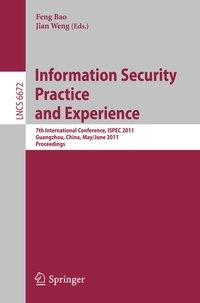
Information Security Practice and Experience
7th International Conference, ISPEC 2011, Guangzhou, China, May 30-June 1, 2011, Proceedings
Published on 6. May 2011
XIII, 448 pages
978-3-642-21031-0 (ISBN)
Description

This book constitutes the refereed proceedings of the 7th International Conference on Information Security Practice and Experience, ISPEC 2011, held in Guangzhou, China, in May/June 2011.
The 26 papers presented together with 6 short papers were carefully reviewed and selected from 108 submissions. They are grouped in sections on public key encryption, cloud security, security applications, post-quantum cryptography and side-channel attack, block ciphers and MACs, signature, secrete sharing and traitor tracing, system security and network security, and security protocols.
The 26 papers presented together with 6 short papers were carefully reviewed and selected from 108 submissions. They are grouped in sections on public key encryption, cloud security, security applications, post-quantum cryptography and side-channel attack, block ciphers and MACs, signature, secrete sharing and traitor tracing, system security and network security, and security protocols.
More details
Other editions
Additional editions
Feng Bao | Jian Weng
Information Security Practice and Experience
7th International Conference, ISPEC 2011, Guangzhou, China, May 30-June 1, 2011, Proceedings
Book
05/2011
1st Edition
Springer
€53.49
Shipment within 7-9 days
Content
- Title Page
- Preface
- Organization
- Table of Contents
- Public Key Encryption
- Public-Key Encryptions Tolerating Adaptive and Composable Adversaries
- Introduction
- Non-committing Bit/Arbitrary-Many Bits Encryptions
- This Work
- Adaptively-Secure Public-Key Encryptions: Functionality and Security Definition
- The Universally Composable Framework
- Functionality of Common Reference String
- Functionality of Non-commitment Encryptions
- The Building Blocks
- Paillier's Encryption Scheme
- The Mixed Commitments
- Damgård-Jurik's Double-Trapdoor Cryptosystem
- The Adaptively-Secure, Interactive Encryptions
- A Description of Adaptively-Secure, Interactive Public-Key Encryptions
- The Proof of Security
- Conclusion
- References
- Encryption Simulatability Reconsidered
- Introduction
- Background
- Our Contributions
- Preliminaries
- Security of Symmetric Encryption
- Hybrid Encryption
- The Simulatability of Symmetric Encryption
- The Simulatability of Symmetric Encryption
- Simulatability of Hybrid Encryption
- Conclusion
- References
- Fully Secure Cipertext-Policy Hiding CP-ABE
- Introduction
- Our Contributions
- Related Work
- Organization
- Preliminaries
- Composite Order Bilinear Groups
- Ciphertext-Policy Attribute-Based Encryption
- Security Model for CP-ABE
- Inner-Product PE
- CP-ABE from Inner-Product PE
- CP-ABE Supporting Restricted Access Structures
- Conclusions
- References
- Generic Methods to Achieve Tighter Security Reductions for a Category of IBE Schemes
- Introduction
- Related Work and Motivation
- Our Contributions
- Outline
- Preliminaries
- Bilinear Diffie-Hellman Assumption
- Basic Definitions
- Security Notions
- Generic Method to Achieve Tighter CPA Security
- Refined Approach i
- A Variant of BF-IBE with Tight Security Reduction
- Refined Approach ii
- A Variant of BB1-IBE with Tight Security Reduction
- Further Discussions
- Conclusion
- References
- New Fully Secure Hierarchical Identity-Based Encryption with Constant Size Ciphertexts
- Introduction
- Our Contribution
- Related Works
- Organization
- Preliminaries
- Bilinear Maps
- Complexity Assumptions
- Algorithms
- Security Model
- Our Construction
- Proof of Security
- Discussions
- Chosen-Ciphertext Security
- Eliminating Decryption Error
- HIBE with Wildcards
- Conclusions
- References
- Cloud Security
- Toward Trustworthy Clouds' Internet Scale Critical Infrastructure
- Introduction
- Cloud Infrastructure Overview
- Cloud Structure
- Cloud's Infrastructure Layering Concept
- Problem Definition
- Requirements for Trustworthy Clouds
- Conclusion
- References
- Realizing Fine-Grained and Flexible Access Control to Outsourced Data with Attribute-Based Cryptosystems
- Introduction
- Background and Motivation
- Related Works
- Challenging Issues
- Our contributions
- System Models and Security Assumption
- Technical Preliminaries
- Ciphertext-Policy Attribute-Based Encryption (CP-ABE)
- Attribute-Based Signature(ABS)
- Fine-Grained and Flexible Data Access Control
- Overview of Our Scheme
- Writer-Reader Differentiation
- Data Access Procedures
- Performance Analysis and Discussion of Existing Works
- Performance Analysis
- Discussion of Existing Works
- Conclusion and Future Directions
- References
- Hierarchical Attribute-Set Based Encryption for Scalable, Flexible and Fine-Grained Access Control in Cloud Computing
- Introduction
- Models and Assumptions
- System Models
- Security Models
- Our Construction
- Preliminaries
- The HASBE Scheme Model
- Scheme Description
- Analysis
- Security Analysis
- Performance Analysis and Evaluation
- Conclusion
- References
- Security Applications
- Privacy Enhanced Access Control by Means of Policy Blinding
- Introduction
- Related Work
- Blinded Server
- Unblinded Database and Reference Monitor
- Blinded Database and Reference Monitor
- Blinding the Database
- Construction
- Scheme
- Extension
- Efficiency
- Discussion of Practical Issues
- Conclusion
- References
- Policy-Based Authentication for Mobile Agents
- Introduction
- Mobile Agent Model
- Policy Model
- Mobile Agent Model
- Definition and Security Model
- Notation
- Definition
- Security Models
- Preliminaries
- Policy-Based Authentication for Mobile Agent Scheme
- Security Analysis
- Existential Unforgeability Against A1
- Existential Unforgeability Against A2
- Existential Unforgeability Against A3
- Credentials Ambiguity
- Conclusion
- References
- Lightweight Delegated Subset Test with Privacy Protection
- Introduction
- Related Work
- Organization
- Problem Formalization
- Definitions
- Notion of Security
- Background and Complexity Assumptions
- Bilinear Groups of Composite Order
- Our Assumptions
- Secure Delegated Subset Test
- The Rationale
- Our Construction
- Proof of Security
- Efficiency Analysis
- Conclusion
- References
- Post-quantum Cryptography and Side-Channel Attack
- Improving BDD Cryptosystems in General Lattices
- Introduction
- Post-Quantum Cryptography
- Lattice-Based Cryptography Overview
- Existing Lattice Cryptosystems
- Rotated Nearly-Orthogonal Bases
- Motivation
- Construction Approaches
- Givens Rotations
- Decryption Error
- Optimal Hermite Normal Forms
- Definition
- Motivation
- Naive Testing
- Coprimality Testing
- Comparison
- Our New Scheme
- Construction
- Results
- Conclusion
- References
- Kipnis-Shamir Attack on Unbalanced Oil-Vinegar Scheme
- Introduction
- The Oil-Vinegar Scheme
- Kipnis-Shamir Attack on the Balanced Oil-Vinegar Scheme
- Kipnis-Shamir Attack on Odd Characteristic Balanced Oil-Vinegar Scheme
- Kipnis-Shamir Attack on Even Characteristic Balanced Oil-Vinegar Scheme
- Improvement of Kipnis-Shamir Attack on Unbalanced Oil-Vinegar Scheme
- Improvement on Odd Characteristic Unbalanced Scheme
- Kipnis-Shamir Attack on Even Characteristic Unbalanced Scheme
- Proof of the Fact that $g_ij(Q_ij)$=0
- Conclusion
- References
- A Novel Group Signature Scheme Based on MPKC
- Introduction
- The Model of Our Group Signature Scheme
- Signature of Knowledge Based on MPKC
- Isomorphism of Polynomials (IP) Problem
- Signature of Knowledge Protocol
- A Novel Group Signature Scheme Based on MPKC
- System Setup
- Joining Group
- Signing Messages
- Verifying Signatures
- Linking Signatures
- Opening Signatures
- Security Analysis
- Security of IP Problem
- Security of Our Scheme
- Comparison
- Conclusion
- References
- How to Characterize Side-Channel Leakages More Accurately?
- Introduction
- Power Leakage Decomposition
- Bitwise Weighted Characterization
- Bitwise Weighted Model
- Determining Parameters for Bitwise Weighted Model
- Construction of BWC-Based Distinguishers
- BWC-CPA
- BWC-DPA
- Experiments
- Simulated Attacks
- Practical Attacks
- Conclusions
- References
- Block Ciphers and MACs
- New Impossible Differential and Known-Key Distinguishers for the 3D Cipher
- Introduction
- Brief Description of the 3D Cipher
- ID Distinguishers
- ID Attack on 10-Round 3D
- Known-Key Distinguishers
- Conclusions
- References
- Meet-in-the-Middle Attack on 8 Rounds of the AES Block Cipher under 192 Key Bits
- Introduction
- Preliminaries
- Notation
- The AES Block Cipher
- Related Results from Previous Work
- Demirci and Selçuk's Attack on 7-Round AES-192
- Demirci et al.'s Method for Improving the 4-Round Property
- An Observation on the Key Schedule due to Dunkelman et al.
- Meet-in-the-Middle Attack on 8-Round AES-192
- Preliminary Results
- Attacking 8-Round AES-192
- Improving the 8-Round AES-192 Attack
- Conclusion
- References
- BCBC: A More Efficient MAC Algorithm
- Introduction
- Background
- Our Contribution
- Related Work
- Preliminaries
- Our Scheme
- Security Analysis
- Part I
- Part II
- Part III
- Proof of Theorem 2 in Section 4
- Construction of Function $f$
- Previous Work
- Using Block Ciphers
- Using Compression Functions
- Performance
- More Consideration
- Security Relation between Our BCBC Scheme and CBC-MAC
- A Trick to Avoid Efficiency Loss in Some Case
- Conclusion
- References
- On the Security of 4-Bit Involutive S-Boxes for Lightweight Designs
- Introduction
- Preliminaries
- Linear Cryptanalysis
- Differential Cryptanalysis
- Almost Resilient Properties
- Analysis of 4-Bit Involutive S-Boxes
- The Total Number of 4-Bit Involutive S-Boxes
- Linear and Differential Cryptanalysis on 4-Bit Involutive S-Boxes
- Almost Resilient Results and Analysis on 4-Bit Involutive S-Boxes
- Conclusion
- References
- Signature, Secrete Sharing and Traitor Tracing
- Short Convertible Undeniable Signature in the Standard Model
- Introduction
- Related Work
- Convertible Undeniable Signature
- Assumptions
- Our Proposed Scheme
- The Scheme
- Efficiency and Comparison
- Extensions
- Conclusion
- References
- A Practical (Non-interactive) Publicly Verifiable Secret Sharing Scheme
- Introduction
- Preliminaries
- (Non-interactive) PVSS
- Security Model
- Bilinear Map
- (n,t)-MSE-DDH (The Multi-Sequence of Exponents Diffie-Hellman Assumption)
- The New ($t, n$)-threshold PVSS Scheme
- Security Analysis
- Verifiability
- Indistinguishability of Secrets (IND)
- Comparison
- Conclusion
- References
- An Efficient Group-Based Secret Sharing Scheme
- Introduction
- Preliminaries
- Our Secret Sharing Scheme
- A Toy Example
- Evaluation of Efficiency
- Our Scheme Is Perfect
- Related Works
- Conclusion
- References
- Traitor Tracing against Public Collaboration
- Introduction
- Building Tools
- Collusion Secure Codes
- Identity-Based Encryption with Wildcards
- Protocol Model and Security Requirements
- Protocol Model
- Security Requirements
- Traitor Tracing Scheme against Public Collaboration
- Construction Idea
- Proposed Generic Scheme
- Security Analysis
- Tracing Imperfect Pirate Decoders
- Extension to Identifiable Parent Property Codes
- An Instance and Performance Evaluation
- An Instance Based on Boneh-Boyen-Goh WIBE
- Performance Evaluation
- Conclusion and Extension
- References
- System Security and Network Security
- Policy-Centric Protection of OS Kernel from Vulnerable Loadable Kernel Modules
- Introduction
- Security Assumption and Threat Model
- Overview of Our Approach
- System Design and Implementation
- Policy Generation
- Policy Enforcement
- Evaluation
- Discussion and Limitations
- Related Work
- Conclusion
- References
- Sanitizing Microdata without Leak: Combining Preventive and Curative Actions
- Introduction
- Problem Statement
- Weakly-Malicious$_Soft$ UE
- Weakly-Malicious$_Hard$ UE
- Detection Probability
- Concluding Remarks
- References
- Hidden Bot Detection by Tracing Non-human Generated Traffic at the Zombie Host
- Introduction
- Background
- Related Work
- Motivation
- Basic Concept
- User Interaction
- Bot Attacks
- Design Overview
- Experimental Results
- Evaluation for User Interaction
- Bot Attack Detection
- Bot Process Detection
- Conclusion
- References
- A Model for Constraint and Delegation Management
- Introduction
- Problems and Motivation
- Constraint Administration
- Assumptions
- Constraint Authority and Trust
- Constraint Effect and Scope Reduction
- Delegation Administration
- Delegation and Re-delegation
- Revocation
- Discussion and Conclusion
- References
- Security Protocols
- Non-black-Box Computation of Linear Regression Protocols with Malicious Adversaries
- Introduction
- The Known Technique
- This Work
- Building Blocks
- Secure Computation of the Linear Regression Problem
- Simulation-Based Security
- A Description of Two-Party Computation of Linear Regression Protocol with Malicious Adversaries
- Linear Regression: The Proof of Security
- Computation and Communication Complexity
- Conclusion
- References
- A New Security Proof of Practical Cryptographic Devices Based on Hardware, Software and Protocols
- Motivation
- Preliminary
- Cryptographic SoC and Device
- Universally Composable Security Model and Bottom-Up Idea
- General Security Framework of Cryptographic Devices
- UC Security of Cryptographic Modules
- UC Security of Hardware
- UC Security of Software
- Composing a Secure Cryptographic Module Universally
- Design Principle for the Cryptographic Device
- Conclusions
- References
- A General and Efficient Obfuscation for Programs with Tamper-Proof Hardware
- Introduction
- Preliminaries
- Turing Machines
- Obfuscation
- The Construction
- High-Level Description
- Actual Description
- Obfuscation Requirement Achieved
- Conclusions
- References
- Analysis and Improvement of an Authenticated Key Exchange Protocol
- Introduction
- Formal Model
- Attacking UP
- An Improved Protocol: UP+
- Improvement and Protocols Comparison
- Security
- Conclusion
- References
- Another Elliptic Curve Model for Faster Pairing Computation
- Introduction
- Background
- Selmer Curves
- Pairing Preliminaries
- Miller's Algorithm for Tate Pairing
- Group Law on Selmer Curves
- Definition of Group Law
- Explicit Formulae
- Miller Functions on Selmer Curves
- Explicit Formulae for Pairing on Selmer Curves
- Finding a Suitable $Q$
- Miller Addition
- Miller Doubling
- Parallel Execution
- Pairing Friendly Selmer Curves with Small d
- Comparison
- Conclusion and Further Work
- References
- Author Index
