

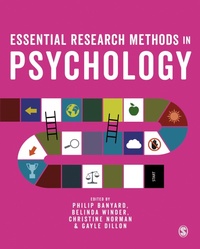
Essential Research Methods in Psychology
1st Edition
Published on 5. April 2022
344 pages
978-1-5297-8744-3 (ISBN)
Description

Looking for a comprehensive and engaging research methods textbook for your psychology studies? Look no further than Essential Research Methods in Psychology!
This book covers the most used methods for successful research in psychology, with a balance of quantitative and qualitative methods. It is written in an accessible and witty style that will keep you engaged and curious throughout your learning journey.
With real published research examples from core domains in psychology, such as social, developmental, cognitive, biological, and individual differences, you'll learn how to apply the methodology to real-world scenarios. Plus, you'll develop critical thinking skills and an understanding of ethical considerations that are crucial to conducting research in an ethical and responsible manner.
Other features include:
Skoolkid errors (examples of)
Ig Nobel Prize (satiric prizes which make you laugh and think)
Whoa there! (stop and think)
Whether you're studying for an introductory methods course or designing a research project, Essential Research Methods in Psychology will equip you for success.
This book covers the most used methods for successful research in psychology, with a balance of quantitative and qualitative methods. It is written in an accessible and witty style that will keep you engaged and curious throughout your learning journey.
With real published research examples from core domains in psychology, such as social, developmental, cognitive, biological, and individual differences, you'll learn how to apply the methodology to real-world scenarios. Plus, you'll develop critical thinking skills and an understanding of ethical considerations that are crucial to conducting research in an ethical and responsible manner.
Other features include:
Skoolkid errors (examples of)
Ig Nobel Prize (satiric prizes which make you laugh and think)
Whoa there! (stop and think)
Whether you're studying for an introductory methods course or designing a research project, Essential Research Methods in Psychology will equip you for success.
More details
Edition
1. Auflage
Language
English
Place of publication
London
United Kingdom
Publishing group
Sage Publications Ltd (Digital)
Target group
College/higher education
Product notice
Reflowable
File size
6,22 MB
ISBN-13
978-1-5297-8744-3 (9781529787443)
Copyright in bibliographic data and cover images is held by Nielsen Book Services Limited or by the publishers or by their respective licensors: all rights reserved.
Schweitzer Classification
Other editions
Additional editions
Philip Banyard | Belinda Winder | Christine Norman
Essential Research Methods in Psychology
Book
04/2022
1st Edition
SAGE Publications Ltd
€184.70
Shipment within 15-20 days
Philip Banyard | Belinda Winder | Christine Norman
Essential Research Methods in Psychology
Book
04/2022
1st Edition
SAGE Publications Ltd
€113.80
Shipment within 15-20 days
Persons
Dr Phil Banyard is Emeritus Professor of Psychology at Nottingham Trent University (NTU). In his thirty years at NTU Phil Banyard taught on a range of courses but focused on introductory modules and critical thinking. His research was concerned with the impact of digital technologies on teaching and learning, especially in schools. He was a chief examiner of A Level Psychology for many years and has written more than twenty texts. Among these is an introductory text with SAGE (now in its fourth edition) that brought in over 50 members of the department at NTU. His cultural interests are largely defined by smallpeople in the family and he is currently enjoying Captain Underpants series three which he regards as riotously creative.
Belinda is a Reader in Forensic Psychology. She teaches primarily within forensic psychology, with specific focus on sexual crime. She has a strong background in psychometrics and individual differences, and retains her enthusiasm for quantitative research (continuing to teach multivariate statistics in what she hopes is a fun and interactive manner). Her research is leading her to incorporate qualitative research methods as she continues to develop a programme of research in collaboration with HMP Whatton (the largest sex offender prison in Europe) that makes a significant and practical contribution to our understanding of sex offenders and sexual crime. Additional areas of interest (both in terms of teaching and research) include the psychology of fraud, lying and deception. Christine Norman is a Senior Lecturer in Psychology at Nottingham Trent University. Gayle Dillon is a Senior Lecturer in Psychology at Nottingham Trent University.
Belinda is a Reader in Forensic Psychology. She teaches primarily within forensic psychology, with specific focus on sexual crime. She has a strong background in psychometrics and individual differences, and retains her enthusiasm for quantitative research (continuing to teach multivariate statistics in what she hopes is a fun and interactive manner). Her research is leading her to incorporate qualitative research methods as she continues to develop a programme of research in collaboration with HMP Whatton (the largest sex offender prison in Europe) that makes a significant and practical contribution to our understanding of sex offenders and sexual crime. Additional areas of interest (both in terms of teaching and research) include the psychology of fraud, lying and deception. Christine Norman is a Senior Lecturer in Psychology at Nottingham Trent University. Gayle Dillon is a Senior Lecturer in Psychology at Nottingham Trent University.
Content
Chapter 1. Psychological research: doing the right thing? - Philip Banyard
Chapter 2. Experimental methods - Andrew Harris, Russell Turk, Mike Vernon and Juliet Ruth Helen Wakefield
Chapter 3. Survey methods - Lucy Betts, Moon Halder, Mark Sergeant and Ben Oldfield
Chapter 4. Neuroscientific methods - Andrew Clouter and Darren Rhodes
Chapter 5. Randomised controlled trials - Janet Vousden and Anna Cunningham
Chapter 6. Interviews - David Wilde, Beth Jones, Jennifer Mackay and Lisa Sanderson
Chapter 7. Focus groups - Lydia Harkin and Francesca Chloe Ryding
Chapter 8. Naturally occurring data - Anastasia Rousaki, Eva Prikrylova, Kristina Newman and Sarah Seymour-Smith
Chapter 9. Visual methods - David Wilde and Amanda Edmondson
Chapter 10. Combining two methods: Interviews and psychometrics - Rowena Hill, Lisa Sanderson and Beth Jones
Chapter 11: Repertory grids - Nicholas Blagden and Rosie Kitson-Boyce
Chapter 12. Case studies - Rusi Jaspal, Caroline Flowers and Melina Throuvala
Chapter 13. Behavioural observations - Emma J. Vardy, Treshi-Marie Perera and James Stiller
Chapter 2. Experimental methods - Andrew Harris, Russell Turk, Mike Vernon and Juliet Ruth Helen Wakefield
Chapter 3. Survey methods - Lucy Betts, Moon Halder, Mark Sergeant and Ben Oldfield
Chapter 4. Neuroscientific methods - Andrew Clouter and Darren Rhodes
Chapter 5. Randomised controlled trials - Janet Vousden and Anna Cunningham
Chapter 6. Interviews - David Wilde, Beth Jones, Jennifer Mackay and Lisa Sanderson
Chapter 7. Focus groups - Lydia Harkin and Francesca Chloe Ryding
Chapter 8. Naturally occurring data - Anastasia Rousaki, Eva Prikrylova, Kristina Newman and Sarah Seymour-Smith
Chapter 9. Visual methods - David Wilde and Amanda Edmondson
Chapter 10. Combining two methods: Interviews and psychometrics - Rowena Hill, Lisa Sanderson and Beth Jones
Chapter 11: Repertory grids - Nicholas Blagden and Rosie Kitson-Boyce
Chapter 12. Case studies - Rusi Jaspal, Caroline Flowers and Melina Throuvala
Chapter 13. Behavioural observations - Emma J. Vardy, Treshi-Marie Perera and James Stiller
