

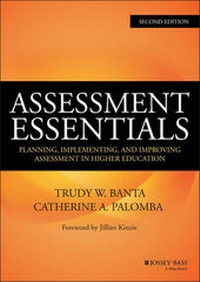
Assessment Essentials
Description

More details
Other editions
Additional editions
Persons
Content
CHAPTER 1
DEFINING ASSESSMENT
The concept of assessment resides in the eye of the beholder. It many definitions, so it is essential that anyone who writes or speaks about assessment defines it at the outset.
Some Definitions
In common parlance, assessment as applied in education describes the measurement of what an individual knows and can do. Over the past three decades, the term outcomes assessment in higher education has come to imply aggregating individual measures for the purpose of discovering group strengths and weaknesses that can guide improvement actions.
Some higher education scholars have focused their attention on the assessment of student learning. Linda Suskie, for instance, in the second edition of her book Assessing Student Learning: A Common Sense Guide (2009) tells us that for her, the term assessment “refers to the assessment of student learning.” In the first edition of this book, we also adopted the focus on student learning:
Assessment is the systematic collection, review, and use of information about educational programs undertaken for the purpose of improving student learning and development. (Palomba and Banta, 1999, p. 4)
The term assessment in higher education has also come to encompass the entire process of evaluating institutional effectiveness. Reflecting her career in applying her background in educational psychology in program evaluation, the first author of this book uses this definition:
Assessment is the process of providing credible evidence of
- resources
- implementation actions, and
- outcomes
undertaken for the purpose of improving the effectiveness of
- instruction,
- programs, and
- services
in higher education.
In this book, the term assessment will certainly apply to student learning. But we also use it to describe the evaluation of academic programs, student support services such as advising, and even administrative services as we look at overall institutional effectiveness.
We will describe the assessment of student learning as well as of instructional and curricular effectiveness in general education and major fields of study. We will consider methods for assessing student learning and program effectiveness in student services areas. We also will present approaches to assessing student learning and program and process effectiveness at the institutional level. In fact, the most meaningful assessment is related to institutional mission.
Disciplinary accreditation is a form of assessing program effectiveness in a major field. Regional accreditation is a form of assessing institutional effectiveness. Both are powerful influences in motivating and guiding campus approaches to assessment. Federal, state, and trustee mandates for measures that demonstrate accountability may determine levels of performance funding and also shape campus assessment responses. We will discuss the many external factors that impel college faculty and administrators to undertake assessment activities.
Our guiding principle in this book, however, will be to present approaches to assessment that are designed to help faculty and staff improve instruction, programs, and services, and thus student learning, continuously. Assessment for improvement can also be used to demonstrate accountability. Unfortunately, assessment undertaken primarily to comply with accountability mandates often does not result in campus improvements.
Pioneering in Assessment
In his book The Self-Regarding Institution (1984), Peter Ewell portrays the first work in outcomes assessment of three institutions. In the early 1970s, Sister Joel Reed, president of Alverno College, and Charles McClain, president of Northeast Missouri State University, determined that the assessment of student learning outcomes could be a powerful force in improving the effectiveness of their respective institutions. Alverno faculty surveyed their alumnae to find out what their graduates valued most in terms of their learning at Alverno (Loacker and Mentkowski, 1993). Survey findings shaped faculty development of eight abilities, including communication, analysis, and aesthetic responsiveness, that would become the foundation for curriculum and instruction at Alverno. In addition to work in their own discipline, Alverno faculty were asked to join cross-disciplinary faculty specializing in one of the eight core abilities. Alverno’s (2011) “assessment as learning” approach has transformed that college, increasing its reputation among students and parents, its enrollment, and its visibility in the United States and abroad as a leader in conducting conscientious and mission-centric assessment.
At Northeast Missouri State University, President McClain and his chief academic officer, Darrell Krueger, became early advocates of value-added assessment, giving tests of generic skills to their freshmen and seniors and tracking the gain scores. In addition, department faculty were strongly encouraged to give their seniors an appropriate nationally normed test in their major field if one existed. McClain famously asked his department chairs one persistent question: “Are we making a difference?” meaning, “How are our students doing on those tests we’re giving?” (Krueger, 1993). The early emphasis on test scores had the effect of raising the ability profile of Northeast Missouri’s entering students. Subsequently the faculty and administration decided to pursue and gain approval from the state as Missouri’s public liberal arts institution, with the new name of Truman State University.
The third pioneering institution profiled in Ewell’s book was the University of Tennessee, Knoxville (UTK). Whereas Alverno’s and Northeast Missouri’s assessment initiatives were internal in their origins and aimed at improving institutional effectiveness in accordance with institutional mission, UTK was confronted with the need to address an external mandate—a performance funding program instituted in 1979 by the Tennessee Higher Education Commission and the Tennessee state legislature. Initially UTK’s chancellor, Jack Reese, called the requirements to test freshmen and seniors in general education and seniors in their major field, conduct annual surveys of graduates, and accredit all accreditable programs “an abridgement of academic freedom.” His administrative intern at the time, Trudy Banta, thought the performance funding components looked like elements of her chosen field, program evaluation. She took advantage of a timely opportunity to write a proposal for a grant that the Kellogg Foundation would subsequently fund: “Increasing the Use of Student Information in Decision-Making.” For the first three years of addressing the external accountability mandate, faculty and administrators charted their own course on the performance funding measures on the basis of their Kellogg Project. While the amount of the Kellogg funding was tiny—just ten thousand dollars—for research-oriented faculty, the “Kellogg grant” gave them the opportunity to begin testing of students and questioning of graduates in their own way. Within five years, UTK was recognized by the National Council for Measurement in Education for outstanding practice in “using measurement technology” (Banta, 1984).
By 1985 three additional states joined Tennessee in establishing performance funding programs for their public colleges and universities. Colorado, New Jersey, and Virginia issued far less prescriptive guidelines than Tennessee, however. The state higher education organizations and legislatures in the three new entries provided examples, but left it to their public institutions to select or design tests and other measures to demonstrate their accountability.
In his 2009 paper for the newly formed National Institute for Learning Outcomes Assessment (NILOA), Ewell notes that “two decades ago, the principal actors external to colleges and universities requiring attention to assessment were state governments.” However, by the 1990s, mandates in several states were no longer being enforced because of budget constraints, and so attention turned to other goals, such as higher degree completion rates. Tennessee remained an exception in continuing to employ several learning outcomes measures in its long-established performance funding program.
In 1988, Secretary of Education William Bennett issued an executive order requiring all federally approved accreditation organizations to include in their criteria for accreditation evidence of institutional outcomes (US Department of Education, 1988). During the next several years, the primary external stimulus for assessment moved from states to regional associations as they began to issue specific outcomes assessment directives for institutional accreditation, and discipline-specific bodies created such guidelines for program accreditation. The 1992 Amendments to the federal Higher Education Act (HEA) codified assessment obligations for accrediting agencies, and subsequent renewals of the HEA have continued to require accreditors to include standards specifying that student achievement and program outcomes be assessed. It has taken some accreditors longer than others to comply, however. Accreditors of health professions were in the vanguard, followed by social science professions like education, social work, and business. Engineering accreditors initiated “ABET 2000” standards in 1997 (ABET, 2013)....
