

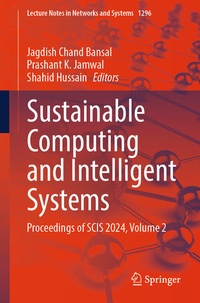
Sustainable Computing and Intelligent Systems
Description

This book presents selected papers from International Conference on Sustainable Computing and Intelligent Systems (SCIS 2024), held on 9-10 September 2024, in University of Canberra, Bruce, Australia. The topics covered in the book are green computing, renewable energy integration, sustainable urban computing, IoT and sustainability, sustainable IoT applications, data analytics for sustainability, internet of things, information security, embedded systems, real-time systems, cloud computing, big data analysis, quantum computing, automation systems, intelligent IoT eHealth, bio-inspired intelligence, brain modeling and simulation, cognitive systems, cyber-physical systems, data analytics, data/web mining, data science, hybrid systems and intelligence for security.
More details
Other editions
Additional editions
Persons
Jagdish Chand Bansal is Associate Professor (Senior Grade) at South Asian University New Delhi and Visiting Professor at Maths and Computer Science, Liverpool Hope University, UK. He also holds a visiting professorship at NIT Goa, India. Dr. Bansal obtained his Ph.D. in Mathematics from IIT Roorkee. Before joining SAU New Delhi, he worked as Assistant Professor at ABV-Indian Institute of Information Technology and Management Gwalior and BITS Pilani. His primary area of interest is Swarm Intelligence and Nature Inspired Optimization Techniques. Recently, he proposed a fission-fusion social structure based optimization algorithm, Spider Monkey Optimization (SMO), which is being applied to various problems in the engineering domain.
Prashant K. Jamwal earned Ph.D. degree and a post-doctoral fellowship from the University of Auckland, New Zealand. Earlier he had obtained M. Tech. from I.I.T., India, securing first position in all the disciplines and B. Tech. from MNREC, Allahabad, India. Presently, he is working as Professor at the school of engineering and design sciences, Nazarbayev University (NU), Astana, Kazakhstan and as Adjunct Professor at University of Canberra, Australia. He is actively pursuing research in Robotics and Artificial Intelligence, multi-objective evolutionary optimization, biomedical engineering and Renewable energy. Over the past decade, he has applied his research in the development of medical robots for rehabilitation and surgical applications besides developing improved algorithms for cancer data analytics.
Shahid Hussain is working at University of Canberra as Associate Professor of Biomedical Robotics. Prior to that he has worked as lecturer at University of Wollongong, Australia. Dr. Hussain has obtained his Ph.D. in Mechanical Engineering from the University of Auckland, New Zealand in 2013. His research interests include assistive and rehabilitation robotics, compliant actuation of robots, robot mechanism design and optimization, non-linear dynamics and control of robotic systems, human-robot interaction, biomechanical modeling, engineering education and micro electro-mechanical systems (MEMS). Dr. Hussain has published more than 65 papers in the prestigious journals of the field.
Content
Chapter 1: Efficient Intrusion Detection through Class Balancing and Feature Selection: A Case Study with SVM.- Chapter 2: A Provisional Study of Detecting Diabetes in Pregnant Women using Machine Learning Models.- Chapter 3: MCDM Methods for Selecting Sustainable Procurement Suppliers in Vietnam's Agricultural Supply Chain Operations.- Chapter 4: Improved Machine Learning Systems for Android Device Malware Detection.- Chapter 5: Unmasking Credit Card Fraud: Advanced Machine Learning and Linear Algebra Techniques for Enhanced Detection.- Chapter 6: Web Application for Insurance Fraud Detection using Machine Learning.- Chapter 7: A Hybrid Efficient Key Management Cloud Scheme for Identifying Insider Misbehaviors and Security Over Data Sharing.- Chapter 8: Advancements in Vedic Multiplier Design: A Comprehensive Review.- Chapter 9: Secure Image Encryption using AES with Chaotic Map-based S Box.- Chapter 10: Leveraging Transformer Models for Abstractive Summarization of Hindi Text.- etc.
