

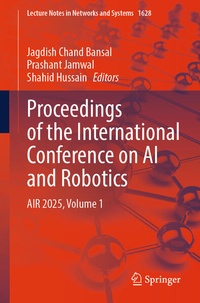
Proceedings of the International Conference on AI and Robotics
Description

This book gathers selected papers from International Conference on AI and Robotics (AIR 2025), held in Astana, Kazakhstan, during May 9-11, 2025. The book presents and discusses the latest research results and generates new ideas in the field of artificial intelligence and robotics. The topics covered are machine learning and deep learning, natural language processing, computer vision, autonomous robots, human-robot interaction, AI and robotics for environmental sustainability, and industrial robotics.
More details
Other editions
Additional editions
Persons
Dr. Jagdish Chand Bansal is an Associate Professor (Senior Grade) at South Asian University New Delhi and a Visiting Professor at Maths and Computer Science, Liverpool Hope University UK. He also holds a visiting professorship at NIT Goa, India. Dr. Bansal obtained his Ph.D. in Mathematics from IIT Roorkee. Before joining SAU New Delhi, he worked as an Assistant Professor at ABV- Indian Institute of Information Technology and Management Gwalior and BITS Pilani. His primary areas of interest are swarm intelligence and nature-inspired optimization techniques. Recently, he proposed a fission-fusion social structure based optimization algorithm, Spider Monkey Optimization (SMO), which is being applied to various problems in the engineering domain. He has published over 70 research papers in various international journals/conferences. He is the Section Editor (editor-in-chief) of the journal MethodsX published by Elsevier. He is the series editor of the four Springer book series AIS, SADIC, ISTC and SST published by Springer. He is also the Associate Editor of Engineering Applications of Artificial Intelligence (EAAI) and ARRAY published by Elsevier. He is also the Associate Editor of the Soft Computing journal published by Springer. He is the general secretary of the Soft Computing Research Society (SCRS). He has also received Gold Medal at UG and PG levels.
Prof. Prashant K. Jamwal earned PhD degree and a post-doctoral fellowship from the University of Auckland, New Zealand. Earlier he had obtained M. Tech. from I.I.T., India, securing first position in all the disciplines and B. Tech. from MNREC, Allahabad, India. Presently, he is working as Professor at the school of engineering and design sciences, Nazarbayev University (NU), Astana, Kazakhstan and as adjunct professor at University of Canberra, Australia. He is actively pursuing research in Robotics and Artificial Intelligence, multi-objective evolutionary optimization, biomedical engineering, and Renewable energy. Over the past decade, he has applied his research in the development of medical robots for rehabilitation and surgical applications besides developing improved algorithms for cancer data analytics. Prof. Prashant received three prestigious World Bank Grants and has launched two startup companies and established a Center of Excellence in Medical Research and Robotics. Lately, he has successfully commercialized an autonomous robotic Gait Rehabilitation System after furnishing all the regulatory requirements, thus making expensive medical robots accessible to small clinics. He has more than 25 years of teaching and research experience and has published more than 100 research articles in reputed international journals/conferences.
Dr. Hussain is working at University of Canberra as Associate Professor of Biomedical Robotics. Prior to that he has worked as lecturer at University of Wollongong, Australia. Dr. Hussain has obtained his PhD in Mechanical Engineering from the University of Auckland, New Zealand in 2013. His research interests include assistive and rehabilitation robotics, compliant actuation of robots, robot mechanism design and optimization, non-linear dynamics and control of robotic systems, human-robot interaction, biomechanical modelling, engineering education and micro electro-mechanical systems (MEMS). Dr. Hussain has published more than 65 papers in the prestigious journals of the field.
