

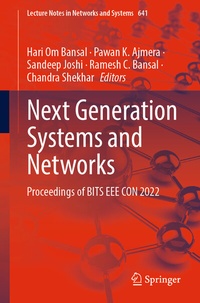
Next Generation Systems and Networks
Proceedings of BITS EEE CON 2022
Published on 9. July 2023
XII, 530 pages
978-981-99-0483-9 (ISBN)
Description

The book is a collection of high-quality research papers presented at International Conference on Next Generation Systems and Networks (BITS EEE CON 2022), held at Birla Institute of Technology & Science, Pilani, Rajasthan, India, during November 4-5, 2022. This book provides reliable and efficient design solutions for the next-generation networks and systems. The book covers research areas in energy, power and control; communication and signal processing; and electronics and nanotechnology.
More details
Series
Edition
1st ed. 2023
Language
English
Place of publication
Singapore
Singapore
Publishing group
Springer Singapore
Target group
Professional and scholarly
Product notice
Reflowable
Illustrations
XII, 530 p. 268 illus., 213 illus. in color.
File size
14,86 MB
ISBN-13
978-981-99-0483-9 (9789819904839)
DOI
10.1007/978-981-99-0483-9
Schweitzer Classification
Other editions
Additional editions
Hari Om Bansal | Pawan K. Ajmera | Sandeep Joshi
Next Generation Systems and Networks
Proceedings of BITS EEE CON 2022
Book
07/2023
Springer
€192.59
Shipment within 3-4 weeks
Persons
Hari Om Bansal
obtained his bachelor's degree in Electrical Engineering from University of Rajasthan in 1998. He received his post-graduate degree from MREC, Jaipur, in Power Systems and Ph.D. from BITS, Pilani, in Electrical Engineering in 2000 and 2005, respectively. Prof. Bansal has been with BITS, Pilani, Pilani campus, since June 2001, and presently, he is serving as a Professor in the Electrical and Electronics Engineering Department. He has contributed to teaching, research, and institution building for over 20 years. He has supervised 5 doctoral theses and worked on 2 government organization-funded projects. He has published over 80 papers in journals and conferences. His fields of interest include power quality, integration of renewable energy sources, hybrid electric vehicles, battery management systems, and application of artificial intelligence techniques in these areas. He is Fellow of the Institution of Engineers (IE), India, Senior Member of IEEE, and Life Member of Indian Society for Technical Education (ISTE).
Pawan K. Ajmera received the B.E. degree in Industrial Electronics Engineering from Dr. B. A. Marathwada University, Aurangabad, India, in 2001 and M. E. degree in Instrumentation Engineering from S. R. T. Marathwada University, Nanded, India, in 2005. He received the Ph.D. degree in Electronics Engineering from SGGS Institute of Engineering and Technology, Nanded, India, in 2012. Since August 2015, he has been with the Department of Electrical and Electronics Engineering, BITS, Pilani, India, where he is currently Assistant Professor and involved in research in the area of signal processing and multimodal biometrics. He is Member of IEEE and has a mix of academic and research experience. The areas of his research interest are digital signal processing, image processing, and unimodal and multimodal biometrics.
Sandeep Joshi received the B.Tech. degree (Hons.) in electronics and communication engineering from Uttar Pradesh Technical University, India, in 2006, the M.E. degree in communication engineering from Birla Institute of Technology and Science (BITS), Pilani, India, in 2009, and the Ph.D. degree in electrical engineering from Indian Institute of Technology (IIT) Delhi in 2019. Since August 2020, he has been with the Department of Electrical and Electronics Engineering, BITS, Pilani, where he is currently working as an Assistant Professor. Prior to that, he worked as Chief Engineer in the Mobile Communications research group at the Samsung R&D Institute Bangalore, where he was involved in research in the area of beyond 5G/6G communication systems. He is Fellow of the Institution of Electronics and Telecommunication Engineers (IETE), India, is Senior Member of IEEE, Life Member of the Indian Society for Technical Education (ISTE), and Life Member of the Institution of Engineers (IE), India. He is Co-founder of Agrix, an AgriTech startup.
Ramesh C. Bansal has over 25 years of teaching, research, academic leadership, and industrial experience. Currently, he is Professor in EE Department at the University of Sharjah, UAE, and Extraordinary Professor at the University of Pretoria, South Africa. In previous postings, he was Professor and Group Head (Power) at the University of Pretoria and worked with the University of Queensland, Australia; USP, Fiji; BITS, Pilani, India. Prof. Bansal has published over 400 journal articles, conference papers, books/book chapters. He has Google citations of over 16000 and an H-index of 60. He has supervised 25 Ph.D. and 5 post-docs. Prof. Bansal has attracted significant funding from industry and government organizations. He is Editor/AE of reputed journals including IEEE Systems Journal, IET-RPG, TESGSE. He is Fellow and CP Engineer of IET-UK, Fellow of IE (India), and Senior Member of IEEE. He has diversified research interests in the areas of Renewable Energy, Power Systems, and Smart Grid.
Chandra Shekhar completed his M.Sc. in Physics and Ph.D. in Semiconductor Electronics from BITS, Pilani, in the years 1971 and 1975, respectively. He joined Central Electronics Engineering Research Institute (CSIR-CEERI), Pilani, as Scientist in 1977 and served as Director from November 2003 to October 2015. His team at CEERI developed the country's first MOS LSI chip, a full-custom dedicated VLSI processor in 6-micron NMOS technology and CMOS Gate Array-based semi-custom VLSI chip. He also led the design of the country's first general-purpose microprocessor, and his team also designed India's first Application Specific Instruction Set Processor for Hindi text-to-speech conversion. He has been awarded the Young Scientist Award by UNESCO/ ROSTSCA; Distinguished Alumnus Award by BITS, Pilani (in 2014); and Distinguished Service Awards by Institution of Engineers and the Institution of Electronics and Telecommunication Engineers. He is currently Chancellor of the Academy of Scientific and Innovative Research (AcSIR).
Pawan K. Ajmera received the B.E. degree in Industrial Electronics Engineering from Dr. B. A. Marathwada University, Aurangabad, India, in 2001 and M. E. degree in Instrumentation Engineering from S. R. T. Marathwada University, Nanded, India, in 2005. He received the Ph.D. degree in Electronics Engineering from SGGS Institute of Engineering and Technology, Nanded, India, in 2012. Since August 2015, he has been with the Department of Electrical and Electronics Engineering, BITS, Pilani, India, where he is currently Assistant Professor and involved in research in the area of signal processing and multimodal biometrics. He is Member of IEEE and has a mix of academic and research experience. The areas of his research interest are digital signal processing, image processing, and unimodal and multimodal biometrics.
Sandeep Joshi received the B.Tech. degree (Hons.) in electronics and communication engineering from Uttar Pradesh Technical University, India, in 2006, the M.E. degree in communication engineering from Birla Institute of Technology and Science (BITS), Pilani, India, in 2009, and the Ph.D. degree in electrical engineering from Indian Institute of Technology (IIT) Delhi in 2019. Since August 2020, he has been with the Department of Electrical and Electronics Engineering, BITS, Pilani, where he is currently working as an Assistant Professor. Prior to that, he worked as Chief Engineer in the Mobile Communications research group at the Samsung R&D Institute Bangalore, where he was involved in research in the area of beyond 5G/6G communication systems. He is Fellow of the Institution of Electronics and Telecommunication Engineers (IETE), India, is Senior Member of IEEE, Life Member of the Indian Society for Technical Education (ISTE), and Life Member of the Institution of Engineers (IE), India. He is Co-founder of Agrix, an AgriTech startup.
Ramesh C. Bansal has over 25 years of teaching, research, academic leadership, and industrial experience. Currently, he is Professor in EE Department at the University of Sharjah, UAE, and Extraordinary Professor at the University of Pretoria, South Africa. In previous postings, he was Professor and Group Head (Power) at the University of Pretoria and worked with the University of Queensland, Australia; USP, Fiji; BITS, Pilani, India. Prof. Bansal has published over 400 journal articles, conference papers, books/book chapters. He has Google citations of over 16000 and an H-index of 60. He has supervised 25 Ph.D. and 5 post-docs. Prof. Bansal has attracted significant funding from industry and government organizations. He is Editor/AE of reputed journals including IEEE Systems Journal, IET-RPG, TESGSE. He is Fellow and CP Engineer of IET-UK, Fellow of IE (India), and Senior Member of IEEE. He has diversified research interests in the areas of Renewable Energy, Power Systems, and Smart Grid.
Chandra Shekhar completed his M.Sc. in Physics and Ph.D. in Semiconductor Electronics from BITS, Pilani, in the years 1971 and 1975, respectively. He joined Central Electronics Engineering Research Institute (CSIR-CEERI), Pilani, as Scientist in 1977 and served as Director from November 2003 to October 2015. His team at CEERI developed the country's first MOS LSI chip, a full-custom dedicated VLSI processor in 6-micron NMOS technology and CMOS Gate Array-based semi-custom VLSI chip. He also led the design of the country's first general-purpose microprocessor, and his team also designed India's first Application Specific Instruction Set Processor for Hindi text-to-speech conversion. He has been awarded the Young Scientist Award by UNESCO/ ROSTSCA; Distinguished Alumnus Award by BITS, Pilani (in 2014); and Distinguished Service Awards by Institution of Engineers and the Institution of Electronics and Telecommunication Engineers. He is currently Chancellor of the Academy of Scientific and Innovative Research (AcSIR).
Content
Real-Time Video Monitoring for Fall Detection-an Overview.- Implementation of Master-Slave Communication using MQTT Protocol.- An Algorithm for Customizing Slicing Floor Plan Design.- A Prediction Model for Real Estate Price using Machine Learning.- Efficient ASIC Implementation of Artificial Neural Network with Posit Representation of Floating-Point Numbers.- Machine Learning Based Stock Market Prediction.- Nature-Inspired Optimization Algorithm Assisted Optimal Sensor Node Positioning for Precision Agriculture Applications in Asymmetric Fields.- Performance Analysis of All-Optical Relaying for UWOC over EGG Oceanic Turbulence.- Stock Price Prediction using GRU and BiLSTM Models.- Evaluation of BERT Model for Aspect Based Sentiment Analysis.- Solidly Mounted BAW Resonator For 5G Application on AlN Thin Films.- Design and Investigation of PMUT Sensor for Medical Imaging Applications.
