

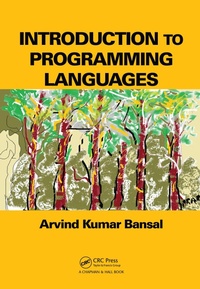
Introduction to Programming Languages
Published on 17. December 2013
624 pages
978-1-040-05917-3 (ISBN)
Description

In programming courses, using the different syntax of multiple languages, such as C++, Java, PHP, and Python, for the same abstraction often confuses students new to computer science. Introduction to Programming Languages separates programming language concepts from the restraints of multiple language syntax by discussing the concepts at an abstract level.
Designed for a one-semester undergraduate course, this classroom-tested book teaches the principles of programming language design and implementation. It presents:
Common features of programming languages at an abstract level rather than a comparative level
The implementation model and behavior of programming paradigms at abstract levels so that students understand the power and limitations of programming paradigms
Language constructs at a paradigm level
A holistic view of programming language design and behavior
To make the book self-contained, the author introduces the necessary concepts of data structures and discrete structures from the perspective of programming language theory. The text covers classical topics, such as syntax and semantics, imperative programming, program structures, information exchange between subprograms, object-oriented programming, logic programming, and functional programming. It also explores newer topics, including dependency analysis, communicating sequential processes, concurrent programming constructs, web and multimedia programming, event-based programming, agent-based programming, synchronous languages, high-productivity programming on massive parallel computers, models for mobile computing, and much more. Along with problems and further reading in each chapter, the book includes in-depth examples and case studies using various languages that help students understand syntax in practical contexts.
Designed for a one-semester undergraduate course, this classroom-tested book teaches the principles of programming language design and implementation. It presents:
Common features of programming languages at an abstract level rather than a comparative level
The implementation model and behavior of programming paradigms at abstract levels so that students understand the power and limitations of programming paradigms
Language constructs at a paradigm level
A holistic view of programming language design and behavior
To make the book self-contained, the author introduces the necessary concepts of data structures and discrete structures from the perspective of programming language theory. The text covers classical topics, such as syntax and semantics, imperative programming, program structures, information exchange between subprograms, object-oriented programming, logic programming, and functional programming. It also explores newer topics, including dependency analysis, communicating sequential processes, concurrent programming constructs, web and multimedia programming, event-based programming, agent-based programming, synchronous languages, high-productivity programming on massive parallel computers, models for mobile computing, and much more. Along with problems and further reading in each chapter, the book includes in-depth examples and case studies using various languages that help students understand syntax in practical contexts.
Reviews / Votes
"... a great introductory text, providing essential knowledge in the field and enabling students to place in the appropriate context the programming concepts they learned in their introductory courses. ... The author has cleverly placed an introduction to data structures commonly used by programming languages in the second chapter, minimizing prerequisites and enabling the book's usage at the sophomore level. Theory has been kept to levels suitable for a general undergraduate population and is supported by a wealth of concise, well-illustrated examples. ... Recommended."-CHOICE, August 2014
More details
Language
English
Place of publication
London
United Kingdom
Publishing group
Taylor & Francis Ltd
Target group
College/higher education
File size
18,87 MB
ISBN-13
978-1-040-05917-3 (9781040059173)
Copyright in bibliographic data and cover images is held by Nielsen Book Services Limited or by the publishers or by their respective licensors: all rights reserved.
Schweitzer Classification
Other editions
Additional editions
Arvind Kumar Bansal
Introduction to Programming Languages
Book
07/2017
1st Edition
CRC Press
€282.53
Shipment within 10-20 days
Arvind Kumar Bansal
Introduction to Programming Languages
Book
12/2013
1st Edition
CRC Press
€131.80
Shipment within 15-20 days
Person
Arvind Bansal is a professor of computer science at Kent State University. A member of IEEE and ACM, he is an area editor of Tools with Artificial Intelligence. His research interests include the areas of concurrent logic programming, fault-tolerant agent-based systems, knowledge bases, program analysis, XML-based multimedia languages and systems, bioinformatics, biological computing, and proteomics. He received a PhD in computer science from Case Western Reserve University.
Content
Introduction. Background and Fundamental Concepts. Syntax and Semantics. Abstractions in Programs and Information Exchange. Implementation Model for Imperative Languages. Dynamic Memory Management. Type Theory. Concurrency Programming Paradigm. Functional Programming Paradigm. Logic Programming Paradigm. Object-Oriented Programming Paradigm. Web and Multimedia Programming Paradigms. Other Programming Paradigms. Scripting Languages. Conclusion and Future of Programming Languages. Appendices. Bibliography. Index.
