

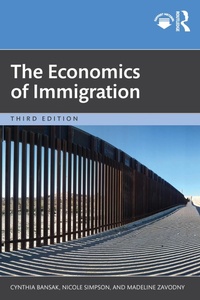
The Economics of Immigration
3rd Edition
Published on 17. November 2025
492 pages
978-1-040-44069-8 (ISBN)
Description

The Economics of Immigration provides students with the tools needed to examine the impact of immigration and immigration policies over the past century. The main objectives of the book are for students to understand the decision to migrate, the impacts of immigration on markets and government budgets, and the consequences of immigration policies in a global context.
Students will develop an appreciation of the importance of immigration as a separate academic field within labor economics and international economics. Topics covered include the effects of immigration on labor markets, housing markets, international trade, tax revenues, human capital accumulation, government fiscal balances, and climate migration. The book also considers the impacts of immigration on what firms choose to produce, the ethnic diversity of restaurants, and financial markets, as well as the theory and evidence on immigrants' economic assimilation. The textbook includes comparisons of immigration policies in a number of immigrant-receiving and sending countries, highlighting recent policy changes in Europe. Finally, the book explores immigration topics that directly affect low- and middle-income countries, such as remittances, brain drain, and human trafficking. Readers will be fully equipped with the tools needed to understand and contribute to policy debates on this controversial topic.
This is the first textbook to comprehensively cover the economics of immigration, and it is suitable both for economics students and for those studying migration in other disciplines, such as sociology and political science.
Students will develop an appreciation of the importance of immigration as a separate academic field within labor economics and international economics. Topics covered include the effects of immigration on labor markets, housing markets, international trade, tax revenues, human capital accumulation, government fiscal balances, and climate migration. The book also considers the impacts of immigration on what firms choose to produce, the ethnic diversity of restaurants, and financial markets, as well as the theory and evidence on immigrants' economic assimilation. The textbook includes comparisons of immigration policies in a number of immigrant-receiving and sending countries, highlighting recent policy changes in Europe. Finally, the book explores immigration topics that directly affect low- and middle-income countries, such as remittances, brain drain, and human trafficking. Readers will be fully equipped with the tools needed to understand and contribute to policy debates on this controversial topic.
This is the first textbook to comprehensively cover the economics of immigration, and it is suitable both for economics students and for those studying migration in other disciplines, such as sociology and political science.
Reviews / Votes
"Everyone, whether immigration proponent or skeptic, has a stake in better immigration policy. Better policy requires understanding the causes and effects of immigration, many of which are economic and powerful. This book stands alone-the first, and still the only, comprehensive textbook on immigration economics for the college student. It was already a treasure: a superb, balanced, and rigorous yet accessible distillation of decades of top scholarship. But it gets even more indispensable in this third edition, with its expanded treatment of issues in the headlines: rising forced migration, common crises on both sides of the Atlantic, and recent political upheaval. This is the book that serious undergraduate students of immigration economics need. No other comes close."-Michael Clemens, Professor of Economics, George Mason University and Non-Resident Senior Fellow, Peterson Institute for International Economics, US.
"The Economics of Immigration covers the breadth and depth of the economic analysis of migration. For each topic, the book provides an intuitive summary of the theory, an overview of the state-of-the-art research as well as interesting case studies from all over the world. The book is an indispensable resource for students interested in the causes and consequences of migration."
-Benjamin Elsner, Professor of Economics, University College Dublin, Ireland.
"Comprehensive, balanced and engaging, there is no better book to empower students with the knowledge and tools to tackle the economics of immigration."
-Pia Orrenius, Vice President, Federal Reserve Bank of Dallas, US.
"Bansak, Simpson, and Zavodny have written an ideal textbook for undergraduate students interested in the Economics of Immigration. The text examines the economic costs and benefits of the migration experience from the perspective of immigrants, residents of origin countries, and people in the destination. The authors cover a range of immigration issues while providing important context for understanding how and why academics sometimes disagree about the economic causes and consequences of migration."
-Chad Sparber, W. Bradford Wiley Professor of Economics, Colgate University, US.
More details
Edition
3rd edition
Language
English
Place of publication
London
United Kingdom
Publishing group
Taylor & Francis Ltd
Target group
College/higher education
Illustrations
33 Tables, black and white; 94 Line drawings, black and white; 4 Halftones, black and white; 98 Illustrations, black and white
File size
7,50 MB
ISBN-13
978-1-040-44069-8 (9781040440698)
Copyright in bibliographic data and cover images is held by Nielsen Book Services Limited or by the publishers or by their respective licensors: all rights reserved.
Schweitzer Classification
Other editions
Additional editions
Cynthia Bansak | Nicole Simpson | Madeline Zavodny
The Economics of Immigration
Book
11/2025
3rd Edition
Routledge
€94.40
Shipment within 10-20 days
Cynthia Bansak | Nicole Simpson | Madeline Zavodny
The Economics of Immigration
Book
11/2025
3rd Edition
Routledge
€209.40
Shipment within 10-20 days
Persons
Cynthia Bansak is the Charles A. Dana Professor of Economics at St. Lawrence University, U.S.A.
Nicole Simpson is the W. Bradford Wiley Professor of Economics at Colgate University, U.S.A.
Madeline Zavodny is the Donna L. Gibbs and First Coast Systems Professor of Economics at the University of North Florida, U.S.A.
Nicole Simpson is the W. Bradford Wiley Professor of Economics at Colgate University, U.S.A.
Madeline Zavodny is the Donna L. Gibbs and First Coast Systems Professor of Economics at the University of North Florida, U.S.A.
Content
Preface. Part I. Background on Immigration 1. Why Study the Economics of Immigration? 2. Patterns of International Migration 3. Determinants of Immigration Part II. Immigrant Selection and Assimilation 4. Selection in Immigration 5. Assimilation 6. The Second Generation Part III. Labor Market Effects of Immigration 7. Labor Market Effects: Theory 8. Labor Market Effects: Evidence Part IV. Other Effects of Immigration 9. Effects on Other Markets in the Destination 10. Fiscal Effects 11. Effects on Source Countries Part V: Immigration Policy 12. Immigration Policy around the World 13. U.S. Immigration Policy Part VI: Frontiers in Immigration Research 14. Frontiers in the Economics of Immigration
