

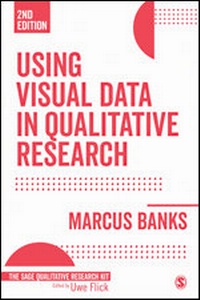
Using Visual Data in Qualitative Research
2nd Edition
Published on 3. September 2018
192 pages
978-1-5264-2611-6 (ISBN)
Description

This book helps students and scholars get started on the exciting journey of using visual data in social research. It covers the many uses a researcher can make of images, from creating images as a part of the research process to collecting and analyzing images from diverse sources. Exploring the opportunities and arming readers with tools to overcome some of the practical challenges, Using Visual Data in Qualitative Research is a perfect guide to uncovering new and unexpected dimensions of social life.
More details
Series
Edition
Second Edition
Language
English
Place of publication
London
United Kingdom
Target group
College/higher education
Professional and scholarly
ISBN-13
978-1-5264-2611-6 (9781526426116)
Copyright in bibliographic data and cover images is held by Nielsen Book Services Limited or by the publishers or by their respective licensors: all rights reserved.
Schweitzer Classification
Other editions
Additional editions
Marcus Banks
Using Visual Data in Qualitative Research
Book
10/2018
2nd Edition
SAGE Publications Ltd
€80.10
Shipment within 15-20 days
Marcus Banks
Using Visual Data in Qualitative Research
Book
10/2018
2nd Edition
SAGE Publications Ltd
€112.85
Article exhausted; check different version
Person
Marcus Banks was Professor of Visual Anthropology at the University of Oxford. Having completed a doctorate in social anthropology at the University of Cambridge, with a study of Jain people in England and India, he trained as an ethnographic documentary filmmaker at the National Film and Television School, Beaconsfield, UK.
He was the author Using Visual Data in Qualitative Research (2007) and co-editor of Rethinking Visual Anthropology (1997, with Howard Morphy), and Made to be Seen: Perspectives on the History of Visual Anthropology (2011, with Jay Ruby), as well as publishing numerous papers on visual research.
He published on documentary film forms and film practice in colonial India, and was conducting research on image production and use in forensic science practice.
He was the author Using Visual Data in Qualitative Research (2007) and co-editor of Rethinking Visual Anthropology (1997, with Howard Morphy), and Made to be Seen: Perspectives on the History of Visual Anthropology (2011, with Jay Ruby), as well as publishing numerous papers on visual research.
He published on documentary film forms and film practice in colonial India, and was conducting research on image production and use in forensic science practice.
Content
1. Introduction
2. The place of visual data in social research: a brief history
3. Approaches to studying the visual
4. Visual methods and field research
5. Presenting visual research
6. Conclusion: images and social research
2. The place of visual data in social research: a brief history
3. Approaches to studying the visual
4. Visual methods and field research
5. Presenting visual research
6. Conclusion: images and social research
