

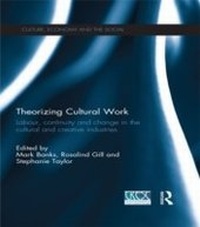
Theorizing Cultural Work
Labour, Continuity and Change in the Cultural and Creative Industries
1st Edition
Published on 11. April 2014
224 pages
978-1-134-08351-0 (ISBN)
Description

In recent years, cultural work has engaged the interest of scholars from a broad range of social science and humanities disciplines. The debate in this 'turn to cultural work' has largely been based around evaluating its advantages and disadvantages: its freedoms and its constraints, its informal but precarious nature, the inequalities within its global workforce, and the blurring of work-life boundaries leading to 'self-exploitation'.
While academic critics have persuasively challenged more optimistic accounts of 'converged' worlds of creative production, the critical debate on cultural work has itself leant heavily towards suggesting a profoundly new confluence of forces and effects. Theorizing Cultural Work instead views cultural work through a specifically historicized and temporal lens, to ask: what novelty can we actually attach to current conditions, and precisely what relation does cultural work have to social precedent? The contributors to this volume also explore current transformations and future(s) of work within the cultural and creative industries as they move into an uncertain future.
This book challenges more affirmative and proselytising industry and academic perspectives, and the pervasive cult of novelty that surrounds them, to locate cultural work as an historically and geographically situated process. It will be of interest to students and scholars of sociology, cultural studies, human geography, urban studies and industrial relations, as well as management and business studies, cultural and economic policy and development, government and planning.
While academic critics have persuasively challenged more optimistic accounts of 'converged' worlds of creative production, the critical debate on cultural work has itself leant heavily towards suggesting a profoundly new confluence of forces and effects. Theorizing Cultural Work instead views cultural work through a specifically historicized and temporal lens, to ask: what novelty can we actually attach to current conditions, and precisely what relation does cultural work have to social precedent? The contributors to this volume also explore current transformations and future(s) of work within the cultural and creative industries as they move into an uncertain future.
This book challenges more affirmative and proselytising industry and academic perspectives, and the pervasive cult of novelty that surrounds them, to locate cultural work as an historically and geographically situated process. It will be of interest to students and scholars of sociology, cultural studies, human geography, urban studies and industrial relations, as well as management and business studies, cultural and economic policy and development, government and planning.
More details
Series
Language
English
Place of publication
London
United Kingdom
Publishing group
Taylor & Francis Ltd
Target group
College/higher education
File size
1,94 MB
ISBN-13
978-1-134-08351-0 (9781134083510)
Copyright in bibliographic data and cover images is held by Nielsen Book Services Limited or by the publishers or by their respective licensors: all rights reserved.
Schweitzer Classification
Other editions
Additional editions
Mark Banks | Rosalind Gill | Stephanie Taylor
Theorizing Cultural Work
Labour, Continuity and Change in the Cultural and Creative Industries
Book
05/2017
1st Edition
Routledge
€68.60
Shipment within 10-20 days
Mark Banks | Rosalind Gill | Stephanie Taylor
Theorizing Cultural Work
Labour, Continuity and Change in the Cultural and Creative Industries
Book
06/2013
1st Edition
Routledge
€231.60
Shipment within 15-20 days
Persons
Mark Banks is Reader in Sociology in the Faculty of Social Sciences at The Open University, UK.
Rosalind Gill is Professor of Social and Cultural Analysis at King's College London.
Stephanie Taylor is a Senior Lecturer in Psychology in the Faculty of Social Sciences at the Open University, UK.
Rosalind Gill is Professor of Social and Cultural Analysis at King's College London.
Stephanie Taylor is a Senior Lecturer in Psychology in the Faculty of Social Sciences at the Open University, UK.
Content
1. Introduction: Cultural Work, Time and Trajectory Part One: Histories 2. Precarious Labour Then and Now: The British Arts and Crafts Movement and Cultural Work Revisited 3. Cultural Work and Antisocial Psychology 4. Hired Hands, Liars, Schmucks: Histories of Screenwriting Work and Workers in Contemporary Screen Production 5. Absentee Workers: Representation and Participation in the Cultural Industries Part Two: Specificities/Transformations 6. Specificity, Ambivalence, and the Commodity Form of Creative Work 7. How Special? Cultural Work, Copyright, Politics 8. Logistics of Cultural Work 9. Learning from Luddites: Media Labor, Technology and Life Below the Line 10. Presence Bleed: Performing Professionalism Online Part Three: Futures 11. Feminist Futures of Cultural Work? Creativity, Gender and Difference in the Digital Media Sector 12. Creativity, Biography and the Time of Individualization 13. Professional Identity and Media Work 14. Theorizing Cultural Work: An Interview with the Editors. References.
