

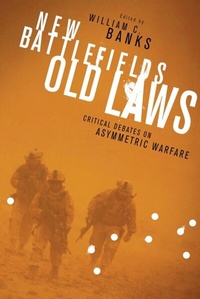
New Battlefields/Old Laws
Critical Debates on Asymmetric Warfare
1st Edition
Published on 25. September 2015
320 pages
978-0-231-52656-2 (ISBN)
Description

An internationally-recognized authority on constitutional law, national security law, and counterterrorism, William C. Banks believes changing patterns of global conflict are forcing a reexamination of the traditional laws of war. The Hague Rules, the customary laws of war, and the post-1949 law of armed conflict no longer account for nonstate groups waging prolonged campaigns of terrorism-or even more conventional insurgent attacks.
Recognizing that many of today's conflicts are low-intensity, asymmetrical wars fought between disparate military forces, Banks's collection analyzes nonstate armed groups and irregular forces (such as terrorist and insurgent groups, paramilitaries, child soldiers, civilians participating in hostilities, and private military firms) and their challenge to international humanitarian law. Both he and his contributors believe gaps in the laws of war leave modern battlefields largely unregulated, and they fear state parties suffer without guidelines for responding to terrorists and their asymmetrical tactics, such as the targeting of civilians. These gaps also embolden weaker, nonstate combatants to exploit forbidden strategies and violate the laws of war.
Attuned to the contested nature of post-9/11 security and policy, this collection juxtaposes diverse perspectives on existing laws and their application in contemporary conflict. It sets forth a legal definition of new wars, describes the status of new actors, charts the evolution of the twenty-first-century battlefield, and balances humanitarian priorities with military necessity. While the contributors contest each other, they ultimately reestablish the legitimacy of a long-standing legal corpus, and they rehumanize an environment in which the most vulnerable targets, civilian populations, are themselves becoming weapons against conventional power.
Recognizing that many of today's conflicts are low-intensity, asymmetrical wars fought between disparate military forces, Banks's collection analyzes nonstate armed groups and irregular forces (such as terrorist and insurgent groups, paramilitaries, child soldiers, civilians participating in hostilities, and private military firms) and their challenge to international humanitarian law. Both he and his contributors believe gaps in the laws of war leave modern battlefields largely unregulated, and they fear state parties suffer without guidelines for responding to terrorists and their asymmetrical tactics, such as the targeting of civilians. These gaps also embolden weaker, nonstate combatants to exploit forbidden strategies and violate the laws of war.
Attuned to the contested nature of post-9/11 security and policy, this collection juxtaposes diverse perspectives on existing laws and their application in contemporary conflict. It sets forth a legal definition of new wars, describes the status of new actors, charts the evolution of the twenty-first-century battlefield, and balances humanitarian priorities with military necessity. While the contributors contest each other, they ultimately reestablish the legitimacy of a long-standing legal corpus, and they rehumanize an environment in which the most vulnerable targets, civilian populations, are themselves becoming weapons against conventional power.
All prices
More details
Other editions
Additional editions
Book
10/2011
Columbia University Press
€39.68
Shipment within 10-20 days
Book
10/2011
Columbia University Press
€124.00
Article not available at the moment
Person
William C. Banks is professor of public administration at the Maxwell School of Syracuse University. He is also Board of Advisors Distinguished Professor at the university's College of Law and director of the Institute for National Security and Counterterrorism (INSCT). Since 1987, Banks has helped draw the parameters of national security law, coauthoring two leading texts in the field: National Security Law and Counterterrorism Law.
Content
Figures and Tables
Introduction: Toward an Adaptive International Humanitarian Law: New Norms
for New Battlefields, by William C. Banks
Critical Debate I: Threshold Issues in Defining Twenty-first-Century Armed Conflicts
1. Extraterritorial Law Enforcement or Transnational Counterterrorist
Military Operations: The Stakes of Two Legal Models, by Geoffrey S. Corn
2. Preventive Detention of Individuals Engaged in Transnational Hostilities: Do We Need a Fourth Protocol Additional to the 1949 Geneva Conventions?, by Gregory Rose
Critical Debate II: Status and Liabilities of Nonstate Actors Engaged in Hostilities
3."Jousting at Windmills": The Laws of Armed Conflict in an Age of Terror-State Actors and Nonstate Elements, by David M. Crane and Daniel Reisner
4. Direct Participation in Hostilities: A Concept Broad Enough for Today's Targeting Decisions, by Eric Talbot Jensen
5. Nonstate Actors in Armed Conflicts: Issues of Distinction and Reciprocity, by Daphné Richemond-Barak
Critical Debate III: Changing Twenty-first-Century Battlefields and Armed Forces
6. Children as Direct Participants in Hostilities: New Challenges for International Humanitarian Law and International Criminal Law, by Hilly Moodrick-Even Khen
7. Private Military Contractors and Changing Norms for the Laws of Armed Conflict, by Renée de Nevers
Critical Debate IV: Military Necessity and Humanitarian Priorities in International Humanitarian Law: Productive Tension or Irreconcilable Differences?
8. The Principle of Proportionality Under International Humanitarian Law and Operation Cast Lead, by Robert P. Barnidge Jr.
9. Humanizing Irregular Warfare: Framing Compliance for Nonstate Armed Groups at the Intersection of Security and Legal Analyses, by Corri Zoli
Notes
Contributor Bios
Index
Introduction: Toward an Adaptive International Humanitarian Law: New Norms
for New Battlefields, by William C. Banks
Critical Debate I: Threshold Issues in Defining Twenty-first-Century Armed Conflicts
1. Extraterritorial Law Enforcement or Transnational Counterterrorist
Military Operations: The Stakes of Two Legal Models, by Geoffrey S. Corn
2. Preventive Detention of Individuals Engaged in Transnational Hostilities: Do We Need a Fourth Protocol Additional to the 1949 Geneva Conventions?, by Gregory Rose
Critical Debate II: Status and Liabilities of Nonstate Actors Engaged in Hostilities
3."Jousting at Windmills": The Laws of Armed Conflict in an Age of Terror-State Actors and Nonstate Elements, by David M. Crane and Daniel Reisner
4. Direct Participation in Hostilities: A Concept Broad Enough for Today's Targeting Decisions, by Eric Talbot Jensen
5. Nonstate Actors in Armed Conflicts: Issues of Distinction and Reciprocity, by Daphné Richemond-Barak
Critical Debate III: Changing Twenty-first-Century Battlefields and Armed Forces
6. Children as Direct Participants in Hostilities: New Challenges for International Humanitarian Law and International Criminal Law, by Hilly Moodrick-Even Khen
7. Private Military Contractors and Changing Norms for the Laws of Armed Conflict, by Renée de Nevers
Critical Debate IV: Military Necessity and Humanitarian Priorities in International Humanitarian Law: Productive Tension or Irreconcilable Differences?
8. The Principle of Proportionality Under International Humanitarian Law and Operation Cast Lead, by Robert P. Barnidge Jr.
9. Humanizing Irregular Warfare: Framing Compliance for Nonstate Armed Groups at the Intersection of Security and Legal Analyses, by Corri Zoli
Notes
Contributor Bios
Index

