
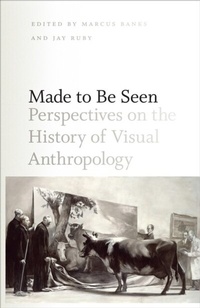
Made to Be Seen
Description
Alles über E-Books | Antworten auf Fragen rund um E-Books, Kopierschutz und Dateiformate finden Sie in unserem Info- & Hilfebereich.
Made to be Seen brings together leading scholars of visual anthropology to examine the historical development of this multifaceted and growing field. Expanding the definition of visual anthropology beyond more limited notions, the contributors to Made to be Seen reflect on the role of the visual in all areas of life. Different essays critically examine a range of topics: art, dress and body adornment, photography, the built environment, digital forms of visual anthropology, indigenous media, the body as a cultural phenomenon, the relationship between experimental and ethnographic film, and more. The first attempt to present a comprehensive overview of the many aspects of an anthropological approach to the study of visual and pictorial culture, Made to be Seen will be the standard reference on the subject for years to come. Students and scholars in anthropology, sociology, visual studies, and cultural studies will greatly benefit from this pioneering look at the way the visual is inextricably threaded through most, if not all, areas of human activity.
All prices
More details
Other editions
Additional editions
Content
- Intro
- Contents
- Introduction: Made To be Seen: Historical Perspectives on Visual Anthropology
- 1. Skilled Visions: Toward an Ecology of Visual Inscriptions
- 2. Material Visions: Dress and Textiles
- 3. Visual Anthropology and the Built Environment: Interpenetrations of the Visible and the Invisible
- 4. Unfinished Dialogues: Notes toward an Alternative History of Art and Anthropology
- 5. Theorizing "the Body" in Visual Culture
- 6. Tracing Photography
- 7. Ethnographic Film
- 8. Digital Visual Anthropology: Potentials and Challenges
- 9. Native Intelligence: A Short History of Debates on Indigenous Media and Ethnographic Film
- 10. Productive Dissonance and Sensuous Image-Making: Visual Anthropology and Experimental Film
- 11. Anthropology and the Problem of Audience Reception
- Hindsight/Postscript: Ethical and Epistemic Reflections on/of Anthropological Vision
- Bibliography
- Filmography
- Contributors
- Index

System requirements
File format: PDF
Copy-Protection: Adobe-DRM (Digital Rights Management)
System requirements:
- Computer (Windows; MacOS X; Linux): Install the free reader Adobe Digital Editions prior to download (see eBook Help).
- Tablet/smartphone (Android; iOS): Install the free app Adobe Digital Editions or the app PocketBook before downloading (see eBook Help).
- E-reader: Bookeen, Kobo, Pocketbook, Sony, Tolino and many more (only limited: Kindle).
The file format PDF always displays a book page identically on any hardware. This makes PDF suitable for complex layouts such as those used in textbooks and reference books (images, tables, columns, footnotes). Unfortunately, on the small screens of e-readers or smartphones, PDFs are rather annoying, requiring too much scrolling.
This eBook uses Adobe-DRM, a „hard” copy protection. If the necessary requirements are not met, unfortunately you will not be able to open the eBook. You will therefore need to prepare your reading hardware before downloading.
Please note: We strongly recommend that you authorise using your personal Adobe ID after installation of any reading software.
For more information, see our eBook Help page.
File format: ePUB
Copy protection: Watermark-DRM (Digital Rights Management)
System requirements:
- Computer (Windows; MacOS X; Linux): Use a reading software that can process the file format ePUB: e.g., Adobe Digital Editions or FBReader – both free (see eBook Help).
- Tablet/Smartphone (Android; iOS): Before downloading, install the free app Adobe Digital Editions (see eBook Help).
- E-reader: Bookeen, Kobo, Pocketbook, Sony, Tolino and many more (not Kindle).
The file format ePUB works well for novels and non-fiction books – i.e., „flowing” text without complex layout. On an e-reader or smartphone, line and page breaks automatically adjust to fit the small displays.
This eBook uses Watermark-DRM, a „soft” copy protection. This means that there are no technical restrictions to prevent illegal distribution. However, there is a personalised watermark embedded in the eBook that can be used to identify the purchaser of the eBook in the event of misuse and to provide evidence for legal purposes.
For more information, see our eBook Help page.
