

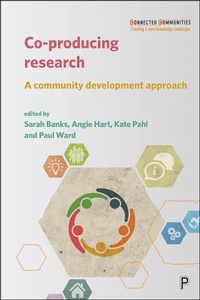
Co-producing Research
A Community Development Approach
1st Edition
Published on 19. December 2018
272 pages
978-1-4473-4078-2 (ISBN)
Description

Offering a critical examination of the nature of co-produced research, this important new book draws on materials and case studies from the ESRC funded project 'Imagine - connecting communities through research'. Outlining a community development approach to co-production, which privileges community agency, the editors link with wider debates about the role of universities within communities. With policy makers in mind, contributors discuss in clear and accessible language what co-production between community groups and academics can achieve. The book will be valuable for practitioners within community contexts, and researchers interested in working with communities, activists, and artists.
More details
Other editions
Additional editions
Book
12/2018
1st Edition
Policy Press
€48.10
Shipment within 15-20 days
Book
12/2018
1st Edition
Policy Press
€105.30
Shipment within 15-20 days
Persons
Editor
Durham University
Sarah Banks is Professor in the School of Applied Social Sciences and Co-director, Centre for Social Justice and Community Action, Durham University, UK. She teaches and researches in the fields of community development, professional ethics and participatory action research. She was Coordinator of Imagine North East.
Sarah Banks is Professor in the School of Applied Social Sciences and Co-director, Centre for Social Justice and Community Action, Durham University, UK. She teaches and researches in the fields of community development, professional ethics and participatory action research. She was Coordinator of Imagine North East.
University of Brighton.
Angie Hart is Professor of Child, Family and Community Health and Director of the Centre of Resilience for Social Justice, University of Brighton. She teaches professional health and social care courses and undertakes participatory research into resilience and inequalities. Angie directs a community interest company, Boingboing, supporting children, families and practitioners (www.boingboing.org.uk).
Angie Hart is Professor of Child, Family and Community Health and Director of the Centre of Resilience for Social Justice, University of Brighton. She teaches professional health and social care courses and undertakes participatory research into resilience and inequalities. Angie directs a community interest company, Boingboing, supporting children, families and practitioners (www.boingboing.org.uk).
Manchester Metropolitan University
Kate Pahl is Professor of Arts and Literacy at Manchester Metropolitan University, UK.
Kate Pahl is Professor of Arts and Literacy at Manchester Metropolitan University, UK.
Edge Hill University
Professor of Public History and Community Heritage and Head of the Department of English, History and Creative Writing, Edge Hill University
Professor of Public History and Community Heritage and Head of the Department of English, History and Creative Writing, Edge Hill University
Contributions
The Search Project
Clare Levi works with older people at the Search project based in Benwell, Newcastle, UK. She coordinated the 'Growing old in West Newcastle' project for Imagine North East.
Clare Levi works with older people at the Search project based in Benwell, Newcastle, UK. She coordinated the 'Growing old in West Newcastle' project for Imagine North East.
Coventry University
Ben Kyneswood is Lecturer in Sociology at Coventry University. His work involves using community photographic archives to challenge dominant narratives and established thinking. His company Photo Archive Miners recently published the photography book of Masterji and exhibits worldwide.
Ben Kyneswood is Lecturer in Sociology at Coventry University. His work involves using community photographic archives to challenge dominant narratives and established thinking. His company Photo Archive Miners recently published the photography book of Masterji and exhibits worldwide.
University of Huddersfield
Beverly Wenger-Trayner is a learning consultant specializing in communities of practice and social learning systems. Her expertise encompasses both the design of learning architectures and the facilitation of processes, activities, and use of new technologies. She has also been the creative director of an Open Source platform for networked communities.
University of Brighton
Suna Eryigit-Madzwamuse is Senior Research Fellow and Deputy Director of the Centre of Resilience for Social Justice, University of Brighton. Her work focuses on promoting wellbeing and resilience of children, young people and their families, taking into account biological and contextual risk and protective factors from a developmental perspective. She also volunteers for the social enterprise, Boingboing.
Suna Eryigit-Madzwamuse is Senior Research Fellow and Deputy Director of the Centre of Resilience for Social Justice, University of Brighton. Her work focuses on promoting wellbeing and resilience of children, young people and their families, taking into account biological and contextual risk and protective factors from a developmental perspective. She also volunteers for the social enterprise, Boingboing.
Mandeep Samra is an oral historian, artist and heritage activist, part of Let's Go Yorkshire. She led Sound System Culture and Let's Play Vinyl, both funded by Arts Council England. She is author of Sound System Culture: Celebrating Huddersfield's Sound Systems (One Love, 2014).
Doctoral student, University of Huddersfield
Elizabeth Pente was awarded her PhD from the University of Huddersfield in 2018. Her research is concerned with public history and post-Second World War urban decline and regeneration. She is co-editor of Re-Imagining Contested Communities (Policy, 2017).
Elizabeth Pente was awarded her PhD from the University of Huddersfield in 2018. Her research is concerned with public history and post-Second World War urban decline and regeneration. She is co-editor of Re-Imagining Contested Communities (Policy, 2017).
Building African Caribbean Communities and Reach Performing Arts
Natalie Pinnock-Hamilton MBE is a Huddersfield-based community activist, who has been involved in numerous community development projects. She is a leading force in Building African Caribbean Communities and Reach Performing Arts.
Natalie Pinnock-Hamilton MBE is a Huddersfield-based community activist, who has been involved in numerous community development projects. She is a leading force in Building African Caribbean Communities and Reach Performing Arts.
Narrative Eye
Onyeka Nubia an historian, writer and law lecturer who promotes the study of early modern histories to contextualise Black and World history. He has a PhD from the University of East Anglia and has published a number of books including Blackamoores: Africans in Tudor England, Their Presence, Status and Origins (Narrative Eye, 2013).
Onyeka Nubia an historian, writer and law lecturer who promotes the study of early modern histories to contextualise Black and World history. He has a PhD from the University of East Anglia and has published a number of books including Blackamoores: Africans in Tudor England, Their Presence, Status and Origins (Narrative Eye, 2013).
Kirklees Local TV
Milton Brown is chief executive of Kirklees Local TV, which documents stories in Huddersfield and Dewsbury and surrounding areas. He is taking a PhD at the University of Huddersfield, on the experience of African-Caribbean people in navigating identity in post-war Britain.
Milton Brown is chief executive of Kirklees Local TV, which documents stories in Huddersfield and Dewsbury and surrounding areas. He is taking a PhD at the University of Huddersfield, on the experience of African-Caribbean people in navigating identity in post-war Britain.
Shabina Aslam is a theatre maker and has been a creative producer and radio drama producer. She is undertaking a PhD at the University of Huddersfield on 'bussing out' - the 1960s and 1970s policy of the educational dispersal of black and Asian children.
Birkbeck, University of London
Elizabeth Chapman Hoult is a lecturer in the Department of Psychosocial Studies at Birkbeck, University of London, where she directs the MSc in Education, Power and Social Change. She uses literary theory and literary analysis to deepen understandings of individual and community resilience, hope and imagined futures.
Elizabeth Chapman Hoult is a lecturer in the Department of Psychosocial Studies at Birkbeck, University of London, where she directs the MSc in Education, Power and Social Change. She uses literary theory and literary analysis to deepen understandings of individual and community resilience, hope and imagined futures.
Louise Ritchie works at the Department for Lifelong learning at the University of Sheffield and has extensive experience as a researcher on community research projects.
Newcastle University
Prue Chiles is a Professor of Architecture at the University of Newcastle.
Prue Chiles is a Professor of Architecture at the University of Newcastle.
University of Crete
Elias Kourkoutas is Professor of Psychology and Special Education, University of Crete. His research explores ways to develop meaningful resilience-based inclusive practices that help teachers, parents, and students with special educational needs, social emotional and academic difficulties, and those at risk for school exclusion, overcome difficulties and be successfully included.
Elias Kourkoutas is Professor of Psychology and Special Education, University of Crete. His research explores ways to develop meaningful resilience-based inclusive practices that help teachers, parents, and students with special educational needs, social emotional and academic difficulties, and those at risk for school exclusion, overcome difficulties and be successfully included.
University of Brighton
Boingboing
Lisa Buttery is an Artist in Residence and trainer with Boingboing where she designs illustrations and artwork, and co-produces books, films, exhibitions and conference presentations around visual arts, mental health and resilience. Her artwork is an important way of coping with mental health issues and raising awareness of mental health issues in young people.
Lisa Buttery is an Artist in Residence and trainer with Boingboing where she designs illustrations and artwork, and co-produces books, films, exhibitions and conference presentations around visual arts, mental health and resilience. Her artwork is an important way of coping with mental health issues and raising awareness of mental health issues in young people.
Etienne Wenger-Trayner is a globally recognized thought leader in the field of social learning and communities of practice. He writes books and articles for practitioners in organisations who want to base their knowledge strategy on communities of practice. His work is influencing a growing number of organizations in the private and public sectors.
University of Brighton
Josh Cameron is Principal Occupational Therapy Lecturer, University of Brighton. His interests include collaborative approaches to adult resilience, including the return-to-work experiences of workers with mental health problems, and combining the expertise and knowledge of people with lived experience, practitioners and academics for research and practice development. He also volunteers for the social enterprise Boingboing.
Josh Cameron is Principal Occupational Therapy Lecturer, University of Brighton. His interests include collaborative approaches to adult resilience, including the return-to-work experiences of workers with mental health problems, and combining the expertise and knowledge of people with lived experience, practitioners and academics for research and practice development. He also volunteers for the social enterprise Boingboing.
University of Brighton
Andrew Church is Professor of Human Geography and Associate Pro-Vice-Chancellor of Research and Enterprise, University of Brighton. His highly interdisciplinary and collaborative work focuses on human-nature relations and interactions to better understand how to manage change into the future.
Andrew Church is Professor of Human Geography and Associate Pro-Vice-Chancellor of Research and Enterprise, University of Brighton. His highly interdisciplinary and collaborative work focuses on human-nature relations and interactions to better understand how to manage change into the future.
Greater Manchester Centre for Voluntary Organisation
Susanne Martikke leads on research at Greater Manchester Centre for Voluntary Organisation (GMCVO), the voluntary sector support organisation for the city-region of Greater Manchester. She has more than twelve years' experience of conducting research with and about the voluntary sector. Some of this research has been in partnership with academics at local and national universities. She is now working on a collaborative Studentship in Sociology at the University of Manchester.
Susanne Martikke leads on research at Greater Manchester Centre for Voluntary Organisation (GMCVO), the voluntary sector support organisation for the city-region of Greater Manchester. She has more than twelve years' experience of conducting research with and about the voluntary sector. Some of this research has been in partnership with academics at local and national universities. She is now working on a collaborative Studentship in Sociology at the University of Manchester.
Pendower Good Neighbour Project
Ruth Taylor works for Pendower Good Neighbour Project, based in Benwell, Newcastle, UK. She coordinated the 'Time traveller' project with young people for Imagine North East.
Ruth Taylor works for Pendower Good Neighbour Project, based in Benwell, Newcastle, UK. She coordinated the 'Time traveller' project with young people for Imagine North East.
Phoenix Detached Youth Project, North Shields
Luke Johnston is a detached youth worker with Phoenix Detached Youth Project in North Shields, UK. His main areas of work are detached work, developing street spaces, working with young men's issues and education around social media safety. He coordinated an intergenerational graffiti art project for Imagine North East.
Luke Johnston is a detached youth worker with Phoenix Detached Youth Project in North Shields, UK. His main areas of work are detached work, developing street spaces, working with young men's issues and education around social media safety. He coordinated an intergenerational graffiti art project for Imagine North East.
Hayden-Harman Foundation
Patrick Harman is Executive Director of the Hayden-Harman Foundation, which focuses on community development efforts in High Point, North Carolina, US. He also teaches courses on the non-profit sector at Elon University, US. He provided assistance to Imagine North East during his Fulbright fellowship.
Patrick Harman is Executive Director of the Hayden-Harman Foundation, which focuses on community development efforts in High Point, North Carolina, US. He also teaches courses on the non-profit sector at Elon University, US. He provided assistance to Imagine North East during his Fulbright fellowship.
The Cedarwood Trust
Yvonne Hall was formerly a community researcher at the Cedarwood Trust, Meadow Well Estate, North Shields, where she coordinated the 'Imagining Community at Cedarwood' project for Imagine North East. She is now studying for a degree in Psychology with History.
Yvonne Hall was formerly a community researcher at the Cedarwood Trust, Meadow Well Estate, North Shields, where she coordinated the 'Imagining Community at Cedarwood' project for Imagine North East. She is now studying for a degree in Psychology with History.
Riverside Community Health Project
Anne Bonner is the Chief Executive of Riverside Community Health Project in Benwell, Newcastle. She works alongside a committed team addressing the effects of inequalities on the lives of people who live in the west end of Newcastle. Riverside undertook a project on 'playing with change and ideas' for Imagine North East.
Anne Bonner is the Chief Executive of Riverside Community Health Project in Benwell, Newcastle. She works alongside a committed team addressing the effects of inequalities on the lives of people who live in the west end of Newcastle. Riverside undertook a project on 'playing with change and ideas' for Imagine North East.
Durham University
Andrea Armstrong is a researcher at Durham University, UK, currently working on the dynamics of trust in physical places/digital spaces. She was Research Associate for Imagine North East.
Andrea Armstrong is a researcher at Durham University, UK, currently working on the dynamics of trust in physical places/digital spaces. She was Research Associate for Imagine North East.
Content
Chapter 1: Co-producing research: A community development approach, Sarah Banks, Angie Hart, Kate Pahl, Paul Ward
Part I: Forming communities of inquiry and developing shared practices
Chapter 2: Between research and community development: Negotiating a contested space for collaboration and creativity, Sarah Banks, Andrea Armstrong, Anne Bonner, Yvonne Hall, Patrick Harman, Luke Johnston, Clare Levi, Kath Smith and Ruth Taylor
Chapter 3: A radical take on co-production? Community partner leadership in research, Susanne Martikke, Andrew Church and Angie Hart
Chapter 4: Community-university partnership research retreats: a productive force for developing communities of research practice, Josh Cameron, Bev Wenger-Trayner, Etienne Wenger-Trayner, Angie Hart, Lisa Buttery, Anne Rathbone, Elias Kourkoutas and Suna Eryigit-Madzawamuse
Part II: Co-creating through and with the arts
Chapter 5: How does arts practice inform a community development approach to the co-production of research? David Bell, Steve Pool, Kim Streets, Natalie Walton with Kate Pahl
Chapter 6: Co-designing for a better future: re-making co-production, Prue Chiles with Louise Ritchie and Kate Pahl
Chapter 7: On not doing co-produced research: the methodological possibilities and limitations of co-producing research with participants in a prison, Elizabeth Hoult
Part III: Co-producing outputs
Chapter 8: Co-production as a new way of seeing: Using photographic exhibitions to challenge dominant stigmatising discourses, Ben Kyneswood
Chapter 9: 'Who controls the past controls the future': Black history and community development, Shabina Aslam, Milton Brown, Onyeka Nubia, Natalie Pinnock-Hamilton, Elizabeth Pente, Mandeep Samra and Paul Ward
Conclusion: Imagining different communities and making them happen, Paul Ward, Sarah Banks, Angie Hart, Kate Pahl
Part I: Forming communities of inquiry and developing shared practices
Chapter 2: Between research and community development: Negotiating a contested space for collaboration and creativity, Sarah Banks, Andrea Armstrong, Anne Bonner, Yvonne Hall, Patrick Harman, Luke Johnston, Clare Levi, Kath Smith and Ruth Taylor
Chapter 3: A radical take on co-production? Community partner leadership in research, Susanne Martikke, Andrew Church and Angie Hart
Chapter 4: Community-university partnership research retreats: a productive force for developing communities of research practice, Josh Cameron, Bev Wenger-Trayner, Etienne Wenger-Trayner, Angie Hart, Lisa Buttery, Anne Rathbone, Elias Kourkoutas and Suna Eryigit-Madzawamuse
Part II: Co-creating through and with the arts
Chapter 5: How does arts practice inform a community development approach to the co-production of research? David Bell, Steve Pool, Kim Streets, Natalie Walton with Kate Pahl
Chapter 6: Co-designing for a better future: re-making co-production, Prue Chiles with Louise Ritchie and Kate Pahl
Chapter 7: On not doing co-produced research: the methodological possibilities and limitations of co-producing research with participants in a prison, Elizabeth Hoult
Part III: Co-producing outputs
Chapter 8: Co-production as a new way of seeing: Using photographic exhibitions to challenge dominant stigmatising discourses, Ben Kyneswood
Chapter 9: 'Who controls the past controls the future': Black history and community development, Shabina Aslam, Milton Brown, Onyeka Nubia, Natalie Pinnock-Hamilton, Elizabeth Pente, Mandeep Samra and Paul Ward
Conclusion: Imagining different communities and making them happen, Paul Ward, Sarah Banks, Angie Hart, Kate Pahl
