

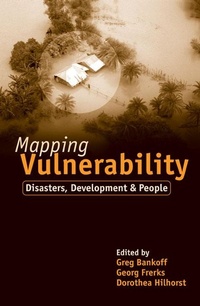
Mapping Vulnerability
Disasters, Development and People
1st Edition
Published on 17. June 2013
256 pages
978-1-136-56162-7 (ISBN)
Description

Raging floods, massive storms and cataclysmic earthquakes: every year up to 340 million people are affected by these and other disasters, which cause loss of life and damage to personal property, agriculture, and infrastructure. So what can be done? The key to understanding the causes of disasters and mitigating their impacts is the concept of 'vulnerability'.
Mapping Vulnerability analyses 'vulnerability' as a concept central to the way we understand disasters and their magnitude and impact. Written and edited by a distinguished group of disaster scholars and practitioners, this book is a counterbalance to those technocratic approaches that limit themselves to simply looking at disasters as natural phenomena. Through the notion of vulnerability, the authors stress the importance of social processes and human-environmental interactions as causal agents in the making of disasters. They critically examine what renders communities unsafe - a condition, they argue, that depends primarily on the relative position of advantage or disadvantage that a particular group occupies within a society's social order. The book also looks at vulnerability in terms of its relationship to development and its impact on policy and people's lives, through consideration of selected case studies drawn from Africa, Asia and Latin America. Mapping Vulnerability is essential reading for academics, students, policymakers and practitioners in disaster studies, geography, development studies, economics, environmental studies and sociology.
Mapping Vulnerability analyses 'vulnerability' as a concept central to the way we understand disasters and their magnitude and impact. Written and edited by a distinguished group of disaster scholars and practitioners, this book is a counterbalance to those technocratic approaches that limit themselves to simply looking at disasters as natural phenomena. Through the notion of vulnerability, the authors stress the importance of social processes and human-environmental interactions as causal agents in the making of disasters. They critically examine what renders communities unsafe - a condition, they argue, that depends primarily on the relative position of advantage or disadvantage that a particular group occupies within a society's social order. The book also looks at vulnerability in terms of its relationship to development and its impact on policy and people's lives, through consideration of selected case studies drawn from Africa, Asia and Latin America. Mapping Vulnerability is essential reading for academics, students, policymakers and practitioners in disaster studies, geography, development studies, economics, environmental studies and sociology.
More details
Language
English
Place of publication
London
United Kingdom
Publishing group
Taylor & Francis Ltd
Target group
College/higher education
File size
1,73 MB
ISBN-13
978-1-136-56162-7 (9781136561627)
Copyright in bibliographic data and cover images is held by Nielsen Book Services Limited or by the publishers or by their respective licensors: all rights reserved.
Schweitzer Classification
Other editions
Additional editions
Greg Bankoff | Georg Frerks | Dorothea Hilhorst
Mapping Vulnerability
Disasters, Development and People
Book
01/2004
1st Edition
Earthscan Ltd
€207.80
Shipment within 3-4 weeks
Greg Bankoff | Georg Frerks | Dorothea Hilhorst
Mapping Vulnerability
Disasters, Development and People
Book
01/2004
1st Edition
Earthscan Ltd
€73.50
Shipment within 3-4 weeks
Persons
Greg Bankoff is associate professor in the School of Asian Studies, University of Auckland, New Zealand, and research fellow in Disaster Studies, Wageningen University, The Netherlands.
Georg Frerks is professor of Disaster Studies, Wageningen University, and chair of Conflict Prevention and Conflict Management at Utrecht University, The Netherlands.
Dorothea Hilhorst is associate professor in Disaster Studies at Wageningen University.
Georg Frerks is professor of Disaster Studies, Wageningen University, and chair of Conflict Prevention and Conflict Management at Utrecht University, The Netherlands.
Dorothea Hilhorst is associate professor in Disaster Studies at Wageningen University.
Content
Introduction: Mapping Vulnerability * Theorizing Vulnerability in a Globalized World: A Political Ecological Perspective * The Historical Geography of Disaster: 'Vulnerability' and 'Local Knowledge' in Western Discourse * The Need for Rethinking the Concepts of Vulnerability and Risk from a Holistic Perspective: A Necessary Review and Criticism for Effective Risk Management * Complexity and Diversity: Unlocking Social Domains of Disaster Response * The Lower Lempa River Valley, El Salvador: Risk Reduction and Development Project * El Ni o Events, Forecasts and Decision-making * Vulnerable Regions versus Vulnerable People: An Ethiopian Case Study * From Vulnerability to Empowerment * Progress in Analysis of Social Vulnerability and Capacity * Vulnerability Reduction: A Task for the Vulnerable People Themselves * Macro-economic Concepts of Vulnerability: Dynamics, Complexity and Public Policy * Gendering Vulnerability Analysis: Towards a More Nuanced Approach * Assessment of Capability and Vulnerability * Conclusion: Vulnerability Analysis as a Means of Strengthening Policy Formulation and Policy Practice * Notes * References * Index
