

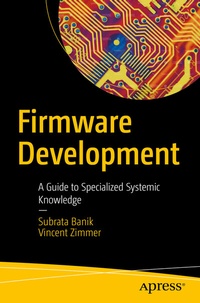
Firmware Development
Description

Build your own system firmware. This book helps you understand system firmware architecture and minimalistic design, and provides a specialized knowledge of firmware development. The book includes guidance on understanding the system firmware build procedure, integrating pieces of firmware and allowing configuration, updating system firmware, creating a development infrastructure for allowing multi-party collaboration in firmware development, and gaining advanced system firmware debugging knowledge.
After reading the book you will be able to assume better control while developing your own firmware and know how to interact with native hardware while debugging. You will understand key principles for future firmware development using newer technology, and be ready for the introduction of modern safe programming languages for firmware development. Detailed system firmware development case studies using a futuristic approach cover:- Future scalable system firmware development models
- Types of firmware development (system firmware, device firmware, manageability firmware)
- Tools and their usage while creating system firmware
- How to build infrastructure for seamless firmware development using a multi-party development model
- Debugging methodologies used during various phases of firmware product development
- Setting up key expectations for future firmware, including thinner firmware footprints and faster execution time, easier configuration, and increased transparent security
What You Will Learn
- Understand the system firmware working model of the future
- Gain knowledge to say goodbye to proprietary firmware for different types of firmware development
- Know the different types of tools required for creating firmware source code before flashing the final image into the boot device of the embedded system
- Develop skills to understand the failure in firmware or in the system and prepare the debugging environment to root cause the defects
- Discern the platform minimal security requirement
- Optimize the system firmware boot time based on the target hardware requirement
- Comprehend the product development cycle using open source firmware development
Who This Book Is For
Embedded firmware and software engineers migrating the product development from closed source firmware to open source firmware for product adaptation needs as well as engineers working for open source firmware development. A secondary audience includes engineers working on various bootloaders such as open source firmware, UEFI, and Slim Bootloader development, as well as undergraduate and graduate students working on developing firmware skill sets.More details
Other editions
Additional editions
Persons
Subrata Banik is a Firmware Engineer with more than a decade being spent in the computer industry and acquired experiences in system firmware design, development and debugging across various firmware architectures like UEFI, coreboot, Slim bootloader etc. for x86 and ARM platforms. Subrata has profound experience on platform enablement that leads into working for all the leading PC-makers' products. Subrata is an active member of open-source firmware (OSF) development across different projects like coreboot, oreboot, flashrom, EDKII etc., where he is one of the leading contributors in the open firmware (coreboot) development. Subrata has received multiple US Patents and is very passionate about learning new technology and sharing knowledge among enthusiast engineers. Subrata has presented his technical talks at industry events such as Open Source Firmware conference, Institute for Security and Technology, Intel Developer Forum etc.
When not writing or working, he can be found enjoying watching sports (especially football) or spending time with his daughter. A fun fact about Subrata is, he is a strong believer of Time travel existence.
Vincent Zimmer
has been working on embedded firmware for the last 30 years. Vincent has contributed to or created firmware spanning various firmware initiatives, including the Extensible Firmware Interface, where Vincent presently leads the Security subteam in the UEFI Forum. Vincent has also co-authored various papers and books, along with being a named co-inventor on over 450 US patents.
