

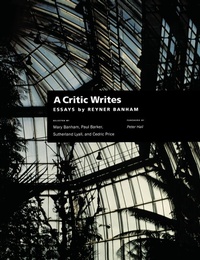
A Critic Writes
Selected Essays by Reyner Banham
1st Edition
Published on 1. September 2023
366 pages
978-0-520-92320-1 (ISBN)
Description

Few twentieth-century writers on architecture and design have enjoyed the renown of Reyner Banham. Born and trained in England and a U.S. resident starting in 1976, Banham wrote incisively about American and European buildings and culture. Now readers can enjoy a chronological cross-section of essays, polemics, and reviews drawn from more than three decades of Banham's writings.
The volume, which includes discussions of Italian Futurism, Adolf Loos, Paul Scheerbart, and the Bauhaus as well as explorations of contemporary architecture by Frank Gehry, James Stirling, and Norman Foster, conveys the full range of Banham's belief in industrial and technological development as the motor of architectural evolution. Banham's interests and passions ranged from architecture and the culture of pop art to urban and industrial design. In brilliant analyses of automobile styling, mobile homes, science fiction films, and the American predilection for gadgets, he anticipated many of the preoccupations of contemporary cultural studies. Los Angeles, the city that Banham commemorated in a book and a film, receives extensive attention in essays on the Santa Monica Pier, the Getty Museum, Forest Lawn cemetery, and the ubiquitous freeway system.
Eminently readable, provocative, and entertaining, this book is certain to consolidate Banham's reputation among architects and students of contemporary culture. For those acquainted with his writing, it offers welcome surprises as well as familiar delights. For those encountering Banham for the first time, it comprises the perfect introduction.
This title is part of UC Press's Voices Revived program, which commemorates University of California Press's mission to seek out and cultivate the brightest minds and give them voice, reach, and impact. Drawing on a backlist dating to 1893, Voices Revived makes high-quality, peer-reviewed scholarship accessible once again using print-on-demand technology. This title was originally published in 1997.
Few twentieth-century writers on architecture and design have enjoyed the renown of Reyner Banham. Born and trained in England and a U.S. resident starting in 1976, Banham wrote incisively about American and European buildings and culture. Now readers can
The volume, which includes discussions of Italian Futurism, Adolf Loos, Paul Scheerbart, and the Bauhaus as well as explorations of contemporary architecture by Frank Gehry, James Stirling, and Norman Foster, conveys the full range of Banham's belief in industrial and technological development as the motor of architectural evolution. Banham's interests and passions ranged from architecture and the culture of pop art to urban and industrial design. In brilliant analyses of automobile styling, mobile homes, science fiction films, and the American predilection for gadgets, he anticipated many of the preoccupations of contemporary cultural studies. Los Angeles, the city that Banham commemorated in a book and a film, receives extensive attention in essays on the Santa Monica Pier, the Getty Museum, Forest Lawn cemetery, and the ubiquitous freeway system.
Eminently readable, provocative, and entertaining, this book is certain to consolidate Banham's reputation among architects and students of contemporary culture. For those acquainted with his writing, it offers welcome surprises as well as familiar delights. For those encountering Banham for the first time, it comprises the perfect introduction.
This title is part of UC Press's Voices Revived program, which commemorates University of California Press's mission to seek out and cultivate the brightest minds and give them voice, reach, and impact. Drawing on a backlist dating to 1893, Voices Revived makes high-quality, peer-reviewed scholarship accessible once again using print-on-demand technology. This title was originally published in 1997.
Few twentieth-century writers on architecture and design have enjoyed the renown of Reyner Banham. Born and trained in England and a U.S. resident starting in 1976, Banham wrote incisively about American and European buildings and culture. Now readers can
More details
Other editions
Additional editions
Book
03/1999
1st Edition
University of California Press
€38.38
Shipment within 10-20 days
Book
01/1997
1st Edition
University of California Press
€43.33
Article exhausted; check different version
Persons
Reyner Banham (1922-1988) was Sheldon H. Solow Professor of the History of Architecture at the Institute of Fine Arts, New York University, and Professor of Art History at the University of California, Santa Cruz. His many books include Los Angeles: The Architecture of Four Ecologies (1973), Theory and Design in the First Machine Age (1980), and A Concrete Atlantis: U.S. Industrial Building and European Modern Architecture (1986). Mary Banham is an artist, editor, and curator who collaborated with her husband on his books and articles. Paul Barker, for many years editor of New Society, writes and broadcasts on social, environmental, and cultural issues. Sutherland Lyall, Literary Advisor to the Banham estate, has written seven books on architecture, design, and building. Cedric Price is an internationally acclaimed architect. The editors currently live in London.
Content
- Intro
- Contents
- Acknowledgments
- Foreword
- The 1950s
- 1. Vehicles of Desire
- 2. The New Brutalism
- 3. Ornament and Crime: The Decisive Contribution of Adolf Loos
- 4. Ungrab That Gondola
- 5. Machine Aesthetes
- 6. Unesco House
- 7. The Glass Paradise
- 8. Primitives of a Mechanized Art
- The 1960s
- 9. 1960-Stocktaking
- 10. Alienation of Parts
- 11. Design by Choice
- 12. Carbonorific
- 13. Big Doug, Small Piece
- 14. Old Number One
- 15. Kent and Capability
- 16. The Dymaxicrat
- 17. The Style for the Job
- 18. How I Learnt to Live with the Norwich Union
- 19. People's Palaces
- 20. The Great Gizmo
- 21. Aviary, London Zoological Gardens
- 22. Unlovable at Any Speed
- 23. Roadscape with Rusting Nails
- 24. History Faculty, Cambridge
- 25. The Wilderness Years of Frank Lloyd Wright
- The 1970s
- 26. Power of Trent and Aire
- 27. The Crisp at the Crossroads
- 28. The Historian on the Pier
- 29. The Master Builders
- 30. Rank Values
- 31. Paleface Trash
- 32. Power Plank
- 33. Iron Bridge Embalmed
- 34. Sundae Painters
- 35. Bricologues a la Lanterne
- 36. Lair of the Looter
- 37. Valley of the Dams
- 38. Grass Above, Glass Around
- 39. Summa Galactica
- 40. Pevsner's Progress
- 41. Taking It With You
- 42. Hotel Deja-quoi?
- 43. Valentino: Simply Filed Away
- The 1980s
- 44. The Haunted Highway
- 45. Dead on the Fault
- 46. O, Bright Star...
- 47. Stirling Escapes the Hobbits
- 48. Fiat: The Phantom of Order
- 49. Modern Monuments
- 50. Building Inside Out
- 51. In the Neighborhood of Art
- 52. On the Wings of Wonder
- 53. Actual Monuments
- 54. A Black Box: The Secret Profession of Architecture
- Bibliography
- Index
