

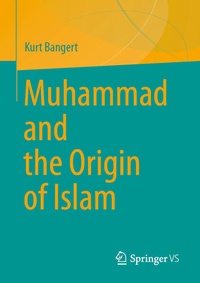
Muhammad and the Origin of Islam
Description

We understand a religion best if we know its origin. Unfortunately, the traditional narrative about the emergence of Islam is based upon sources most of which were written some 150 to 250 years after the events they claim to describe. From a modern historical-critical point of view such late sources only document what people believed at the time when these sources were written, but do not necessarily tell us what actually happened 150 to 250 years earlier. But are there no contemporary sources of the seventh century? In fact, there are! But these exist mostly in the form of official inscriptions such as those in the Dome of the Rock in Jerusalem. This book looks at such inscriptions and shows that they tell us a very different story of the origin of Islam, when compared to the traditional narrative. They seem to indicate that Muhammad was a construct that emerged at the end of the seventh century and whose biography was further developed in the following decades and centuries through questionable reports many of which were invented by different schools of jurisprudence. At the end of his book, the author offers an alternative narrative about the emergence of Islam that differs substantially from the traditional story but is in keeping with modern Orientalist research.
More details
Other editions
Additional editions
Person
Dr. theol. Kurt Bangert studied theology in Germany and the United States (B.A. and M.A.) and received his doctorate in systematic theology from the University of Marburg. For much of his professional life, he worked as an expert for development cooperation and public relations before returning to theology and becoming an author of 20 books and countless articles - on questions of theology, Islam, poverty, and children's rights. He is currently the editor of "Freies Christentum," a magazine for liberal theology.
Content
Chapter 1. The Traditional Narrative and its Embellishments.- Chapter 2. A Summary of Modern Historical Research.- Chapter 3. Hadith, Sira and Qur'an.- Chapter 4. Contemporary Evidence of the Seventh Century.- Chapter 5. The Inscriptions of the Dome of the Rock.- Chapter 6. The Meaning of the Word Muhammad .- Chapter 7. ?Abd al-Malik and the Origin of Islam.- Chapter 8. The Sunna and the Islamic Jurisprudence.- Chapter 9. Judaeo-Christian Roots of Islam.- Chapter 10. Alternative Narrative of the Origin of Islam.
