

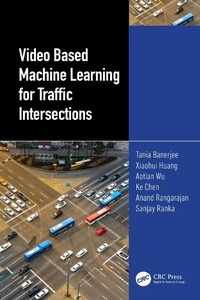
Video Based Machine Learning for Traffic Intersections
1st Edition
Published on 17. October 2023
194 pages
978-1-000-96977-1 (ISBN)
Description

Video Based Machine Learning for Traffic Intersections describes the development of computer vision and machine learning-based applications for Intelligent Transportation Systems (ITS) and the challenges encountered during their deployment. This book presents several novel approaches, including a two-stream convolutional network architecture for vehicle detection, tracking, and near-miss detection; an unsupervised approach to detect near-misses in fisheye intersection videos using a deep learning model combined with a camera calibration and spline-based mapping method; and algorithms that utilize video analysis and signal timing data to accurately detect and categorize events based on the phase and type of conflict in pedestrian-vehicle and vehicle-vehicle interactions.
The book makes use of a real-time trajectory prediction approach, combined with aligned Google Maps information, to estimate vehicle travel time across multiple intersections. Novel visualization software, designed by the authors to serve traffic practitioners, is used to analyze the efficiency and safety of intersections. The software offers two modes: a streaming mode and a historical mode, both of which are useful to traffic engineers who need to quickly analyze trajectories to better understand traffic behavior at an intersection.
Overall, this book presents a comprehensive overview of the application of computer vision and machine learning to solve transportation-related problems. Video Based Machine Learning for Traffic Intersections demonstrates how these techniques can be used to improve safety, efficiency, and traffic flow, as well as identify potential conflicts and issues before they occur. The range of novel approaches and techniques presented offers a glimpse of the exciting possibilities that lie ahead for ITS research and development.
Key Features:
Describes the development and challenges associated with Intelligent Transportation Systems (ITS)
Provides novel visualization software designed to serve traffic practitioners in analyzing the efficiency and safety of an intersection
Has the potential to proactively identify potential conflict situations and develop an early warning system for real-time vehicle-vehicle and pedestrian-vehicle conflicts
The book makes use of a real-time trajectory prediction approach, combined with aligned Google Maps information, to estimate vehicle travel time across multiple intersections. Novel visualization software, designed by the authors to serve traffic practitioners, is used to analyze the efficiency and safety of intersections. The software offers two modes: a streaming mode and a historical mode, both of which are useful to traffic engineers who need to quickly analyze trajectories to better understand traffic behavior at an intersection.
Overall, this book presents a comprehensive overview of the application of computer vision and machine learning to solve transportation-related problems. Video Based Machine Learning for Traffic Intersections demonstrates how these techniques can be used to improve safety, efficiency, and traffic flow, as well as identify potential conflicts and issues before they occur. The range of novel approaches and techniques presented offers a glimpse of the exciting possibilities that lie ahead for ITS research and development.
Key Features:
Describes the development and challenges associated with Intelligent Transportation Systems (ITS)
Provides novel visualization software designed to serve traffic practitioners in analyzing the efficiency and safety of an intersection
Has the potential to proactively identify potential conflict situations and develop an early warning system for real-time vehicle-vehicle and pedestrian-vehicle conflicts
More details
Edition
1. Auflage
Language
English
Place of publication
London
United Kingdom
Publishing group
Taylor & Francis Ltd
Target group
Professional and scholarly
Product notice
Reflowable
Illustrations
17 Tables, black and white; 25 Line drawings, color; 5 Line drawings, black and white; 75 Halftones, color; 100 Illustrations, color; 5 Illustrations, black and white
ISBN-13
978-1-000-96977-1 (9781000969771)
Copyright in bibliographic data and cover images is held by Nielsen Book Services Limited or by the publishers or by their respective licensors: all rights reserved.
Schweitzer Classification
Other editions
Additional editions
Tania Banerjee | Xiaohui Huang | Aotian Wu
Video Based Machine Learning for Traffic Intersections
Book
06/2025
1st Edition
CRC Press
€76.10
Shipment within 10-20 days
Tania Banerjee | Xiaohui Huang | Aotian Wu
Video Based Machine Learning for Traffic Intersections
Book
10/2023
1st Edition
CRC Press
€165.50
Shipment within 10-20 days
Persons
Tania Banerjee, PhD, is a research assistant scientist in Computer and Information Science and Engineering at the University of Florida. She earned her PhD in Computer Science from the University of Florida in 2012. She completed her MSc in Mathematics from the Indian Institute of Technology, Kharagpur. Her research interests are video analytics, intelligent transportation, data compression, and high performance computing.
Xiaohui Huang, PhD, earned her PhD in the Department of Computer & Information Science & Engineering, University of Florida, Gainesville, Florida, in December, 2020. Her research interests include machine learning, computer vision, and intelligent transportation systems.
Aotian Wu is currently a PhD student in the Department of Computer & Information Science & Engineering, University of Florida, Gainesville, Florida. Her research interests are machine learning, computer vision, and intelligent transportation systems.
Ke Chen is currently a PhD student in the Department of Computer & Information Science & Engineering, University of Florida, Gainesville, Florida. His research interests are machine learning, computer architecture, operating systems and algorithms, and data structures.
Anand Rangarajan, PhD, is a Professor, Department of CISE, University of Florida. His research interests are machine learning, computer vision, medical and hyperspectral imaging, and the science of consciousness.
Sanjay Ranka, PhD, is a Distinguished Professor in the Department of Computer Information Science and Engineering at University of Florida. His current research interests are high performance computing and big data science with a focus on applications in CFD, healthcare and transportation. He has co-authored four books and 290+ journal and refereed conference articles. He is a Fellow of the IEEE and AAAS. He is an Associate Editor-in-Chief of the Journal of Parallel and Distributed Computing and an Associate Editor for ACM Computing Surveys, Applied Sciences, Applied Intelligence, IEEE/ACM Transactions on Computational Biology and Bioinformatics.
Xiaohui Huang, PhD, earned her PhD in the Department of Computer & Information Science & Engineering, University of Florida, Gainesville, Florida, in December, 2020. Her research interests include machine learning, computer vision, and intelligent transportation systems.
Aotian Wu is currently a PhD student in the Department of Computer & Information Science & Engineering, University of Florida, Gainesville, Florida. Her research interests are machine learning, computer vision, and intelligent transportation systems.
Ke Chen is currently a PhD student in the Department of Computer & Information Science & Engineering, University of Florida, Gainesville, Florida. His research interests are machine learning, computer architecture, operating systems and algorithms, and data structures.
Anand Rangarajan, PhD, is a Professor, Department of CISE, University of Florida. His research interests are machine learning, computer vision, medical and hyperspectral imaging, and the science of consciousness.
Sanjay Ranka, PhD, is a Distinguished Professor in the Department of Computer Information Science and Engineering at University of Florida. His current research interests are high performance computing and big data science with a focus on applications in CFD, healthcare and transportation. He has co-authored four books and 290+ journal and refereed conference articles. He is a Fellow of the IEEE and AAAS. He is an Associate Editor-in-Chief of the Journal of Parallel and Distributed Computing and an Associate Editor for ACM Computing Surveys, Applied Sciences, Applied Intelligence, IEEE/ACM Transactions on Computational Biology and Bioinformatics.
Content
1. Introduction 2. Detection, Tracking, and Classification 3. Near-miss Detection 4. Severe Events 5. Performance-Safety Trade-offs 6. Trajectory Prediction 7. Vehicle Tracking across Multiple Intersections 8. User Interface 9. Conclusion
