

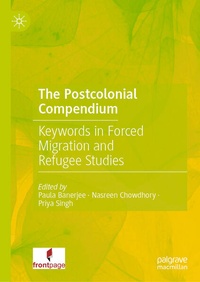
The Postcolonial Compendium
Description

The postcolonial compendium aims at a compilation and brief explication of key terms used in the multidisciplinary field of forced migration and refugee studies. There have been significant debates, contributions, and interpretations in recent years which have reshaped the way academia analyses and maps refugee and migration studies, at the same time, expanding its scope. Research on refugees and forced migrants has had a long history cutting across disciplines, exploring multiple dynamics such as forced and voluntary movements, displacement and dispossession, heterogeneity and agency of forced migrants, human rights, humanitarianism, protection, practice and policy. In addition, academics, policy makers and practitioners are still contending with the diverse challenges that remain in the aftermath of a global pandemic and continue to permeate the refugee and migrant space exacerbating the precarious state of public health, particularly in the global south with far reaching consequences.
At this critical juncture/crossroads, migrant and refugee studies as a field of enquiry is rapidly expanding and diversifying, concomitantly, its terminology is constantly evolving to keep pace with the burgeoning discipline, which found its moorings as a separate entity in the early 1980s. With the development of refugee and forced migration studies, academic research as well as advocacy in terms of the rights of migrants and refugees have acquired a global reach which in turn has induced the emergence of a rapidly growing literature focused on the same, including handbooks devoted to the study of refugees and forced migrants from an interdisciplinary perspective. In comparison, the vocabulary or terminology of refugee and forced migration studies, which has amplified by leaps and bounds in scope and importance, has not yet found a separate, focused and comprehensive compendium dedicated to itself. The Postcolonial Compendium: Keywords in Forced Migration and Refugee Studies intends to fill this lacuna/void.
More details
Other editions
Additional editions
Persons
Paula Banerjee, IDRC Endowed Chair on Gender and Forced Displacement, AIT, Bangkok
Nasreen Chowdhory, Associate Professor, University of Delhi, New Delhi
Priya Singh, Associate Director, Asia in Global Affairs, Kolkata
Content
Preface.- Acknowledgements.- Contributors.- Introduction.- Keywords.- References.- Glossary.
