

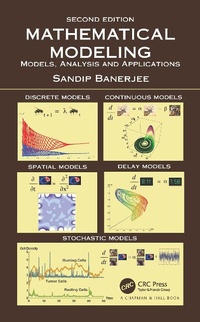
Mathematical Modeling
Models, Analysis and Applications
2nd Edition
Published on 5. December 2021
433 pages
978-1-351-02292-7 (ISBN)
Description

Mathematical Modeling: Models, Analysis and Applications, Second Edition introduces models of both discrete and continuous systems. This book is aimed at newcomers who desires to learn mathematical modeling, especially students taking a first course in the subject. Beginning with the step-by-step guidance of model formulation, this book equips the reader about modeling with difference equations (discrete models), ODE's, PDE's, delay and stochastic differential equations (continuous models). This book provides interdisciplinary and integrative overview of mathematical modeling, making it a complete textbook for a wide audience.
A unique feature of the book is the breadth of coverage of different examples on mathematical modelling, which include population models, economic models, arms race models, combat models, learning model, alcohol dynamics model, carbon dating, drug distribution models, mechanical oscillation models, epidemic models, tumor models, traffic flow models, crime flow models, spatial models, football team performance model, breathing model, two neuron system model, zombie model and model on love affairs. Common themes such as equilibrium points, stability, phase plane analysis, bifurcations, limit cycles, period doubling and chaos run through several chapters and their interpretations in the context of the model have been highlighted. In chapter 3, a section on estimation of system parameters with real life data for model validation has also been discussed.
Features
Covers discrete, continuous, spatial, delayed and stochastic models.
Over 250 illustrations, 300 examples and exercises with complete solutions.
Incorporates MATHEMATICA (R) and MATLAB (R), each chapter contains Mathematica and Matlab codes used to display numerical results (available at CRC website).
Separate sections for Projects. Several exercise problems can also be used for projects.
Presents real life examples of discrete and continuous scenarios.
The book is ideal for an introductory course for undergraduate and graduate students, engineers, applied mathematicians and researchers working in various areas of natural and applied sciences.
A unique feature of the book is the breadth of coverage of different examples on mathematical modelling, which include population models, economic models, arms race models, combat models, learning model, alcohol dynamics model, carbon dating, drug distribution models, mechanical oscillation models, epidemic models, tumor models, traffic flow models, crime flow models, spatial models, football team performance model, breathing model, two neuron system model, zombie model and model on love affairs. Common themes such as equilibrium points, stability, phase plane analysis, bifurcations, limit cycles, period doubling and chaos run through several chapters and their interpretations in the context of the model have been highlighted. In chapter 3, a section on estimation of system parameters with real life data for model validation has also been discussed.
Features
Covers discrete, continuous, spatial, delayed and stochastic models.
Over 250 illustrations, 300 examples and exercises with complete solutions.
Incorporates MATHEMATICA (R) and MATLAB (R), each chapter contains Mathematica and Matlab codes used to display numerical results (available at CRC website).
Separate sections for Projects. Several exercise problems can also be used for projects.
Presents real life examples of discrete and continuous scenarios.
The book is ideal for an introductory course for undergraduate and graduate students, engineers, applied mathematicians and researchers working in various areas of natural and applied sciences.
Reviews / Votes
Praise for the previous edition"...the book is rich with examples. There are examples from ecology, physics, chemistry, economy, medicine, sociology, epidemiology, and more, including specific examples that could be of interest in computer simulation ... there are many solved problems and exercises ... Both features makes the book a good selection for drawing out examples, problems, and exercises to show what differential equations have to offer to the aspiring modeler ..."
-Computing Reviews, October 2014
"...the reader may find quite a few interesting examples illustrating several important methods used in applied mathematics. ... it may be well used as a valuable source of interesting examples as well as complementary reading in a number of courses."
-Svitlana P. Rogovchenko, Zentralblatt MATH 1298
"...The book presents a wide range of methods for mathematical modeling of different problems and teaches how to formulate, solve, and interpret the results of various techniques mostly of differential equation kind, applied to numerous examples in many areas of science and technology, biology and medicine, economics and other fields of human needs and interests. In comparison with the first edition of 2014, the material is extended more than by a half, with new problems and approaches, exercises and projects. The book is organized in seven chapters, each divided to multiple sections and subsections. .......The book holds over 250 illustrations, and 300 examples and exercises help to understand the presented topics on applied mathematics in engineering and natural sciences. .... requires a knowledge in advance calculus at the level of ordinary and partial differential equations and their systems. ...... can be very much educational to graduate students and extremely useful to researchers who employ methods of mathematical modeling for solving their problems......"
-Stan Lipovetsky (2022), Technometrics, 64:4, 580-581
More details
Edition
2nd edition
Language
English
Place of publication
London
United Kingdom
Publishing group
Taylor & Francis Ltd
Target group
College/higher education
Product notice
Reflowable
Illustrations
122 Line drawings, black and white; 122 Illustrations, black and white
ISBN-13
978-1-351-02292-7 (9781351022927)
Copyright in bibliographic data and cover images is held by Nielsen Book Services Limited or by the publishers or by their respective licensors: all rights reserved.
Schweitzer Classification
Other editions
Additional editions
Book
12/2021
2nd Edition
CRC Press
€172.30
Shipment within 10-20 days
Previous edition
E-Book
01/2018
1st Edition
Chapman & Hall/CRC
€65.99
Available for download
Person
Sandip Banerjee is a Professor in the Department of Mathematics, Indian Institute of Technology Roorkee (IITR), India. His areas of research is Mathematical Biology. Mathematical modeling is his passion. Prof. Banerjee was the recipient of the Indo-US Fellowship in 2009 and he was awarded IUSSTF Research Fellow medal by the Indo-US Technology Forum. In addition to several national and international projects, Prof. Banerjee is involved in the Virtual Network in Mathematical Biology project, which promotes Mathematical Biology in India. He has also developed several courses like Differential Equations and Numerical Analysis for e-Pathshala and National Programme on Technology Enhanced Learning (NPTEL) projects, initiated by Ministry of Human Resource Development (MHDR) India.
Content
1. About Mathematical Modeling. 1.1. What is Mathematical Modeling? 1.2. History of Mathematical Modeling. 1.3. Importance of Mathematical Modeling. 1.4. Latest Developments in Mathematical Modeling. 1.5. Limitations of Mathematical Modeling. 1.6. Units. 1.7. Dimensions. 1.8. Dimensional Analysis. 1.9. Scaling. 1.10. How to built Mathematical Models. 1.11. Mathematical Models and Functions. 1.12. Functional Responses in Population Dynamics. 1.13. Miscellaneous Examples. 1.14. Exercises.
2. Discrete Models using Difference Equations. 2.1. Difference Equations. 2.2. Introduction to Discrete Models. 2.3. Linear Models. 2.4. Non-Linear Models. 2.5. Bifurcations in Discrete Models. 2.6. Chaos in Discrete Models. 2.7. Miscellaneous Examples. 2.8. Mathematica Codes. 2.9. Matlab Codes. 2.10. Exercises. 2.11. Projects.
3. Continuous Models using Ordinary Differential Equations. 3.1. Introduction to Continuous Models. 3.2. Steady State Solution. 3.3. Stability. 3.4. Phase Plane Diagrams of Linear Systems. 3.5. Continuous Models. 3.6. Bifurcations. 3.7. Estimation of Model Parameters. 3.8. Chaos in Continuous Models. 3.9. Miscellaneous Examples. 3.10. Mathematica Codes. 3.11. Matlab Codes. 3.12. Exercises. 3.13. Projects.
4. Spatial Models using Partial Differential Equations. 4.1. Introduction. 4.2. Heat Flow through a Small Thin Rod (One Dimensional). 4.3. Two dimensional Heat-equation (Diffusion equation). 4.4. Steady Heat Flow: Laplace equation. 4.5. Wave Equation. 4.6. Two dimensional Wave Equation. 4.7. Fluid Flow through a Porous Medium. 4.8. Traffic Flow. 4.9. Crime Model. 4.10. Reaction Diffusion Systems. 4.11. Mathematica Codes. 4.12. Matlab Codes. 4.13. Miscellaneous Examples. 4.14. Exercises. 4.15. Project.
5. Modeling with Delay Differential Equations. 5.1. Introduction. 5.2. Linear Stability Analysis. 5.3. Different Models with Delay Differential Equations. 5.4. Immunotherapy with Interleukin-2, a study based on Mathematical Modeling. 5.5. Miscellaneous Examples. 5.6. Mathematica Codes. 5.7. Matlab Codes. 5.8. Exercises. 5.9. Project.
6. Modeling with Stochastic Differential Equations. 6.1. Introduction. 6.2. Stochastic Models. 6.3. Research Problem: Cancer Self-Remission and Tumor Stability - a stochastic approach. 6.4. Mathematica Codes. 6.5. Matlab Codes. 6.6. Exercises.
7. Hints and Solutions.
Bibliography.
Index.
2. Discrete Models using Difference Equations. 2.1. Difference Equations. 2.2. Introduction to Discrete Models. 2.3. Linear Models. 2.4. Non-Linear Models. 2.5. Bifurcations in Discrete Models. 2.6. Chaos in Discrete Models. 2.7. Miscellaneous Examples. 2.8. Mathematica Codes. 2.9. Matlab Codes. 2.10. Exercises. 2.11. Projects.
3. Continuous Models using Ordinary Differential Equations. 3.1. Introduction to Continuous Models. 3.2. Steady State Solution. 3.3. Stability. 3.4. Phase Plane Diagrams of Linear Systems. 3.5. Continuous Models. 3.6. Bifurcations. 3.7. Estimation of Model Parameters. 3.8. Chaos in Continuous Models. 3.9. Miscellaneous Examples. 3.10. Mathematica Codes. 3.11. Matlab Codes. 3.12. Exercises. 3.13. Projects.
4. Spatial Models using Partial Differential Equations. 4.1. Introduction. 4.2. Heat Flow through a Small Thin Rod (One Dimensional). 4.3. Two dimensional Heat-equation (Diffusion equation). 4.4. Steady Heat Flow: Laplace equation. 4.5. Wave Equation. 4.6. Two dimensional Wave Equation. 4.7. Fluid Flow through a Porous Medium. 4.8. Traffic Flow. 4.9. Crime Model. 4.10. Reaction Diffusion Systems. 4.11. Mathematica Codes. 4.12. Matlab Codes. 4.13. Miscellaneous Examples. 4.14. Exercises. 4.15. Project.
5. Modeling with Delay Differential Equations. 5.1. Introduction. 5.2. Linear Stability Analysis. 5.3. Different Models with Delay Differential Equations. 5.4. Immunotherapy with Interleukin-2, a study based on Mathematical Modeling. 5.5. Miscellaneous Examples. 5.6. Mathematica Codes. 5.7. Matlab Codes. 5.8. Exercises. 5.9. Project.
6. Modeling with Stochastic Differential Equations. 6.1. Introduction. 6.2. Stochastic Models. 6.3. Research Problem: Cancer Self-Remission and Tumor Stability - a stochastic approach. 6.4. Mathematica Codes. 6.5. Matlab Codes. 6.6. Exercises.
7. Hints and Solutions.
Bibliography.
Index.
