

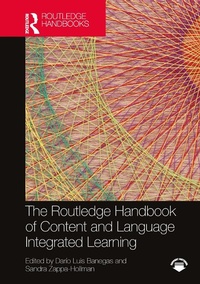
The Routledge Handbook of Content and Language Integrated Learning
1st Edition
Published on 3. July 2023
568 pages
978-1-000-87293-4 (ISBN)
Description

Content and language integrated learning (CLIL) is an increasingly popular educational approach given its dual focus on enabling learners to acquire subject-matter through an additional language, while learning this second language in tandem with content. This Handbook provides a comprehensive overview of recent CLIL developments, illustrating how CLIL has been uniquely conceptualised and practised across educational and geographical contexts.
Divided into six sections, covering language and language teaching, core topics and issues, contexts and learners, CLIL in practice, CLIL around the world, and a final section looking forward to future research directions, every chapter provides a balanced discussion of the benefits, challenges and implications of this approach. Representing the same diversity and intercultural understanding that CLIL features, the chapters are authored by established as well as early-career academics based around the world.
The Routledge Handbook of Content and Language Integrated Learning is the essential guide to CLIL for advanced students and researchers of applied linguistics, education and TESOL.
Divided into six sections, covering language and language teaching, core topics and issues, contexts and learners, CLIL in practice, CLIL around the world, and a final section looking forward to future research directions, every chapter provides a balanced discussion of the benefits, challenges and implications of this approach. Representing the same diversity and intercultural understanding that CLIL features, the chapters are authored by established as well as early-career academics based around the world.
The Routledge Handbook of Content and Language Integrated Learning is the essential guide to CLIL for advanced students and researchers of applied linguistics, education and TESOL.
Reviews / Votes
Capturing the multifaceted nature of CLIL, this Handbook spans levels of education and linguistic, geographical and socio-political contexts. It is a timely synthesis of CLIL research and practice, with perceptive insights for future development. This comprehensive handbook will be a valuable resource for CLIL researchers and teachers alike.-- Tarja Nikula, University of Jyvaeskylae, Finland
With its impressive range of topics covered by leading scholars in CLIL, this Handbook will be a crucial and valuable source of relevant knowledge and cutting-edge thinking, and a treasured resource for students, researchers, teacher educators and last, but far from least, teachers engaged in bilingual education.
-- Ute Smit, University of Vienna, Austria
More details
Series
Edition
1. Auflage
Language
English
Place of publication
London
United Kingdom
Publishing group
Taylor & Francis Ltd
Target group
College/higher education
Product notice
Reflowable
Illustrations
190 Tables, black and white; 10 Line drawings, black and white; 3 Halftones, black and white; 13 Illustrations, black and white
ISBN-13
978-1-000-87293-4 (9781000872934)
Copyright in bibliographic data and cover images is held by Nielsen Book Services Limited or by the publishers or by their respective licensors: all rights reserved.
Schweitzer Classification
Other editions
Additional editions
Dario Luis Banegas | Sandra Zappa-Hollman
The Routledge Handbook of Content and Language Integrated Learning
Book
05/2025
1st Edition
Routledge
€75.70
Shipment within 10-20 days
Dario Luis Banegas | Sandra Zappa-Hollman
The Routledge Handbook of Content and Language Integrated Learning
Book
07/2023
1st Edition
Routledge
€315.00
Shipment within 10-20 days
Persons
Dario Luis Banegas is Lecturer in Language Education at the University of Edinburgh. He is involved in teacher associations in Latin America and Europe. He is a fellow of the Higher Education Academy and an associate fellow with the University of Warwick. His main research and teaching interests are CLIL, action research, social justice, and initial language teacher education. He has edited volumes with Bloomsbury, Multilingual Matters, and Palgrave on different aspects of language education.
Sandra Zappa-Hollman is Associate Professor in the Faculty of Education at the University of British Columbia, Canada, and Director of Academic English at UBC's Vantage College. Her research examines processes of language and literacy socialisation of multilingual English language post-secondary students, including the perspectives of faculty members working with diverse student populations. Her work also aims to shed light on questions and issues concerning curricular and pedagogical approaches that support culturally and linguistically responsive teaching.
Consulting Editor: Graham Hall
Sandra Zappa-Hollman is Associate Professor in the Faculty of Education at the University of British Columbia, Canada, and Director of Academic English at UBC's Vantage College. Her research examines processes of language and literacy socialisation of multilingual English language post-secondary students, including the perspectives of faculty members working with diverse student populations. Her work also aims to shed light on questions and issues concerning curricular and pedagogical approaches that support culturally and linguistically responsive teaching.
Consulting Editor: Graham Hall
Content
List of figures
List of tables
List of contributors
Acknowledgments
Introduction
Dario Luis Banegas and Sandra Zappa-Hollman
PART 1
Language and language teaching in CLIL
1 CLIL and linguistics
Ana Llinares
2 Translanguaging in CLIL
Pat Moore
3 CLIL and language teaching approaches
Raul Albuquerque Parana, Savio Siqueira and Julia Landau
4 CLIL and English for specific purposes
Gabriela Tavella and Soledad Loutayf
5 CLIL and English-medium instruction
Joyce Kling and Slobodanka Dimova
6 Epistemological and methodological trends in CLIL research
Jose Goris
PART 2
Core topics and issues
7 CLIL and educational policy
Yolanda Ruiz de Zarobe
8 L2 proficiency and development in CLIL
Christiane Dalton-Puffer and Silvia Bauer-Marschallinger
9 Cognitive development in CLIL
Alberto Fernandez-Costales
10 Intercultural citizenship as CLIL in foreign language education
Melina Porto
11 CLIL and professional development
Limin Yuan and Yuen Yi Lo
12 Collaboration between CLIL teachers
Josephine Moate
PART 3
Contexts and learners
13 CLIL with heritage languages
Joanna McPake
14 CLIL with languages other than English
Kim Bower
15 Doing CLIL with primary learners: From principles to practice
Fabiana Fazzi and Marcella Menegale
16 CLIL with secondary school learners
Veronico N. Tarrayo and Philippe Jose S. Hernandez
PART 4
CLIL in practice
17 Teachers' perceptions, beliefs, and attitudes on CLIL
Jermaine S. McDougald
18 The learner's perspective on CLIL: Attitudes, motivations, and perceptions
Xabier San Isidro and Maria Luisa Perez Canado
19 Instructional scaffolding in CLIL: An overview of theory and research
Karina Rose Mahan
20 Classroom interaction in CLIL
Dongying Li
21 CLIL challenges in designing learning experiences
Liz Dale and Tessa Mearns
22 CLIL materials: From theory to practice
Laura Karabassova and Nurziya Oralbayeva
23 Corrective feedback in CLIL
Ruth Milla and Pilar Garcia Mayo
24 Assessment in CLIL
Takanori Sato
PART 5
CLIL around the world
25 CLIL in various forms around the world
Liss Kerstin Sylven and Keiko Tsuchiya
26 CLIL in the Nordic countries
Sotiria Varis and Anssi Roiha
27 CLIL in The Netherlands: Three decades and innovation and development
Tessa Mearns, Evelyn van Kampen, and Wilfried Admiraal
28 CLIL in Italy
Jacqueline Aiello and Emilia Di Martino
29 CLIL in Ecuador
Juanita Argudo, Tammy Fajardo-Dack, and Monica Abad
30 CLIL in Colombia
Kathleen A. Corrales and Paige M. Poole
31 The CLIL experience in Cameroon
Innocent Mbouya Fasse and Alain Flaubert Takam
32 Current practice and research of CLIL in Japan
Chantal Hemmi
33 CLIL in Taiwan
Wenhsien Yang
PART 6
Looking forward
34 CLIL: Critical perspectives
Bong-gi Sohn
35 CLIL: Future directions
Tom Morton
36 Coda: Carpe diem
Do Coyle
Index
List of tables
List of contributors
Acknowledgments
Introduction
Dario Luis Banegas and Sandra Zappa-Hollman
PART 1
Language and language teaching in CLIL
1 CLIL and linguistics
Ana Llinares
2 Translanguaging in CLIL
Pat Moore
3 CLIL and language teaching approaches
Raul Albuquerque Parana, Savio Siqueira and Julia Landau
4 CLIL and English for specific purposes
Gabriela Tavella and Soledad Loutayf
5 CLIL and English-medium instruction
Joyce Kling and Slobodanka Dimova
6 Epistemological and methodological trends in CLIL research
Jose Goris
PART 2
Core topics and issues
7 CLIL and educational policy
Yolanda Ruiz de Zarobe
8 L2 proficiency and development in CLIL
Christiane Dalton-Puffer and Silvia Bauer-Marschallinger
9 Cognitive development in CLIL
Alberto Fernandez-Costales
10 Intercultural citizenship as CLIL in foreign language education
Melina Porto
11 CLIL and professional development
Limin Yuan and Yuen Yi Lo
12 Collaboration between CLIL teachers
Josephine Moate
PART 3
Contexts and learners
13 CLIL with heritage languages
Joanna McPake
14 CLIL with languages other than English
Kim Bower
15 Doing CLIL with primary learners: From principles to practice
Fabiana Fazzi and Marcella Menegale
16 CLIL with secondary school learners
Veronico N. Tarrayo and Philippe Jose S. Hernandez
PART 4
CLIL in practice
17 Teachers' perceptions, beliefs, and attitudes on CLIL
Jermaine S. McDougald
18 The learner's perspective on CLIL: Attitudes, motivations, and perceptions
Xabier San Isidro and Maria Luisa Perez Canado
19 Instructional scaffolding in CLIL: An overview of theory and research
Karina Rose Mahan
20 Classroom interaction in CLIL
Dongying Li
21 CLIL challenges in designing learning experiences
Liz Dale and Tessa Mearns
22 CLIL materials: From theory to practice
Laura Karabassova and Nurziya Oralbayeva
23 Corrective feedback in CLIL
Ruth Milla and Pilar Garcia Mayo
24 Assessment in CLIL
Takanori Sato
PART 5
CLIL around the world
25 CLIL in various forms around the world
Liss Kerstin Sylven and Keiko Tsuchiya
26 CLIL in the Nordic countries
Sotiria Varis and Anssi Roiha
27 CLIL in The Netherlands: Three decades and innovation and development
Tessa Mearns, Evelyn van Kampen, and Wilfried Admiraal
28 CLIL in Italy
Jacqueline Aiello and Emilia Di Martino
29 CLIL in Ecuador
Juanita Argudo, Tammy Fajardo-Dack, and Monica Abad
30 CLIL in Colombia
Kathleen A. Corrales and Paige M. Poole
31 The CLIL experience in Cameroon
Innocent Mbouya Fasse and Alain Flaubert Takam
32 Current practice and research of CLIL in Japan
Chantal Hemmi
33 CLIL in Taiwan
Wenhsien Yang
PART 6
Looking forward
34 CLIL: Critical perspectives
Bong-gi Sohn
35 CLIL: Future directions
Tom Morton
36 Coda: Carpe diem
Do Coyle
Index
