

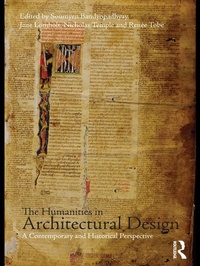
The Humanities in Architectural Design
A Contemporary and Historical Perspective
Published on 25. February 2010
288 pages
978-1-134-99964-4 (ISBN)
Description

Offering an in-depth consideration of the impact which humanities have had on the processes of architecture and design, this book asks how we can restore the traditional dialogue between intellectual enquiry in the humanities and design creativity.
Written by leading academics in the fields of history, theory and philosophy of design, these essays draw profound meanings from cultural practices and beliefs. These are as diverse as the designs they inspire and include religious, mythic, poetic, political, and philosophical references.
This timely and important book is not a benign reflection on humanities' role in architectural design but a direct response to the increased marginalization of humanities in a technology driven world. The prioritization of technology leaves critical questions unanswered about the relationships between information and knowledge, transcription and translation, and how emerging technologies can usefully contribute to a deeper understanding of our design culture.
Written by leading academics in the fields of history, theory and philosophy of design, these essays draw profound meanings from cultural practices and beliefs. These are as diverse as the designs they inspire and include religious, mythic, poetic, political, and philosophical references.
This timely and important book is not a benign reflection on humanities' role in architectural design but a direct response to the increased marginalization of humanities in a technology driven world. The prioritization of technology leaves critical questions unanswered about the relationships between information and knowledge, transcription and translation, and how emerging technologies can usefully contribute to a deeper understanding of our design culture.
Reviews / Votes
"The essays in this volume provide a thoughtful consideration of a body of knowledge too often lacking in the curricular framework of architecture's accredited professional degree programs. And they remind us that humanist traditions can ascribe meaning to technical knowledge, thereby enriching the collective creative dialogue."- Journal of Architectural EducationMore details
Language
English
Place of publication
London
United Kingdom
Publishing group
Taylor & Francis Ltd
Target group
College/higher education
Illustrations
54 s/w Photographien bzw. Rasterbilder, 2 s/w Zeichnungen
2 Line drawings, black and white; 54 Halftones, black and white
File size
5,52 MB
ISBN-13
978-1-134-99964-4 (9781134999644)
Copyright in bibliographic data and cover images is held by Nielsen Book Services Limited or by the publishers or by their respective licensors: all rights reserved.
Schweitzer Classification
Other editions
Additional editions
Soumyen Bandyopadhyay | Jane Lomholt | Nicholas Temple
The Humanities in Architectural Design
A Contemporary and Historical Perspective
Book
02/2010
1st Edition
Routledge
€262.40
Shipment within 15-20 days
Soumyen Bandyopadhyay | Jane Lomholt | Nicholas Temple
The Humanities in Architectural Design
A Contemporary and Historical Perspective
Book
02/2010
1st Edition
Routledge
€69.70
Shipment within 15-20 days
Persons
Soumyen Bandyopadhyay is Professor of Architecture and Design at Nottingham Trent University and has previously taught at Liverpool University.
Jane Lomholt is a Senior Lecturer in Architecture at the University of Lincoln where she is head of History and Theory.
Nicholas Temple is Professor of Architecture at the University of Lincoln, having previously taught at the University of Liverpool, the University of Pennsylvania and Nottingham University.
Renee Tobe is Architecture Field Leader at the University of East London.
Jane Lomholt is a Senior Lecturer in Architecture at the University of Lincoln where she is head of History and Theory.
Nicholas Temple is Professor of Architecture at the University of Lincoln, having previously taught at the University of Liverpool, the University of Pennsylvania and Nottingham University.
Renee Tobe is Architecture Field Leader at the University of East London.
Content
Introduction Part 1: Freedom in the Shadow of Uncertainty 1. The Responsibility of Design 2. Inhumanities: Ethics in Architectural Praxis 3. Cultivating Architects: The Humanities in Architectural Education 4. The Architect as Humanist 5. Migration, Emancipation and Architecture Part 2: Spectre of Technology 6. Fantasies of the End of Technology 7. Le Corbusier and the Modern Modality of Representation 8. Humanist Machines: Daniel Libeskind's "Three Lessons of Architecture" 9. Draw Like a Builder: Build Like a Writer 10. The Word Made Flesh: In the Name of the Surveyor, the Nomad, and the Lunatic Part 3: Measures of Awareness 11. Creative Inspirations or Intellectual Impasses? 12. Leon Battista Alberti and Lineamentis 13. Renaissance Visual Thinking: Architectural Representation as a Medium of True Form 14. Neoplatonism at the Accademia di San Luca in Rome 15. Who's on First? Part 4: The Challenges of Instrumental Knowledge 16. Architcture as a Humanistic Discipline 17. Communicating Vessels: Andre Breton and his Atelier in Paris 18. L'histoire assassinee: Manfredo Tafuri 19. Nature Choreographed 20. Birth of Modernity out of the Spirit of Music
