

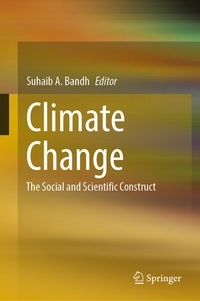
Climate Change
Description

Beginning in the second half of the twentieth century, the impacts of climate change have been fierce, causing loss of human life and irreparable destruction to natural and man-made infrastructure in many parts of the world.
The difference between climate change now and in the past is that of sudden and disproportionate disruption of the natural energy dynamics by the changing consumption patterns of billions of human beings who have polluted terrestrial and aquatic ecosystems. The picture that emerges from the exhaustive analysis of international data drawn from the most reliable sources indicates that we have possibly gained access to the gateway of extinction and it is time that we take corrective steps immediately.
Global climate change is further altering our relationship with the environment, modifying relatively stable climatic factors and making them uncertain, unpredictable, and threatening. Changes in land use and an increasing demand for water resources due toclimate change have affected the capacity of ecosystems to sustain food production, ensure the supply of freshwater resources, provide ecosystem services, and promote rural multi-functionality. Ensuring food production does not just depend on increasing water efficiency, promoting climate resilient crop production, or reducing land-use competition for urbanization but also on a more suitable and stable climate as the changes in climatic factors like precipitation, temperature, radiation, evaporation, and wind bring about some major shifts in global food supplies.
According to Special Report on Emission Scenarios (SRES), focused on greenhouse gas emissions projections, and Representative Concentration Pathways (RCPs) conducted by the Intergovernmental Panel on Climate Change (IPCC), climate change increases the risk of simultaneous crop failures (including corn, rice, legumes, and vegetables) if irrigation systems are not fully adapted to water stress situations. A changing climate could have many adverse impacts on other sectors of our environment.
This book offers concrete, up-to-date, and appropriate study cum research material for students, researchers, academicians and policymakers. It will be of a greater interest to students and researchers in the field of environmental science, agriculture science, agronomy, and sustainable development.
More details
Other editions
Additional editions
Person
Content
