

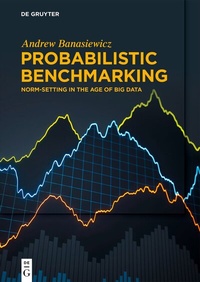
Probabilistic Benchmarking
Description

What is a 'good' outcome? In relation to others, and in relation to the past? Commonly associated with the ideas of benchmarking and baselining, comparative assessment is an important part of organizational management, but this broadly defined undertaking lacks clear conceptual framing and methodological foundations. At the same time, the readily available transactional data make robust tracking and measurement possible at an unprecedented scale, but also accentuate the impact of assessment paradox: To be truly meaningful, exact magnitudes-expressed values often need to be 'translated' into qualitative, assessment-laden categories, but that task is impeded by lack of established approaches for doing so.
Inspired by these observations, Probabilistic Benchmarking frames the notions of benchmarking and baselining as two complementary but distinct mechanisms of comparative assessment that make use of informational contents of organizational data to contribute unbiased, systematic, and consistent evaluation of outcomes or states of interest. In that general context, this book provides much-needed conceptual and methodological clarity to guide construction and use of benchmarks and baselines, and re-casts the idea of assessment standards in the context of data-derived estimates, to better align the practice of comparative assessment with the emerging realities of the Age of Data.
This pioneering research-based but application-minded book bridges the gap between theory and practice. It will greatly benefit professionals, business students and others interested in the broad domain of organizational assessment.
More details
Other editions
Additional editions
Person
Andrew Banasiewicz is the founder of Erudite Analytics, a consultancy specializing in executive risk exposure estimation. He is a career business analytics practitioner and academician with extensive experience in the development of data-driven decision support systems, having spent nearly 20 years in corporate roles and about 15 years as a full-time university professor. Andrew is the author of seven other books, and his most recent publications - Data Analytic Literacy (2023), Organizational Learning in the Age of Data (2021), and Evidence-Based Decision-Making (2019) - have been focused on different facets of instituting data-driven decision-making practices, a topic he frequently speaks on at conferences around the globe. He holds a Ph.D. in business from Louisiana State University and lives in Bristol, Rhode Island.
