

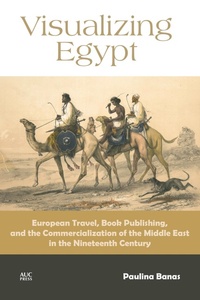
Visualizing Egypt
Description

Illustrated publications and the role of market forces in shaping representations of Egypt at a time when European colonial interests in the region were at their peak, with 80 color and black and white illustrations
In the nineteenth century, following Napoleon Bonaparte's 1798 campaign in Egypt, new possibilities of travel and improvements in printing technology saw an emergence of publishing ventures in France and Britain dedicated to the production of albums and travel accounts featuring images of Muslim Egypt and Islamic architecture and catering to a growing European fascination with the East.
Visualizing Egypt analyzes the context and process of production of these highly illustrated publications, from their conceptualization to the finished product and its afterlife, from marketing to the sales of these books, and from circulation to their reception by nineteenth-century audiences. By tracing the long, arduous, and often risky publishing journeys of the makers of these books, including publishers, writers, and artists, such as the Frenchman Émile Prisse d'Avennes, Paulina Banas reveals a complex terrain of changing market demands, collaborations, and conflicting views, and the unsettled authorship of these works, prompting us to think more profoundly about artistic and intellectual exchange in the world of nineteenth-century Orientalist book production.
Visualizing Egypt considers nineteenth-century book illustrations on Egypt and the "Orient" not merely as expressions of enduring ideology and colonial propaganda, but as representations shaped by the often-overlooked commercial exigencies of the growing publishing industry and the reckless competition within it.
More details
Other editions
Additional editions
Person
Content
List of Figures
List of Plates
List of Abbreviations
Acknowledgments
Introduction: Making it "Real": Illustrated Books on Egypt as Sites for Knowledge Production, Commercial Mediation, and Technological Investigation
Part 1: From the late 1830s to the 1850s
1. Making it "Modern": The Publisher's Perspective and the Marketing of the Nile Valley
2. Observing, Recording, and Building the Archive: The Author's Perspective
3. Creating Cultural Tropes: The Publishers, the Authors, and the Politics of Circulation of Visual Sources
4. Recasting Stereotypes? Multivocal Reading through the Artist, Writer, and Audience's Perspective
Part 2: The 1860s and 1870s
5. Conflicting Viewpoints and New Visualization Strategies: The Audience, Publisher(s), Author(s), and the Printmakers
6. The Authors, the Uneven Politics of Citation and Collaboration, and the Reuse of Commercial Photographs
Epilogue: The Venture of Orientalist Publishing
Notes
Bibliography
Index
