

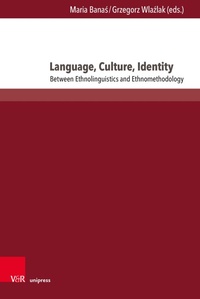
Language, Culture, Identity
Between Ethnolinguistics and Ethnomethodology
1st Edition
Published on 15. May 2023
196 pages
978-3-8470-1574-1 (ISBN)
Description

The contributions gathered in this volume attempt to take varied perspectives on current state of art within the field of linguistics, sociolinguistics and ethnolinguistics. This vast interpretative perspective stretches from the modern European and American conceptualisations of the societal identity, through the extralinguistic reality hidden behind the language expressions and phraseology in order to complete this image with the insightful presentation of various linguistic diasporas. Sociopragmatic and ethnolinguistic considerations accomplish this attempt to represent the leading themes of modern linguistic studies. Diverse methodological and empirical perspectives are employed in the present volume - from socio- and ethnolinguistic issues through (inter)cultural and communication studies to good practices in translatology.
Maria Bana?, PhD in social science, is an assistant professor at the Division of Applied Linguistics in the Silesian University of Technology in Gliwice, Poland. Her research interests include everyday life sociology, symbolic interactionism, and conversation analysis.
Maria Bana?, PhD in social science, is an assistant professor at the Division of Applied Linguistics in the Silesian University of Technology in Gliwice, Poland. Her research interests include everyday life sociology, symbolic interactionism, and conversation analysis.
More details
Other editions
Additional editions
Maria Banas | Grzegorz Wlazlak
Language, Culture, Identity
Between Ethnolinguistics and Ethnomethodology
Book
05/2023
1st Edition
Brill Deutschland
€45.00
Shipment within 7-9 days
Persons
Maria Banas, PhD in social science, is an assistant professor at the Division of Applied Linguistics in the Silesian University of Technology in Gliwice, Poland. Her research interests include everyday life sociology, symbolic interactionism, and conversation analysis.
Content
- Intro
- Title Page
- Copyright
- Table of Contents
- Body
- Acknowledgements
- Introduction
- References
- List of common abbreviations
- Maria Banas / Grzegorz Wlazlak: Chapter 1 - Preliminary considerations and state of art
- 1. Identity: literature overview
- 2. Ethnolinguistics / ethnopragmatics, ethnometodology
- References
- Tomasz Burzynski: Chapter 2 - The dialogicality of identity. The self as a theatrical performance
- 1. Introduction
- 2. Social Situatedness, Textuality, and Dialogicality
- 3. Self-Identity as a Theatrical Performance
- 4. Texts, Discourses, Languages
- 5. The Stage
- 6. Actors and the Audience
- 7. Conclusions
- References
- Iwona Dronia / Pawel Zakrajewski: Chapter 3 - Maintaining respectful (?) communication by Generation Z students. The case of written discourse in the academic settings
- 1. Defining respectful communication
- 2. Respectful communication in the academic context
- 3. The development of pragmatic competence vs. the ability to produce polite e-mails
- 4. The study
- 4.1 Context of the study
- 4.2 Objectives of the study
- 4.3 The objects and subjects of the study
- 4.4 The relation between the senders and receivers of the messages
- 5. The analysis - results
- 5.1 The (mis)?use of English honorifics, academic and professional titles
- 5.2 Greeting formulae
- 5.3 Terminating formulae
- 5.4 FTA - high level of imposition
- 5.5 Vague language
- 5.6 Overpoliteness / "super standard English"
- 5.7 Lack of proper development
- 5.8 Using capital letters / exclamation marks to increase the sense of emergency
- Conclusions and Summary
- References
- Malgorzata Godlewska: Chapter 4 - Cultural conceptualization of humour in audiovisual translation: subtitling the American series Big Little Lies
- 1. Introduction
- 2. Theoretical background
- 2.1 Cultural imagery and cultural conceptualisations
- a. Audio-visual translation framework
- b. Jeroene Vandaele's theory of humour
- 3. Methodology
- 4. The analysis of representative "units of conversation" from the series Big Little Lies
- a. Unit of conversation 1 - register clash and witticism
- b. Unit of conversation 2 - register clashes
- c. Unit of conversation 3 - register clash and putdown
- d. Unit of conversation 4 - register clash and tease
- e. Unit of conversation 5 - register clash and retorts
- 5. Conclusions
- References
- Online sources
- Agnieszka Gwiazdowska: Chapter 5 - "Tell me what phraseology you use, and I'll tell you who you are." Some remarks concerning the diatopic variation and cultural diversity of the Spanish language
- 1. Language as a tool for interpreting reality and an element of national identity
- 2. The concept of phraseological variation
- 3. Diversity in unity
- 4. Conclusions
- References
- Dictionaries
- Marcin Kuczok: Chapter 6 - The semantics of bodily fluids in Biblical Hebrew and contemporary English: A contrastive study from the cognitive-linguistic perspective
- 1. Introduction
- 2. Bodily fluids in culture and language
- 3. Blood - ?????? (dam)
- 4. Milk - ??????? (chalab)
- 5. Seed (semen) - ??????? (zera)
- 6. Bile - ??????? (marar) and vomit - ????? (qe)
- 7. Tears - ?????????? (dimah) and sweat - ??????? (zeah)
- 8. Saliva - ?????? (rir)
- 9. Urine - ???????? (shayin)
- 10. Conclusion
- References
- Hadrian Lankiewicz: Chapter 7 - Found in hybridity: Translingual practices of a plurilingual in the context of linguistic identity
- 1. Introduction
- 2. Translingual practices
- 3. Linguistic identity
- 4. Case study
- 5. Methodology
- 6. Objectives
- 7. Respondent's profile
- 8. The ecology of linguistic repertoires in Barbara's accounts
- 9. Translanguaging vs. linguistic identity
- 10. Conclusions
- References
- Appendices
- The narrative task
- Semi-structured interview
- Rafal Krzysztof Matusiak: Chapter 8 - Linguistic and cultural identity of the Ukrainian diaspora in Poland
- 1. Linguistic and legal status of Ukrainian and Russian in Ukraine
- 2. Linguistic identity of Ukrainians and their acculturation
- 3. Goals and research questions
- 4. Research method and participants
- 5. Results
- 6. Conclusions
- 7. References
- Appendix
- Anna Szkonter-Bochniak / Joanna Warmuzinska-Rogóz: Chapter 9 - Does the reader really have to understand everything? The role and scope of paratexts in the translation of cultural elements on the example of the Polish translation of Made in Mauritius by Amal Sewtohul
- 1. Introduction
- 2. Frankofonia Literaria series
- 3. Made in Mauritius at the crossroads of cultures
- 4. Footnotes - a translator's failure?
- 5. Specificity of footnotes in Made in Mauritius
- 6. Toponyms and proper names
- 7. Cultural elements
- 8. Third language?(s)
- 9. Mauritianisms
- 10. Afterword as a specific translation paratext
- 11. The role of the afterword in Made in Mauritius
- 12. Does the reader really have to understand everything? In lieu of a summary
- References
- Mikolaj Wozniak: Chapter 10 - Intercultural competence in business: on the use of tools of bridging cultural gaps on the example of Polish managers working with Chinese teams
- Introduction
- 1. Setting the scene
- 1.1 Definitions
- 1.2 Literature review
- 2. The interview
- 2.1 Structure
- 2.2 Findings
- 3. Analysis
- 3.1 Intercultural competence
- 3.2 Cultural dimensions
- 4. Conclusions
- References
- Appendix 1: Interview Questions
- Notes on Contributors
