

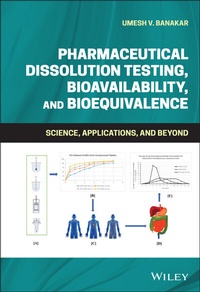
Pharmaceutical Dissolution Testing, Bioavailability, and Bioequivalence
Description

In Pharmaceutical Dissolution Testing, Bioavailability, and Bioequivalence: Science, Applications, and Beyond, distinguished pharmaceutical advisor and consultant Dr. Umesh Banakar delivers a comprehensive and up-to-date reference covering the established and emerging roles of dissolution testing in pharmaceutical drug development.
After discussing the fundamentals of the subject, the included resources go on to explore common testing practices and methods, along with their associated challenges and issues, in the drug development life cycle.
Over 19 chapters and 1100 references allow practicing scientists to fully understand the role of dissolution, apart from mere quality control. Readers will discover a wide range of topics, including automation, generic and biosimilar drug development, patents, and clinical safety.
This volume offers a one-stop resource for information otherwise scattered amongst several different regulatory regimes. It also includes:
* A thorough introduction to the fundamentals and essential applications of pharmaceutical dissolution testing
* Comprehensive explorations of the foundations and drug development applications of bioavailability and bioequivalence
* Practical discussions about solubility, dissolution, permeability, and classification systems in drug development
* In-depth examinations of the mechanics of dissolution, including mathematical models and simulations
* An elaborate assessment of biophysiologically relevant dissolution testing and IVIVCs, and their unique applications
* A complete understanding of the methods, requirements, and global regulatory expectations pertaining to dissolution testing of generic drug products
Ideal for drug product development and formulation scientists, quality control and assurance professionals, and regulators, Pharmaceutical Dissolution Testing, Bioavailability, and Bioequivalence is also the perfect resource for intellectual property assessors.
More details
Other editions
Additional editions
Person
Umesh V. Banakar, PhD, is an independent consultant and advisor to the pharmaceutical industry and academia. He's made extensive contributions to drug product development, evaluation (both in vitro and clinical), and regulatory affairs. He is the founding Board Member and Principal Scientific Adviser of the Society for Pharmaceutical Dissolution Science [SPDS] and Founding Chairperson of two International Contract Research Organizations. Dr. Banakar is the Founder of Goa - Center for Excellence in Intellectual Property [G-CEIP] in Panaji, Goa, India. He has served as a worldwide testifying/non-testifying expert in over 65 patent litigations in the disciplines of pharmaceutical formulations/technology, clinical investigations, and dissolution testing. Dr. Banakar has received numerous awards for excellence in teaching, research, and scholarly activity along with two Service to Country Awards from the United Nations and a nomination for the distinguished Fulbright Scholar Award for Teaching.
Content
Foreword xvii
Foreword xix
Preface xxi
Acknowledgments xxvii
1 Pharmaceutical Dissolution Testing: Fundamentals and Essential Applications (An Overview) 1
1.1 Introduction and Objective(s) 1
1.2 Science of Dissolution Over Past 120+ Years 3
1.2.1 Journey from Quality Control (QC) to Development 5
1.3 Fundamentals of Dissolution Testing (An Overview) 6
1.4 Factors Influencing Dissolution Test(ing) 8
1.5 Pharmaceutical Product Life Cycle: Role of Dissolution (An Overview) 12
1.6 Dissolution Test(ing): What It Is and What It Is Not! 13
1.7 Need for This Textbook 14
1.8 Summary and Concluding Remarks 15
References 16
2 Bioavailability (BA) and Bioequivalence (BE): Fundamentals and Applications in Drug Product Development 20
2.1 Introduction and Objective(s) 20
2.2 Definitions 21
2.3 Bioequivalence (BE) Testing: Basics, Advances, and Global Perspectives 23
2.3.1 BA/BE Study Designs 26
2.3.2 Sample Size, n 28
2.3.3 BE (Acceptance) Criteria and Statistical Considerations 31
2.3.4 Bioequivalence (BE) Studies: Role of Modeling and Simulations 33
2.3.5 Surrogates to BE 35
2.3.6 PD Endpoint-Based and Clinical Endpoint-Based BE Assessment 37
2.3.7 Regulatory Requirements 40
2.4 Current Challenges and Solutions (Insight into Chapter 14) 43
2.5 Summary and Concluding Remarks 44
References 44
3 Solubility, Dissolution, Permeability, and Classification Systems 54
3.1 Introduction and Objective(s) 54
3.2 Definitions 56
3.3 Solubility Versus Solubilization: What Is Critical in Development? 58
3.3.1 Theories of Solubilization 58
3.3.2 Solubility: Challenges in Drug Development! 63
3.3.3 Solubility Enhancement: Purpose, Theoretical and Practical Considerations! 68
3.4 Dissolution: Intrinsic Versus Apparent! 70
3.4.1 Theories of Dissolution 70
3.4.1.1 Noyes-Whitney Theory (1897) 70
3.4.1.2 Brunner and Tolloczko Theory (1900) 71
3.4.1.3 Nernst and Brunner Theory (1904) 71
3.4.2 Intrinsic Versus Apparent Dissolution 72
3.5 Permeability Versus Permeation (Process): What Is Critical for Bioefficacy! 74
3.6 Classification Systems: Theoretical Versus Pragmatic Considerations! 75
3.7 Summary and Concluding Remarks 78
References 79
4 Understanding the Mechanics of Dissolution: Mathematical Models and Simulations 86
4.1 Introduction and Objective(s) 86
4.2 Mechanics of Dissolution: Theories, Presumptions, and Reality Check 87
4.3 Dissolution Theories/Models 91
4.4 Dissolution Mechanics (Model-Dependent Methods) 92
4.4.1 Zero Order 92
4.4.2 First-Order Model (Gibaldi-Feldman Model 1967) 93
4.4.3 Makoid-Banakar Model (1993) 93
4.4.4 Hixson and Crowell Model (1931) 95
4.4.5 Higuchi Model (1961, 1963, 1967) 96
4.4.6 Baker-Lonsdale (1974) 97
4.4.7 Korsmeyer-Peppas Model (1983) 98
4.4.8 Hopfenberg Model (1976) 98
4.4.9 Gompertz Distribution Model 99
4.4.10 El-Yazigi Model (1981) 100
4.5 Dissolution Mechanics (Model-Independent Methods) 101
4.5.1 Weibull Distribution Model (1951) 101
4.5.2 Statistical Mean Time Concept/Model (1982) 101
4.5.3 (Other) Statistical Regression-Based Models 102
4.5.4 Sequential Model 102
4.5.5 Density Function Theory (DFT) 103
4.6 Relevance of Mathematical Modeling of Dissolution 104
4.7 Purposeful Modeling and Simulation 105
4.8 Summary and Concluding Remarks 106
References 107
5 Dissolution Testing Methods: Necessity Is the Mother of Invention! 110
5.1 Introduction and Objective(s) 110
5.2 Need for Dissolution Testing Method 112
5.3 Dissolution Testing Methods 113
5.3.1 Science of Dissolution 114
5.3.2 Intrinsic and Apparent Dissolution Methods 116
5.3.3 Compendial Methods Versus Regulatory Perspective 120
5.3.4 Predictive Testing Methods and "Biorelevant Dissolution" Methods 124
5.4 Necessity Is the Mother of Invention! 137
5.4.1 Controlled Release Parenteral Systems Including Drug-Eluting Stents 138
5.4.2 Pharmaceutical Formulations for the Oral Cavity 139
5.4.2.1 Soft Gelatin Capsules (SGC): Oral Delivery and Rectal Inserts 144
5.4.3 Inhalation Products 145
5.4.4 Semisolid Pharmaceutical Systems Including Transdermal Drug Delivery Systems (TDDSs) 148
5.4.5 Nanotechnology-Based Systems: Nanobiomedicine Formulations 149
5.4.6 Others 150
5.5 The Perpetual Struggle 152
5.6 Concluding Remarks 154
References 155
6 Essentials of Dissolution Testing of Pharmaceutical Systems 166
6.1 Introduction and Objective(s) 166
6.2 Objectives of Dissolution Testing of Pharmaceutical Systems 167
6.3 Oral Solid Dosage Forms (SDFs) 168
6.3.1 Immediate Release/Rapid Release SDFs 170
6.3.1.1 Conventional IR SDFs (Focus: Recent Advances in Solubility Enhancement!) 171
6.3.1.2 Chewable: Tablets and Gums 175
6.3.2 Modified Release (MR) SDFs 179
6.3.3 Advanced/Innovative MR-SDFs 193
6.4 Oral Liquid Dosage Forms 197
6.4.1 Rapid Release Systems (RRSs) 198
6.5 Non-oral Dosage Forms 201
6.5.1 Topical Dosage Forms 202
6.5.1.1 Traditional Topical Dosage Forms 203
6.5.1.2 Transdermal Drug Delivery Systems 204
6.5.1.3 Nasal, Ocular, Otic, Vaginal, and Rectal Dosage Forms 205
6.5.2 Parenteral Dosage Forms 213
6.6 Nanotechnology-Based Pharmaceutical Systems 220
6.7 Nutraceuticals and Natural Products 221
6.8 Concluding Remarks: Need for Purposeful Dissolution/Release Testing! 225
References 226
7 Dissolution/Release Test Data (Profile): Requirements, Analyses, and Regulatory Expectations 237
7.1 Introduction and Objective(s) 237
7.2 Academic Curiosity 239
7.3 Early Development 241
7.4 Product Development Stage 242
7.5 Comparative Analyses 244
7.6 Summary and Concluding Remarks 248
References 250
8 Automation in Dissolution Testing: Recent Advances and Continuing Challenges! 254
8.1 Introduction and Objective(s) 254
8.2 Automated Dissolution Testing: Why and What to Automate? 255
8.3 Challenges in Automation of Dissolution Test(ing) 263
8.4 Automation in Dissolution Testing: Looking Forward! 264
8.5 Concluding Remarks 266
References 267
9 In vitro-In vivo Correlations (IVIVCs): What Makes Them Challenging! 269
9.1 Introduction and Objective(S) 269
9.2 Basic Model, Scheme, and Assumptions 270
9.3 Mechanics for Determination of IVIVC 277
9.4 BCS and IVIVC 280
9.5 IVIVC in New Drug Development vis-à-vis Generic Drug Development 283
9.6 IVIVCs in Topical/Transdermal Drug Delivery Systems (TDDSs) 284
9.7 Nonlinear IVIVCs 286
9.8 Validation of IVIVC Prediction Error (PE) 286
9.9 IVIVC in Drug Product Life Cycle: What Is the Ultimate Objective? 287
9.10 Summary and Conclusions 289
References 289
10 Biorelevant Dissolution/Release Test Method Development for Pharmaceutical Dosage Forms 294
10.1 Introduction and Objective(s) 294
10.2 General Considerations in BDM Development 295
10.3 Oral Drug Delivery Systems 296
10.3.1 Challenges in the Simulation of GI Biorelevant Factors: Motility and Hydrodynamics 299
10.3.2 Biorelevant Dissolution Media for Oral Drug Delivery Systems 301
10.4 Inhalation Drug Delivery Systems 303
10.5 Parenteral Drug Delivery Systems 306
10.6 Other Drug Delivery Systems 308
10.7 The Roadmap 309
10.8 Summary and Concluding Remarks 310
References 311
11 Bioavailability Prediction Software: Hype or Reality! 320
11.1 Introduction and Objective(s) 320
11.2 The Need for Simulations and Predictions in Drug Product Development 322
11.3 Simulation and Prediction of In Vivo Performance: The Catch- 22 Situation!325
11.4 Bioavailability (BA)/Bioequivalence (BE) Simulation Software: What They Do and Do Not! 327
11.5 Appreciating and Depreciating Potential Utility of BA Prediction Software 335
11.6 Concluding Remarks 336
References 337
12 Challenges and Unique Applications of IVIVC in Drug Development 340
12.1 Introduction and Objective(s) 340
12.2 USP <1088> and US FDA Guidance for Industry (1997): Operational Challenges 342
12.3 Applications of IVIVC(s) 347
12.4 Prospective IVIVC(s) 349
12.4.1 Background 349
12.4.2 Process 349
12.4.3 Application 352
12.4.3.1 Unique Application of IVIVC 353
12.5 Retrospective IVIVC(s): Responding to Agency Queries! 355
12.6 Summary and Concluding Remarks 361
References 362
13 Dissolution Testing in Generic Drug Development: Methods, Requirements, and Regulatory Expectations/Requirements 366
13.1 Introduction and Objective(s) 366
13.2 Generic Drug Development Process: Role of Dissolution Testing 368
13.2.1 Preformulation 369
13.2.2 Prototype Formulation 371
13.2.3 Prospective Development: IVIVC with BE as the Objective! 372
13.2.4 Pilot BE to Pivotal BE 375
13.3 Generic Pharmaceutical Systems: Role of Dissolution 375
13.3.1 Traditional: Para III Formulations - Rush to "First to File" 376
13.3.2 Para IV Formulations 377
13.3.3 Exploring 505(b)(2) Opportunities 380
13.3.4 Differentiated Products and/or Incremental Innovations 384
13.3.5 Supergenerics: Are They? 385
13.3.6 Complex Generics 386
13.4 Generics: Finished Products - Role of Dissolution Testing 388
13.4.1 Tentative Approval to Final Approval: Setting QC Specifications! 388
13.4.2 Biowaivers: Global Considerations and Perspectives! 389
13.4.3 Regulatory Queries and Responses 392
13.5 Summary and Concluding Remarks 396
References 396
14 Successful Bioequivalence Investigations: Current Challenges and Possible Solutions! 400
14.1 Introduction and Objective(s) 400
14.2 Understanding Challenges and Approaches to Overcome Them! 402
14.2.1 Oral Dosage Forms 404
14.2.1.1 Highly Variable Drugs (HVDs) 405
14.2.1.2 Oral Dosage Forms: Locally Acting 406
14.2.2 Narrow Therapeutic Index (NTI) Drugs 409
14.2.3 Topical Dosage Forms 411
14.2.3.1 Ophthalmic Dosage Forms 413
14.2.4 Oral Inhalation Products 417
14.2.5 Complex Generics 420
14.2.6 Nutraceuticals and Natural Products 422
14.3 Concluding Remarks 423
References 424
15 Beyond Guidance(s): Convincing Regulatory Authorities Through Creative Dissolution Data Interpretation 434
15.1 Introduction and Objective(s) 434
15.2 Regulatory Guidance(s): Reading Versus Understanding! 435
15.3 Regulatory Submission: Premise and Expectation(s) 438
15.4 Handling Regulatory Query/Deficiency: Efficient and Satisfying Response 440
15.5 Winning an Argument: Three Cs to Succeed! 443
15.6 Sample Case Study(ies) 444
15.7 Summary and Concluding Remarks 447
References 447
16 Biosimilars: The Emerging Frontier for Generics - Role of Dissolution Testing! 449
16.1 Introduction and Objective(s) 449
16.2 Generics, (Bio)betters, and Biosimilars: What Are They? 451
16.3 Regulatory Approval Process (Brief): Focus on Efficacy! 453
16.4 Role of Solubility and Dissolution 456
16.5 Concluding Remarks 458
References 459
17 Patentability of Drug Product Based on Dissolution Data: Intellectual Property Considerations! 461
17.1 Introduction and Objective(s) 461
17.2 Patentability and the Patent Process (Brief): Scientist's Perspective 462
17.2.1 Is Solubility and Dissolution Patentable: Scientist's Perspective 465
17.3 Pharmaceutical Product: Patentability and Role of Dissolution Testing 466
17.4 Patentability: Double-Edged Sword! 468
17.5 Concluding Remarks 471
References 471
18 Setting Up Clinical Therapeutics Safety-Based QC Specifications for Dissolution Testing of a Finished Product 473
18.1 Introduction and Objective(s) 473
18.2 Critical Quality Attributes (CQA): Role of In vitro Dissolution as a QC Test! 475
18.3 Clinical Drug Product Performance: Adequate or Predictable! 476
18.4 Clinically Relevant Specifications (CRS): Basics and Challenges! 478
18.4.1 Setting Up CRDS or CRS 481
18.5 Idealism and Pragmatism Versus Realism! 484
18.6 Concluding Remarks 489
References 490
19 Unlocking the Mystery(ies) While Predicting Bioavailability from Dissolution 493
19.1 Introduction and Objective(s) 493
19.2 The IVIVC Model and Objective(s) of IVIVC 494
19.3 Challenges Encountered in Predicting Bioavailability from Dissolution 495
19.4 What Are We Doing Now? 499
19.4.1 Mathematical Modeling: Limitations and Feel Good Phenomena! 499
19.4.2 BCS and Its Relation to Drug Formulation's Dissolution Performance 500
19.4.3 The Application (or the Lack) of f 1 and f 2 Parameters 501
19.4.4 Dissolution Data Banks, Agency Recommendations, and Compendial Monographs 502
19.4.5 Dissolution Testing Apparatuses (Choice Versus Selection!) 503
19.4.6 Advent of Biophysiologically Relevant Dissolution Media(um) 504
19.4.7 What Are We Missing in This Picture? 505
19.5 What We Should Be Doing! The Way Forward: The Missing Link! 506
19.6 Advent of IVRT, IVPT, PBPK, and PBAM 508
19.6.1 Role of IVRT, IVPT, and PBAM in Predicting In Vivo Absorption of Drug from Oral Solid Dosage Forms 510
19.7 Summary and Concluding Remarks 511
References 512
Index 515
Preface
An active pharmaceutical ingredient (API) is seldom administered alone to a subject (human or an animal) for evaluation of its biological efficacy, i.e., bioefficacy. It is invariably combined with excipients and processed into a formulation that is ultimately administered as a dosage form (pharmaceutical product) that meets the required attributes of quality with respect to performance, both in vitro and in vivo. Without regard to the type of the dosage form - solid (powders, tablet, capsule, etc.,), liquids (suspensions, creams, etc.,), and semisolids (ointments, creams, lotions, etc.,) - administered to a subject (human and/or animal) for determination of its resultant systemic availability (in vivo absorption, i.e., bioavailability [BA]), if the API exists in its solid state, it has to dissolve out of the formulation into the biological medium - in vivo dissolution. The dissolved drug is subsequently absorbed across the biological absorption surface (in vivo absorption). It results in the appearance of the drug in the systemic circulation, thus effecting BA. Such a process, comprehensively, is commonly referred to as the overall bioefficacy of the administered dosage form. Thus, it has been realized that in vivo dissolution is a prerequisite to in vivo absorption and thereby the resulting bioefficacy of the administered formulation (drug product/dosage form).
Pharmaceutical product design and development is still considered more of an art than science! Nonetheless, a clear and comprehensive understanding of the multitude of factors influencing formulation design and development including evaluation, both in vitro and in vivo, is pivotal to succeed in the development of a pharmaceutical formulation. The constant quest of a pharmaceutical scientist and formulation scientist, in particular, is to implement appropriate steps during the development process such that the resultant formulation (product) meets the preset criteria for bioefficacy and ultimately clinical efficacy.
The development of pharmaceutical dosage forms often requires a multidisciplinary approach taking advantage of sound science and the technical skills required to combine these approaches. While the primary target of formulation development is to meet the preset and/or expected requirements of BA (bioefficacy), each and every formulation cannot be evaluated for BA for obvious reasons of cost, time, and availability of limited resources. Hence, there are numerous prospective tests, such as in vitro dissolution tests, presumably biophysiologically relevant (biorelevant), employed to screen the formulations during the various stages of drug development process. In so doing, the potential for success of the various formulations designed, developed, and evaluated can be substantially enhanced if such surrogate tests are appropriately used. As a result, a bioefficacy-centered pharmaceutical product design, development, and evaluation especially focusing on the role of dissolution testing in drug product development is of paramount significance.
Generic drug development, in particular, leading to the successful demonstration of bioequivalence (BE) relies heavily on in vitro dissolution test, right from screening of formulations to deciding which formulation proceeds to evaluation of BE. Additionally, the in vitro dissolution test is employed to demonstrate compliance with the criteria for biowaivers for dose-proportionate formulations and various levels of changes employed in the manufacturing process of the product post approval. Furthermore, in vitro dissolution test is often employed to respond and satisfy regulatory queries about the quality performance, both in vitro dissolution and in vivo efficacy, of the product.
Two pharmaceutical formulations are considered BE when their respective rate and extent of BA following administration of a unit dose under standard clinical conditions are substantially similar. Statements regarding bioavailability and bioequivalence appear to be simple and straightforward but have given rise to considerable controversy in pharmaceutical and clinical circles for many years that are compounded by economic factors associated with establishing bio- and therapeutic equivalence. Numerous rules and global regulations have been issued, and equal, if not more, number of interpretations and opinions have been reported primarily due to our insufficient understanding of the scope and depth of fundamental considerations associated with pharmaceutical bioequivalence.
Challenges, more than often, surface while designing bioequivalence investigations for complex generic formulations. While generic bioequivalence that is strictly based on similar bioefficacy between two formulations and their respective clinical and therapeutic equivalence is more desirable, thus, designing a bioequivalence investigation with clinical endpoint assessment seems to be emerging as an assessment tool for generic equivalence between two products. Despite complying with the regulatory requirements, various regulatory agencies seek further clarifications in the submissions in the data of a "successful" bioequivalence investigation. To address such challenges, one has to adopt an "out-of-the-box" approaches that are scientifically sound yet are convincing and compelling.
Global perspectives - regulatory and technical - addressing the various challenges in designing, conducting, and presenting successful BA/BE investigations including providing satisfactory and convincing rationale for queries from various regulatory agencies pose submission of results/data through a judicial blend of technical information and case studies. Special attention is warranted to stand the intricacies associated with BE of complex generics!
Dissolution testing, of course, is a regular quality control procedure in good manufacturing practice. However, the dissolution test can be employed prospectively - while developing a formulation with appropriate drug release characteristics and retrospectively - to assess whether a dosage form is releasing the drug at prescribed/predetermined rate and extent. The common principal assumption underlying these two uses of this test is that the dissolution test is able to adequately represent, if not predict, the biological performance, i.e., BA, of the drug.
As of date, in vitro dissolution tests seem to be the most reliable predictors of in vivo availability. Although official tests have great practical value, the fact that there is still a need for test more directly related to bioavailability has been recognized. Numerous attempts have been made to understand, develop, and potentially quantify the correlation between dissolution and bioavailability. Additionally, several compendial descriptions and regulatory guidelines are available that provide assistance and direction in establishing and demonstrating such correlations. However, accomplishing an in vitro-in vivo correlation (IVIVC) still appears to be elusive and potentially comprehensible only in a handful of circumstances. As a result, a concerted focus on how to overcome such challenges, both in the conceptual and the practical understanding of IVIVC and its applications in drug development and approval through case studies, yet ensuring that such an attempt results in its simplified workable approach, is not only essential but also overdue.
Biologics Price Competition and Innovation () Act creates an abbreviated licensure pathway for biological products shown to be biosimilar to or interchangeable with an Food and Drug Administration (FDA)-licensed (approved) reference product (Section 351(k) of Public Health Service [PHS]). The biological product is highly similar to the reference product notwithstanding minor differences in clinically inactive components, and there are no clinically meaningful differences between the biological product and the reference product in terms of safety, purity, and potency of the product. As a consequence, biosimilarity is judged on demonstrated "Totality of Evidence" that is expected to integrate various types of information - scope and extent of development plan and, ultimately, an overall assessment that a biological product is (or is not) biosimilar to an approved reference product. One of the primary criteria is the structural and functional characterization of the proposed biosimilar product. The role of dissolution in this context can play a critical role in the functional characterization, among others, of the proposed biosimilar product. Hence, biosimilars, which is considered as the emerging frontier for generics, and the role of dissolution testing in their development and evaluation should be explored.
Over the past decade, the dissolution test in drug development has matured from a simple convenient test for routine testing to assure batch-to-batch quality of the product to extremely complex application to predict bioefficacy of the product through demonstration of IVIVC. This test has now forayed into the discipline of intellectual property (IP) wherein the novel and innovative considerations of the invention have been secured. Often these inventions are worth "multimillion dollars," and their ratification through (in)validity and/or (non)infringement focuses on convincing and compelling rationale based on...
