

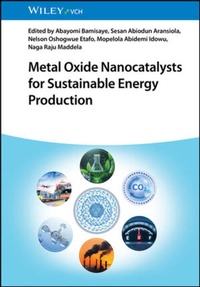
Metal Oxide Nanocatalysts for Sustainable Energy Production
Description

More details
Other editions
Additional editions
Persons
Sesan Abiodun Aransiola is a lecturer at the Department of Microbiology, University of Abuja, Nigeria.. His research is deeply rooted in innovative solutions for soil and water remediation, with significant contributions to microbial biotechnology and waste management. He has co-edited several books, e.g. Microbial Biofilms (CRC Press) and Biotechnology for Bioenergy (Elsevier).
Nelson Oshogwue Etafo is a lecturer at the Carolina Universidad in Saltillo, Coahuila, Mexico, with more than 15 years of teaching experience . His research is focused on photoluminescence and photocatalysis of phosphor materials and nanomaterials. He is a member of the Royal Society of Chemistry (RSC), the American Chemical Society (ACS), and the Chemical Society of Nigeria (CSN).
Mopelola Idowu is a Professor in the Department of Pure and Applied Chemistry at the Federal University of Agriculture in Abeokuta, Nigeria. She holds a Ph.D in Chemistry from Rhodes University, South Africa and was a postdoctoral scholar at the University of Michigan, USA. Her research efforts are towards design and evaluation of light absorbing systems with interesting electronic properties; towards discovery of materials with applications in photoscience, photomedicine, sensors, environmental remediation, and energy storage.
Naga Raju Maddela is a full professor at the Facultad de Ciencias de la Salud, Universidad Técnica de Manabí, Portoviejo, Ecuador. He received his M.Sc. and Ph.D. (2012) in microbiology from Sri Krishnadevaraya University, Anantapuramu, India. He presented his research in China, Cuba, Ecuador, India, and Singapore.
Content
1. The Climate Change Crisis - Emerging Causes and Effects
2. The Role of Catalysts in Combating Climate Change
3. Metal Oxide Nanocatalysts in Climate Change Mitigations
4. Synthesis and Characterisation of Metal Oxide Nanocatalysts for Energy Production
Part 2: Metal Oxide Nanocatalysis - Mechanisms and Reactions
5. Surface Chemistry of Metal Oxide Nanocatalysts
6. Redox Reactions Catalyzed by Metal Oxides Nanocatalysts
7. Photocatalysis using Metal Oxides
Part 3: Applications of Metal Oxide Nanocatalysts in Energy Production for a Sustainable Environment
8. Metal Oxides for Carbon Dioxide Capture and Conversion
9. Green Hydrogen from Water Splitting Using Metal Oxide Nanocatalysts
9. Metal Oxide Catalysts in Fuel Cells Production
10. Innovation of Metal Oxide Nanocatalysts for Air Pollution Control
11. Metal Oxide Nanocatalysts for Water Purification Processes
Part 4: Advanced, Industrial, and Environmental Impact of Metal Oxide Nanocatalyst Systems
12. Metal-Organic Frameworks (MOFs) and Metal Oxide Nanocatalysts
13. Bimetallic and Multimetallic Metal Oxide Nanocatalysts
14. Composite and Hybrid Metal Oxide Nanocatalysts
15. Metal Oxide Nanocatalysts in Sustainable Energy Production for Climate Change Mitigation
16. Metal/Bimetallic Oxide Nanocatalysts for CO2 Conversion
17. Metal Oxide Nanocatalysts: Eco-friendly Solutions for Catalysis in Green Chemistry
About the Editors
Abayomi Bamisaye received his Bachelor of Science (Hons.), Industrial Chemistry in 2012 at the Department of Chemistry, Ekiti State University, Ado-Ekiti, Nigeria. He also obtained his MSc (2016) and PhD (2021) in Industrial Chemistry with distinction at the Department of Chemistry, Federal University of Agriculture, Abeokuta, where he worked on the Development of Oil-in-Water (O/W) Nanoemulsion systems for drug delivery and Cosmetology purposes. He is a senior lecturer and researcher at the Department of Chemistry, Lead City University, Ibadan, Nigeria. Dr. Bamisaye is a dynamic researcher whose work reflects a rare combination of leadership, analytical rigor, and innovative thinking. His scholarly contributions span a wide range of interdisciplinary domains including nanomaterials synthesis, photocatalysis, biomass valorization, wastewater treatment, energy storage, and drug delivery systems. Currently serving as a Postdoctoral Research Fellow at the University of Pretoria (UP), South Africa, where his research is focused on the synthesis of nano-mesoporous biomass metal-organic frameworks composites for energy storage. His work in this emerging field directly supports the development of sustainable energy technologies through the valorization of biomass waste, addressing critical challenges in environmental and energy sustainability. He is also a recipient of the prestigious Coimbra Postdoctoral Fellowship, underscoring his academic excellence and global recognition. Dr. Bamisaye's dedication to impactful research and academic engagement is evident in his robust publication portfolio, which includes peer-reviewed journal articles, comprehensive review papers, book chapters, and a full-length academic book. His scholarly work cuts across nanotechnology, materials science, environmental engineering, and nanomedicine, contributing valuable insights to both fundamental science and applied research. He is a member of American Chemical Society (ACS) and Chemical Society of Nigeria (CSN). He is also serving as a reviewer of many peer-reviewed local and international journal outlets.
Sesan Abiodun Aransiola is a Lecturer at the Department of Microbiology, University of Abuja, Nigeria. He obtained his BTech, MTech, and PhD in Environmental Microbiology from the Federal University of Technology, Minna, Nigeria. He has demonstrated his research expertise in the production of vermicasts from vermicomposting of organic wastes to assist plants in the remediation of polluted soil with heavy metals. His expertise spans environmental health, phytoremediation, vermicomposting, marine resources, and bioremediation of pollutants in the soil. Aransiola's research is deeply rooted in innovative solutions for soil and water remediation, with significant contributions to microbial biotechnology and waste management. He is an award-winning researcher and has over 100 publications including book chapters, research and review articles of good international repute with a high impact factor. He has co-edited scientific books of global interest, which include Microbial Biotechnology for Bioenergy, Marine Bioresources: Prospects and Obstacles, Marine Microbial Products: Applications and Opportunities (Elsevier). Ecological Interplays in Microbial Enzymology, Prospects for Soil Regeneration and Its Impact on Environmental Protection, Soil Microbiome in Green Technology Sustainability, Marine Bioprospecting for Sustainable Blue-Bioeconomy, Vermitechnology: Economic, Environmental and Agricultural Sustainability, White Pollution: Biodiversity and Hazards in Marine Plastisphere, Wetland Ecosystems: Conservation Strategies, Policy Management and Applications (Springer). Microbial Biofilms-Applications and Control, Marine Greens: Environmental, Agricultural, Industrial and Biomedical Applications, Environmental Footprint of Bioplastic Additives, Emerging Contaminants in Food and Food Products, Phytoremediation in Food Safety: Risks and Prospects, Biotoxins in Food: Threats and Benefits (CRC Press) with many more in the process. He has been a review editor, and as guest editor, he hosted two special issues with Elsevier (Research in Microbiology) and Frontiers on biofilms-community, structure, applications, and mitigation-and effects of microplastics on soil ecosystems, respectively. Also, he rose to the rank of assistant chief scientific officer at National Biotechnology Research and Development Agency, Nigeria, for years, where he was involved in the uses of vinasse (a by-product of ethanol) as bio-fertilizer to reclaim polluted soil for agricultural purposes before joining the university. Dr. Aransiola's academic journey is complemented by robust research (with some grants won), teaching career (with proper mentoring and supervising both undergraduate and postgraduate students), and active involvement in community services, where he leverages his knowledge to foster sustainability. His contributions continue to impact both academia and the broader environmental sciences community. Abiodun is a member of Nigerian Society for Microbiology, Association of Environmental Impact Assessment of Nigeria (Affiliation of International Association for Impact Assessment), and American Society for Microbiology.
Nelson Oshogwue Etafo is a Lecturer at the Carolina Universidad in Saltillo, Coahuila, Mexico, with more than 15 years of experience in teaching different categories of science students. He obtained his doctorate at the esteemed Autonomous University of Coahuila (UadeC), Saltillo, Coahuila, Mexico. His research focused on photoluminescence and photocatalysis of phosphor materials and nanomaterials. He earned his BSc and MSc degrees in chemistry and Industrial chemistry from the Federal University of Agriculture, Abeokuta (FUNAAB), Nigeria. He is a member of many organizations like the Royal Society of Chemistry (RSC), the American Chemical Society (ACS), and the Chemical Society of Nigeria (CSN). As a researcher, he has collaborated with leading institutions and industry partners to develop new materials with unique properties and applications. His research focused on the development of sustainable and eco-friendly materials and their use in healthcare, energy storage and conversion, catalysis, and other fields. He is committed to conducting research that has a positive impact on society and the environment. He has published many articles, book chapters, and a book in high-impact journals and has attended both national and international conferences as well as reviewed many articles and book chapters. He has won awards for his scholarly and teaching skills both in Nigeria and Mexico.
Mopelola A. Idowu is a Professor in the Department of Pure and Applied Chemistry, Federal University of Agriculture, Abeokuta, Nigeria (FUNAAB). She holds a PhD in Chemistry from Rhodes University, South Africa, and was a postdoctoral scholar at the University of Michigan, USA. Earlier, she earned her BSc Honours and MSc in Chemistry from the University of Ibadan, Nigeria. She has participated in many short courses, including International Deans' Course Africa by German Academic Exchange Service, the German Rectors' Conference and the Alexander von Humboldt Foundation. She is a Fellow of the Andrew Mellon Foundation, an Awardee of the Schlumberger Faculty for the Future fellowship, an Awardee of the Africa Scholarship, a grantee of the German/African bilateral agreement Fellowship in Science and CSIC i-COOP, Spanish/African bilateral agreement grant. Professor Idowu's research efforts are toward the design and evaluation of light-absorbing systems with interesting electronic properties; toward the discovery of materials with applications in photoscience, photomedicine, photocatalysis, sensors, environmental remediation, and energy storage. Her collaborative efforts have furthered her work in the area of time-resolved dynamics of photoexcited molecules; photoinduced damage by exogenous sensitizers through formation of adducts with proteins and their components; kinetics and thermodynamics of use of biomass and nanostructured materials for remediation; computational elucidation of molecules for photovoltaic applications; and evaluation of organic compounds and their mechanism of inhibition in corrosion. Professor Idowu's commitment to excellence in research and education is reflected in her extensive publication record and involvement in academic activities. She has authored numerous research papers and book chapters and has mentored many students, majorly and collaboratively, some of which have gained tenure at institutions nationally and internationally. She is actively involved in academic leadership and administrative duties. Her administrative experience spans, but not limited to, Headship of the Department of Chemistry at FUNAAB, Member, University senate, Faculty appointment and promotion committee and service/headship in university committees, which involve a high level of integrity and staff discipline. Professor Idowu's contributions continue to impact both academia and the broader chemistry community. She is a member of the Chemical Society of Nigeria and other international Chemistry bodies, a former Associate Editor of the journal of the Society, and a reviewer of many peer-reviewed International Journals of Chemistry and Materials Science. She has also been actively involved in many international grants' bodies review panels.
Naga Raju Maddela received his MSc (1996-1998) and PhD (2012) in Microbiology from Sri Krishnadevaraya University, Anantapuramu, India. During his doctoral program in the area of Environmental Microbiology, he investigated the effects of industrial effluents/insecticides...
