

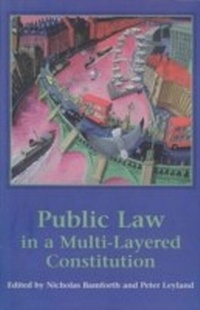
Public Law in a Multi-Layered Constitution
1st Edition
Published on 30. October 2003
448 pages
978-1-84731-323-2 (ISBN)
Description

How is the distribution of power between the different levels of the contemporary constitution to be policed? What is the emerging contribution of the courts in regard to EC law,the Human Rights Act 1998 and devolution? What roles should be played by the legislative and judicial bodies at each level? Who should have access to the courts in public law disputes, and on what grounds should the courts regulate the exercise of public power? Can a coherent distinction be maintained between public and private law? These essays by leading public law scholars explore the allocation and regulation of public power in the United Kingdom.
At the beginning of the twenty first century it appears that the traditional Diceyan model of a unitary constitution has been superseded as power has come to be distributed - particularly in the post-1997 period - between institutions at European, national, devolved and local level. Furthermore, the courts have come to play a powerful role at all levels through judicial review, while forms of regulation and contracting, together with other informal techniques of governance, have emerged. The contemporary constitution can be characterised as involving a multi-layered distribution of power - a situation which raises many key questions about the role of public law. The essays in this important collection tackle such questions from a variety of perspectives, aiming between them to provide a dynamic picture of the role of public law in the contemporary, multi-layered constitution.
At the beginning of the twenty first century it appears that the traditional Diceyan model of a unitary constitution has been superseded as power has come to be distributed - particularly in the post-1997 period - between institutions at European, national, devolved and local level. Furthermore, the courts have come to play a powerful role at all levels through judicial review, while forms of regulation and contracting, together with other informal techniques of governance, have emerged. The contemporary constitution can be characterised as involving a multi-layered distribution of power - a situation which raises many key questions about the role of public law. The essays in this important collection tackle such questions from a variety of perspectives, aiming between them to provide a dynamic picture of the role of public law in the contemporary, multi-layered constitution.
More details
Edition
1. Auflage
Language
English
Place of publication
London
United Kingdom
Publishing group
Bloomsbury Publishing PLC
Target group
Professional and scholarly
ISBN-13
978-1-84731-323-2 (9781847313232)
Copyright in bibliographic data and cover images is held by Nielsen Book Services Limited or by the publishers or by their respective licensors: all rights reserved.
Schweitzer Classification
Other editions
Additional editions
Nicholas Bamforth | Peter Leyland
Public Law in a Multi-layered Constitution
Book
10/2003
Hart Publishing
€75.71
Article exhausted; check different version

Nicholas Bamforth | Peter Leyland
Public Law in a Multi-layered Constitution
Book
10/2003
Hart Publishing
€65.79
Article exhausted; check for reprint
Persons
Nicholas Bamforth is Fellow in Law at The Queen's College, Oxford University.
Peter Leyland is Professor of Public Law at London Metropolitan University.
Peter Leyland is Professor of Public Law at London Metropolitan University.
Content
- Half Title Page
- Title Page
- Title verso
- Preface
- Contents
- List of Contributors
- 1. Public Law in a Multi-Layered Constitution
- The Multi-Layered Constitution: An Overview
- The Multi-Layered Constitution: The Features, as Outlined in the Essays
- Conclusion
- 2. Constitutional Law: The Third Order of the Political
- The Concept of the Political
- Politics and the State
- Politics as Statecraft
- The Third Order: Constitutional Law
- Constitutions
- Constitutional Legalism
- Conclusion
- 3. What is Parliament for?
- Introduction
- Some History: What was Parliament for?
- Parliament Since 1990
- Parliament and Improving Scrutiny
- Future Developments: A Proposal
- 4. European Governance and Accountability
- Questions About Accountability
- Democratic and Political Accountability
- Audit and Accountability
- Accountability Through Law
- Conclusions
- 5. Devolution and England: What is on Offer?
- Introduction
- Devolution and New Labour
- Defining Devolution
- What is England Being Offered?
- Conclusion: Could the English Question be Answered by Addressing the Union Question?
- 6. Does the Devolved Northern Ireland Need an Independent Judicial Arbiter?
- Introduction
- Devolution and the Judges: Earlier Versions
- Northern Ireland Act 1998: New Century Devolution?
- Robinson v Secretary of State for Northern Ireland
- Conclusion
- 7. Modernising Government and the E-Government Revolution: Technologies of Government and Technologies of Democracy
- Introduction
- Governmentality and Constitutional Theory
- Government, Governance and Governmentality
- Modernising Government
- E-Government: UK Online as a Technology of Governance
- E-Goverment: A Technology of Democracy
- Conclusion
- 8. UK Utility Regulation in an Age of Governance
- Introduction
- From Public to Privative Ownership/Stadard Form of Nationalisation
- Privatisation and Regulation
- Regulation and New Labour: Correction, Repair and Consultation
- Utility Regulation and Devolution
- Utility Regulation, Concordats and Environmental Protection
- Co-ordinating Regulation
- Conclusion
- 9. Freedom of Information: A New Constitutional Landscape?
- Background
- Principles of Freedom of Information
- The New Freedom of Information Legislation
- The Exemptions
- The Information Commissioner and Independent Scrutiny
- Conclusion
- 10. Accountability and the Public/Private Distinction
- Introduction
- The Public/Private Distinction in Operation
- Critiques of the Public/Private Distinction
- Conclusion
- 11. Courts in a Multi-Layered Constitution
- The Reception of EC Law within the United Kingdom
- The Human Rights Act 1998 and the Courts
- The 'Spill Over' Effect
- The Multi-Layered Constitution and Public Law Theory
- Conclusion
- 12. Reinventing Administrative Law
- The Classic Model of Administrative Law
- Wednesbury: The Case
- Wednesbury Today
- Towards a Culture of Justification
- Conclusion
- 13. Sovereignty's Blight: Why Contemporary Public Law Needs the Concept of 'Due Deference'
- Introduction
- The Problem: What Does Daly Require?
- The False Step: Emergence of the Spatial Metaphor
- 'Due Deference' as an Alternative Approach
- Practical Examples of Why 'Due Deference' Matters
- Conclusion
- 14. Civil Liberties and Human Rights
- Introduction
- Civil Liberties, 'Human Rights' and the ECHR
- Civil Liberties in Britain
- Civil Liberties, the Judiciary and the Political Process
- Conclusion
- 15. Standing in a Multi-Layered Constitution
- A Case Study: Greenpeace at Home and Abroad
- A. Standing Rules
- B. Intervention Rules
- The Foundations of Standing and Intervention Rules
- Standing and Intervention Rules and the Constitutional Role of the Courts
- Conclusion
- Index
