

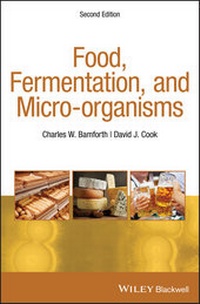
Food, Fermentation, and Micro-organisms
Description

More details
Other editions
Additional editions
Persons
Professor Charles W. Bamforth, Head of Malting and Brewing Science, Department of Food Science and Technology, University of California, Davis, USA.
Professor David J. Cook, AB InBev Chair in Brewing Science, School of Biosciences, University of Nottingham, Loughborough, UK.
Content
Preface xiii
Introduction 1
Bibliography 3
1 The Science Underpinning Food Fermentations 5
1.1 Micro-Organisms 6
1.2 Microbial Metabolism 8
1.2.1 Nutritional Needs 9
1.2.2 Environmental Impacts 11
1.2.2.1 Temperature 11
1.2.2.2 pH 14
1.2.2.3 Water Activity 14
1.2.2.4 Oxygen 17
1.2.2.5 Radiation 19
1.2.2.6 Hydrostatic Pressure 19
1.2.3 Controlling or Inhibiting Growth of Micro-organisms 19
1.2.3.1 Heating 19
1.2.3.2 Cooling 20
1.2.3.3 Drying 20
1.2.3.4 Irradiation 20
1.2.3.5 Filtration 20
1.2.3.6 Chemical Agents 21
1.2.4 Metabolic Events 22
1.2.4.1 Catabolism 22
1.2.4.2 Anabolism 25
1.3 The Origins of the Organisms Employed in Food Fermentations 28
1.4 Some of the Major Micro-Organisms in This Book 30
1.4.1 Yeast 32
1.4.2 Lactic Acid Bacteria 35
1.4.2.1 Lactococcus 36
1.4.2.2 Leuconostoc 36
1.4.2.3 Streptococcus 36
1.4.2.4 Lactobacillus 36
1.4.2.5 Pediococci 36
1.4.2.6 Enterococcus 36
1.5 Providing the Growth Medium for the Organisms 37
1.6 Fermenters 37
1.7 Downstream Processing 37
1.8 Some General Issues for a Number of Foodstuffs 38
1.8.1 Non-enzymatic Browning 38
1.8.2 Enzymatic Browning 40
1.8.3 Caramelisation of Sugars 41
1.8.4 Antioxidants 41
Bibliography 42
2 Beer 43
2.1 Overview of Malting and Brewing 43
2.2 Barley and Malt Production 46
2.3 Mashing: The Production of Sweet Wort 53
2.3.1 Milling 53
2.3.2 Mashing 55
2.3.3 Adjuncts 59
2.3.4 Wort Separation 60
2.3.4.1 Lauter Tun 60
2.3.4.2 Mash Filters 61
2.4 Water 61
2.5 Hops 64
2.6 Wort Boiling and Clarification 66
2.7 Wort Cooling 66
2.8 Yeast 67
2.9 Brewery Fermentations 73
2.10 Filtration 76
2.11 The Stabilisation of Beer 77
2.12 Gas Control 77
2.13 Packaging 78
2.13.1 Filling Bottles and Cans 79
2.13.2 Filling Kegs 79
2.14 The Quality of Beer 80
2.14.1 Flavour 80
2.14.2 Foam 88
2.14.3 Gushing 88
2.15 Spoilage of Beer 88
2.16 Beer Styles 90
Bibliography 90
3 Wine 93
3.1 Grapes 93
3.2 Grape Processing 97
3.2.1 Stemming and Crushing 98
3.2.2 Drainers and Presses 99
3.3 Fermentation 101
3.3.1 Juice 101
3.3.2 Yeast 102
3.4 Clarification 103
3.5 Filtration 104
3.6 Stabilisation 104
3.7 The Use of Other Micro-Organisms in Wine Production 104
3.8 Champagne/Sparkling Wine 105
3.9 Ageing 106
3.10 Packaging 108
3.11 Taints and Gushing 108
3.12 The Composition of Wine 108
3.13 Classifications of Wine 108
3.14 Wine Evaluation 109
Bibliography 110
4 Fortified Wines 111
4.1 Sherry 112
4.2 Port 113
4.3 Madeira 114
Bibliography 115
5 Cider 117
5.1 Apples 118
5.2 Milling and Pressing 121
5.3 Fermentation 122
5.4 Cider Colour and Flavour 125
5.5 Post- Fermentation Processes 126
5.6 Problems With Cider 126
5.7 Perry 129
Bibliography 130
6 Distilled Alcoholic Beverages 131
6.1 Whisk(e)y 131
6.1.1 Distillation 133
6.1.2 Whiskey Variants 137
6.2 Cognac 138
6.3 Armagnac and Wine Spirits 138
6.4 Rum 140
Bibliography 141
7 Vodka, Flavoured Spirits and Liqueurs 143
7.1 Vodka 143
7.2 Gin 144
7.3 Liqueurs 145
Bibliography 153
8 Sake 155
8.1 Sake Brewing 159
8.1.1 Polishing, Steeping and Steaming 160
8.1.2 Making Koji 160
8.1.3 Making Moto 160
8.1.4 Moromi 161
8.1.5 Modern Sake Making 162
8.2 The Flavour of Sake 163
8.3 Types of Sake 163
8.4 Serving Temperature 164
Bibliography 164
9 Vinegar 165
9.1 Vinegar-Making Processes 166
9.2 Malt Vinegar 168
9.3 Wine Vinegar 168
9.4 Balsamic Vinegar 168
9.5 Other Vinegars 169
9.6 Chemical Synthesis of Vinegar 169
Bibliography 171
10 Cheese 173
10.1 Milk 175
10.2 The Culturing of Milk with Lactic Acid Bacteria 177
10.3 Milk Clotting 178
10.4 Whey Expulsion 178
10.5 Curd Handling 179
10.6 The Production of Processed Cheese 179
10.7 The Maturation of Cheese 179
Bibliography 182
11 Yoghurt and Other Fermented Milk Products 183
Bibliography 186
12 Bread 187
12.1 Flour 188
12.2 Water 188
12.3 Salt 188
12.4 Fat 188
12.5 Sugar 189
12.6 Leavening 189
12.7 Additives 189
12.8 Fermentation 191
12.9 Dough Acidification 191
12.10 Formation of Dough 191
12.11 Leavening of Doughs 192
12.12 Processing of Fermented Doughs 193
12.13 Baking 193
12.14 Bread Flavour 194
12.15 Staling of Bread 195
12.16 Bread Composition 195
Bibliography 195
13 Meat 197
13.1 Fermented Sausage 197
13.1.1 The Role of Components of the Curing Mixture 197
13.1.2 Meat Fermentation 198
13.2 Raw Hams 199
Bibliography 200
14 Indigenous Fermented Foods 201
14.1 Soy Sauce 201
14.1.1 Mash (Moromi) Stage 204
14.2 Miso 205
14.3 Natto 208
Bibliography 208
15 Vegetable Fermentations 211
15.1 Factors Impacting Vegetable Fermentations 211
15.2 Cucumbers 211
15.3 Cabbage 213
15.4 Olives 214
15.4.1 Untreated Naturally Ripe Black Olives in Brine 214
15.4.2 Lye-Treated Green Olives in Brine 215
Bibliography 215
16 Cocoa 217
16.1 Roasting 220
16.2 Production of Cocoa Mass or Chocolate Liquor 220
16.3 Cocoa Butter 221
16.4 Production of Chocolate 221
Bibliography 222
17 Microbial Biomass Protein 223
17.1 Production and Properties of Quorn 223
Bibliography 224
18 Miscellaneous Fermentation Products 225
Bibliography 234
Index 235
1
The Science Underpinning Food Fermentations
Use the word 'biotechnology' nowadays and the vast majority of people will register an image of genetic alteration of organisms in the pursuit of new applications and products, many of them pharmaceutically relevant. Even the Merriam-WebsterDictionary tells us that biotechnology is 'biological science when applied especially in genetic engineering and recombinant DNA technology'. Fortunately the Oxford English Dictionary gives the rather more accurate definition as 'the branch of technology concerned with modern forms of industrial production utilising living organisms, especially microorganisms, and their biological processes'.
Accepting the truth of the second of these, then we can realise that biotechnology is far from being a modern concept. It harks back historically vastly longer than the traditional milepost for biotechnology, namely Watson and Crick's announcement in the Eagle pub in Cambridge (and later, more formally, in Nature) that they had found 'the secret of life'.
Eight thousand years ago our ancient forebears may have been, in their own way, no less convinced that they had hit upon the essence of existence when they made the first beers and breads. The first micro-organism was not seen until draper Anton van Leeuwenhoek peered through his microscope in 1676 and neither were such agents firmly causally implicated in food production and spoilage until the pioneering work of Needham, Spallanzani and Pasteur and Bassi de Lodi in the eighteenth and nineteenth centuries.
Without knowing the whys and wherefores, the dwellers in the Fertile Crescent were the first to make use of living organisms in fermentation processes. They truly were the first biotechnologists. And so beer, bread, cheese, wine and most of the other foodstuffs being considered in this book come from the oldest of processes. In some cases these have not changed very much in the ensuing aeons.
Unlike the output from modern biotechnologies, for the most part we are considering high volume, low value commodities. However for products such as beer, there is now a tremendous scientific understanding of the science that underpins the product, science that is none the less tempered with the pressures of tradition, art and emotion. For all of these food fermentation products, the customer expects. As has been realised by those who would apply molecular biological transformations to the organisms involved in the manufacture of foodstuffs, there is vastly more resistance to this than for applications in, say, the pharmaceutical area. You don't mess with a person's meal!
Historically, of course, the micro-organisms employed in these fermentation processes were adventitious. Even then, however, it was realised that the addition of a part of the previous process stream to the new batch could serve to 'kick off' the process. In some businesses this was called 'back slopping'. We now know that what the ancients were doing was seeding the process with a hefty dose of the preferred organism(s). Only relatively recently have the relevant microbes been added in a purified and enriched form to knowingly trigger fermentation processes.
The two key components of a fermentation system are the organism and its feedstock. For some products, such as beer, there is a radical modification of the properties of the feedstock, rendering them more palatable (in the case of beer, the grain extracts pre-fermentation are most unpleasant in flavour; by contrast, grape juice is much more acceptable). For other products the organism is less central, albeit still important. One thinks for instance of bread, where not all styles involve yeast in their production.
For some products, such as cheese, the end product is quite distinct from the raw materials as a result of a series of unit operations. For products such as beer, wine and vinegar the product is actually the spent growth medium - the excreta of living organisms if one was to put it crudely. Only occasionally is the product the actual micro-organism itself - for example the surplus yeast generated in a brewery fermentation or that generated in a microbial biomass ('single cell protein') operation such as the production of mycoprotein.
The organisms employed in food fermentations are many and diverse. Key players are the lactic acid bacteria, in dairy products for instance, and yeast, in the production of alcoholic beverages and bread. The lactic acid bacteria, to illustrate, may also have a positive role to play in the production of certain types of wines and beers, but equally they represent major spoilage organisms for many such products. It truly is a case of the organism being in the right niche for the product in question.
In this chapter we will focus on the generalities of science and technology that underpin fermentations and the organisms that are involved. We will look at commonalities in terms of quality - for example the Maillard reaction that is of widespread significance as a source of colour and aroma in many of the foods that we are considering. The reader will discover (and this betrays the primary expertise of the authors) that many of the examples given are from beer making. It must be said, however, that the scientific understanding of the brewing of beer is somewhat more advanced than that for most if not all of the other foodstuffs described in this book. Many of the observations made in a brewing context very much translate to what must occur in the less well-studied foods and beverages.
1.1 Micro-Organisms
Microbes can essentially be divided into two categories: the prokaryotes and the eukaryotes.
The former, which embrace the bacteria, are substantially the simpler, in that essentially they comprise a protective cell wall, surrounding a plasma membrane, within which is a nuclear region immersed in cytoplasm (Figure 1.1). This is a somewhat simplistic description, but sufficient for our needs. The nuclear material (deoxyribonucleic acid, ) of course figures as the genetic blueprint of the cell. The cytoplasm contains the enzymes that catalyse the reactions necessary to the growth, survival and reproduction of the organisms (the sum total of reactions of course being referred to as metabolism). The membrane regulates the entry and exit of materials into and from the cell.
Figure 1.1 A simple representation of a prokaryotic cell. The major differences between Gram positive and Gram negative cells concerns their outer layers, with the latter having an additional membrane outwith the wall in addition to a different composition of the wall itself.
The eukaryotic cell (of which bakers or brewers yeast, Saccharomyces cerevisiae, a unicellular fungus, is the model organism) is substantially more complex (Figure 1.2). It is divided into organelles, the intracellular equivalent of our bodily organs. Each has its function. Thus the DNA is located in the nucleus which, like all the organelles, is bounded by a membrane. All the membranes in eukaryotes (and prokaryotes) comprise lipid and protein. Other major organelles in eukaryotes are the mitochondria, wherein energy is generated, and the endoplasmic reticulum. The latter is an interconnected network of tubules, vesicles and sacs with various functions including protein and sterol synthesis, sequestration of calcium, production of the storage polysaccharide glycogen and insertion of proteins into membranes. Both prokaryotes and eukaryotes have polymeric storage materials located in their cytoplasm.
Figure 1.2 A simple representation of a eukaryotic cell.
Table 1.1 lists some of the organisms that are mentioned in this book. Some of the relevant fungi are unicellular, for example Saccharomyces. However the major class of fungi, namely the filamentous fungi with their hyphae (moulds), are of significance for a number of the foodstuffs, notably those Asian products involving solid state fermentations, e.g. sake and miso, as well as the only successful and sustained single cell protein operation (Chapter 17).
Table 1.1 Some micro-organisms involved in food fermentation processes.
Bacteria Fungi Gram negativea Gram positivea Filamentous Yeasts and non-filamentous fungi Acetobacter Arthrobacter Aspergillus Brettanomyces Acinetobacter Bacillus Aureobasidium Candida Alcaligenes Bifidobacterium Fusarium Cryptococcus Escherichia Cellulomonas Mucor Debaromyces Flavobacterium Corynebacter Neurospora Endomycopsis Lactobacillus Penicillium Geotrichum Gluconobacter Lactococcus Rhizomucor Hanseniaspora...