

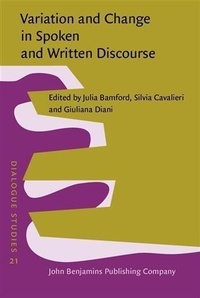
Variation and Change in Spoken and Written Discourse
Perspectives from corpus linguistics
1st Edition
Published on 31. October 2013
XIII, 290 pages
978-90-272-7121-1 (ISBN)
Description

This book focuses on aspects of variation and change in language use in spoken and written discourse on the basis of corpus analyses, providing new descriptive insights, and new methods of utilising small specialized corpora for the description of language variation and change. The sixteen contributions included in this volume represent a variety of diverse views and approaches, but all share the common goal of throwing light on a crucial dimension of discourse: the dialogic interactivity between the spoken and written. Their foci range from papers addressing general issues related to corpus analysis of spoken dialogue to papers focusing on specific cases employing a variety of analytical tools, including qualitative and quantitative analysis of small and large corpora. The present volume constitutes a highly valuable tool for applied linguists and discourse analysts as well as for students, instructors and language teachers.
More details
Other editions
Additional editions
Julia Bamford | Silvia Cavalieri | Giuliana Diani
Variation and Change in Spoken and Written Discourse
Perspectives from corpus linguistics
Book
10/2013
John Benjamins Publishing Co
€100.70
Shipment within 10-15 days
Persons
Content
- Variation and Change in Spoken and Written Discourse
- Editorial page
- Title page
- LCC data
- Table of contents
- Acknowledgements
- Introduction
- Overview of the chapters
- Part I. Corpus analysis of spoken dialogue
- Section I. Variation and academic dialogue
- 1. Speaking professionally in an L2 - Issues of corpus methodology
- 1. Introduction
- 2. Background
- 3. The ELFA corpus
- 3.1 Setting-related choices
- 3.2 Speaker-related choices
- 4. Using corpora of professional speaking
- 4.1 Starting by brainstorming
- 4.2 Starting by listing
- 4.3 Starting by reading transcripts
- 5. Issues of comparability
- 5.1 External comparability
- 5.2 Internal comparability
- 6. Conclusion
- Notes
- References
- Corpora referred to
- 2. Common features and variations in the use of personal pronouns
- 1. Introduction
- 2. Corpus
- 3. Findings
- 3.1 Comparing frequency of the use of "I", "we" and "you" and their possessive and object forms
- 3.2 Collocates of "we", "I" and "you"
- 4. Discussion and conclusions
- Notes
- References
- Section II. Dialogue in spoken and written business discourse
- 3. Variation across spoken and written registers in internal corporate communication
- 1. Introduction
- 2. Business data
- 3. Method
- 4. The analysis
- 4.1 Nominalization in the power point corpus
- 4.2 Text structure and organization in the oral presentation
- 4.3 Visual and spatial imagery: A feature of spontaneous speech in multimodal discourse
- 4.4 The "conversationalization" of written communication
- 5. Corporate messaging networks: Identity and image in "employer branding"
- 6. Concluding remarks
- Notes
- References
- 4. Using grammatical tagging to explore spoken/written variation in small specialized corpora
- 1. Introduction
- 2. Financial disclosure
- 3. Materials and methods
- 3.1 The corpora
- 3.2 Methodology
- 4. Results and discussion
- 4.1 Lexical density
- 4.2 Evaluative adjectives
- 5. Conclusions
- Notes
- References
- Section III. Dialogic variation and language varieties
- 5. Exploring regional variation in Italian question intonation: A corpus-based study
- 1. Introduction
- 2. Materials and method
- 2.1 Corpus
- 2.2 Pragmatic analysis of yes-no questions
- 2.3 Intonation analysis
- 3. Results
- 3.1 Yes-no question intonation in the Northern Italian varieties
- 3.2 Yes-no question intonation in the Central Italian varieties
- 3.3 Yes-no question intonation in the Southern Italian varieties
- 3.4 Discussion
- 4. Concluding remarks
- Acknowledgments
- References
- 6. Estonian emotional speech corpus: Content and options
- 1. Introduction
- 2. Emotion recognition from voice
- 3. Creation of the Estonian emotional speech corpus
- 4. Materials and methods
- 5. Listening and reading results
- 6. Corpus data
- 7. Conclusion
- Notes
- References
- 7. Using movie corpora to explore spoken American English
- 1. Introduction
- 2. Framework and methodology
- 3. Multi-dimensional analysis
- 4. A teaching experiment with movies
- 5. Conclusions
- Notes
- References
- 8. "But that's dialect, isn't it?" Exploring geographical variation in the SCOTS corpus
- 1. Introduction
- 2. The SCOTS corpus
- 3. Quantitative approaches
- 4. Qualitative approaches
- 5. Conclusion
- Notes
- References
- Web resources
- Part II. Using corpora to analyse written discourse: A diachronic perspective
- Section I. Diachronic approaches to historical corpora
- 9. Variation in the language of London newspapers: January 1701
- 1. Introduction
- 1.1 Newspaper texts in Modern English corpora
- 1.2 Newspaper texts in historical corpora
- 2. The ZEN corpus
- 2.1 The ZEN corpus 2006
- 2.2 Expanding the ZEN corpus
- 3. Aspects of early newspaper language
- 3.1 Text classes
- 3.2 Quality vs. popular papers
- 4. Newspapers in 1701
- 4.1 Establishing a corpus of foreign news
- 4.2 Newspaper profiles for 1701
- 5. Variation in newspapers of January 1701
- 5.1 Variation in morphology
- 5.2 Variation in text-linguistic features
- 6. Conclusions
- References
- List of corpora and collections of early English newspaper texts
- 10. From letters to guidebooks: Ruskin's Mornings in Florence
- 1. Introduction
- 2. Methodological approach
- 3. Data and content
- 4. Procedure and findings
- 5. Conclusions
- Notes
- References
- 11. Justificatory arguments in writing on art
- 1. Introduction
- 2. Data
- 3. Analysis
- 4. Observations
- 5. Concluding remarks
- Notes
- References
- 12. Analysing discourse in research genre: The case of biostatistics
- 1. Introduction
- 2. Materials and methods
- 3. Language policy in the development of experimental reports
- 3.1 John Graunt's Natural and Political Observations made upon the Bills of Mortality
- 4. The evolution of modern and contemporary scientific prose
- 4.1 Analysing language and discourse in Fisher's prose
- 4.2 Language and discourse in a contemporary specialised text
- 5. Concluding remarks
- Notes
- References
- Section ii. Diachronic methodologies and language change
- 13.A diachronic corpus-based study of the demonstrative 'this' in tourism research article abstracts
- 1. Introduction
- 2. Variation in academic genres
- 3. Tourism studies
- 4. Materials and methods
- 5. Results
- 6. Discussion and conclusions
- References
- 14. Changing trends in Italian newspaper language: A diachronic, corpus-based study
- 1. Introduction
- 2. Non-homogeneity of newspaper language
- 3. The search for "animation"
- 4. Materials and methods
- 5. Findings
- 5.1 Dislocations
- 5.2 Sentence-initial connectives
- 5.3 Measures of structural complexity
- 6. Conclusions
- Notes
- References
- 15. A corpus-based analysis of some time-related aspects of contemporary Japanese
- 1. Introduction
- 2. Corpora and method
- 2.1 Corpora
- 2.2 Method
- 3. Diachronic changes of the grammar of contemporary Japanese
- 3.1 The morphology of the verb suru
- 3.2 The selection of the adjectivalizing suffixes -na and -no
- 3.3 The permissive construction V sasete itadaku
- 4. Seasonal changes in the use frequency of vocabulary items
- 4.1 Terms for referring to {last/this/next} year
- 4.2 Terms denoting the four seasons
- 4.3 Adjectives of temperature
- 5. Conclusions
- Notes
- References
- It's always the same old news! A diachronic analysis of shifting newspaper language style, 1993-2005
- 1. Introduction
- 2. Research questions
- 3. Methodology
- 4. Corpora
- 5. Analysis
- 5.1 Honorifics
- 5.2 'Taboo' language
- 5.3 Pronouns
- 5.4 Contracted forms
- 5.5 Quoted utterances
- 6. Conclusions
- Notes
- References
- Name index
- Subject index
