

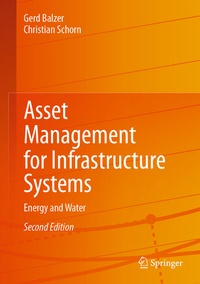
Asset Management for Infrastructure Systems
Description

This book offers a broad overview of asset management processes for different utilities, with a special emphasis on energy and water. It provides readers with important practical considerations concerning the development of new competitive structures and procedures for guaranteeing a sufficient supply of energy and water in a regulated environment, using clearly defined technical and economic cornerstones. On the one hand, asset owners expect suitable interests from their investment and business growth; on the other hand, regulators focus more on a reliable and cost-effective customer supply. This book shows how to take into consideration these different perspectives in the process of designing new structures, and how to guarantee organizational transparency. It describes essential principles and boundary conditions for ensuring the optimal use of resources in a network, covering issues relating to equipment service life, IT landscape and computer programs, operational costs management, and investment and maintenance strategies, highlighting their impact on the organization of the company. This thoroughly revised and updated second edition, includes extensive information about IEC standard (IEC/TS 63060), and cover operation research methods focusing on the optimization of the maintenance tasks. Furthermore, a discussion on the political environment has been included, with a special emphasis on the European situation and the "Green Deal": specifically, some measures to cope with the topic of energy transition are presented. Last, but not least, a brand-new chapter on condition assessment has been included.
More details
Other editions
Additional editions
Persons
Gerd Balzer , born in 1946, received his PhD in 1977 from the Technical University of Darmstadt. He worked seventeen years as head of the electro-consulting department at BBC/ABB. From 1994 to 2011 he served as a Professor for Electrical Power System at the Technical University of Darmstadt. During this period, he was actively involved in asset management, networking planning, insulation coordination and network integration of renewable energy. He is currently engaged in a number of activities organized by the International Council on Large Electric Systems (CIGRE) and International Electrotechnical Commission (IEC).
Christian Schorn , born in 1964, studied electrical engineering at the University of Saarland in Saarbrucken and at the Karlsruhe Institute of Technology. He has been working at EnBW Energie Baden-Württemberg AG since 1996, holding different leadership roles within the grid segment in Germany and other European countries. He founded and supervised the department of technical asset management, responsible for network planning, technical standardization, budget controlling and policy development for electricity, gas and water at all voltage levels and pressure stages at the DSO Netze BW (former EnBW Regional AG). From 2013 to 2017 he served as Group Expert for Grid Business at EnBW AG. Since 2017 he has been responsible for Asset Operation at TransnetBW GmbH, one of the four Transmission Grid Operators of Germany.
Content
Introduction.- Tasks of the Asset Management.- Control functions.- Integration into the business organization.- System landscape in the area of Asset management.- Statistic.- Condition assessment.
