

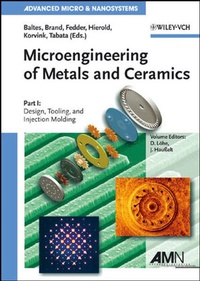
Microengineering of Metals and Ceramics
Part I: Design, Tooling, and Injection Molding
1st Edition
Published on 26. September 2008
XXXVI, 356 pages
978-3-527-61694-7 (ISBN)
Description

Microstructures, electronics, nanotechnology - these vast fields of research are growing together as the size gap narrows and many different materials are combined. Current research, engineering sucesses and newly commercialized products hint at the immense innovative potentials and future applications that open up once mankind controls shape and function from the atomic level right up to the visible world without any gaps.
In this volume, authors from three major competence centres for microengineering illustrate step by step the process from designing and simulating microcomponents of metallic and ceramic materials to replicating micro-scale components by injection molding.
In this volume, authors from three major competence centres for microengineering illustrate step by step the process from designing and simulating microcomponents of metallic and ceramic materials to replicating micro-scale components by injection molding.
More details
Other editions
Additional editions
Software
02/2008
Wiley-VCH
€313.92
No shipping information available
Detlef Löhe | Jürgen Haußelt
Microengineering of Metals and Ceramics
Part I: Design, Tooling, and Injection Molding
Book
07/2005
1st Edition
Wiley-VCH
from
€225.00
Article exhausted; check different version
Persons
Prof. Dr.-Ing. Detlef Löhe studied mechanical engineering at the Technical University of Karlsruhe, Germany and obtained his Ph.D. in 1980. After heading the microstructure and mechancal behaviour working group there, he was appointed in 1991 as professor for materials science at Paderborn University, Germany, where he received an award for outstanding teaching achievements in 1994. In the same year, he returned to the Institute for Materials Science and Enginering I at Karlsruhe Technical University as its Director. He is Speaker of the Collaborative Research Centre 499 "Design, production and quality assurance of molded microparts constructed of metals and ceramics" and has been a Senator of the Deutsche Forschungsgemeinschaft (DFG) since 2003.
His research interests focus on metallic and ceramic materials properties and durability under different kinds of stress, component manufacture and behaviour, optimisation of heat treatment methods, and failure analysis.
Prof. Dr.-Ing. Jürgen Haußelt studied Physics and Materials Sciences at the University of Erlangen, Germany. After his doctorate and a research stay at Stanford University he joined Degussa AG in 1977, starting in metals research. After having worked as technical director in Degussa´s subsidiary in New York City, he returned to Germany in 1985 and was first in charge of metals research, then managed the entire materials development und process technology of Degussa´s corporate division "Metals". In 1993 he joined Forschungszentrum Karlsruhe as head of the Institute of Materials Research III. In addition, he was appointed professor at Freiburg University as Chair for Micromaterials Process Technology at IMTEK in 1996. In 1998 he became member of the supervisory board of Norddeutsche Affinerie AG, Hamburg.
His research interests focus on metallic and ceramic materials properties and durability under different kinds of stress, component manufacture and behaviour, optimisation of heat treatment methods, and failure analysis.
Prof. Dr.-Ing. Jürgen Haußelt studied Physics and Materials Sciences at the University of Erlangen, Germany. After his doctorate and a research stay at Stanford University he joined Degussa AG in 1977, starting in metals research. After having worked as technical director in Degussa´s subsidiary in New York City, he returned to Germany in 1985 and was first in charge of metals research, then managed the entire materials development und process technology of Degussa´s corporate division "Metals". In 1993 he joined Forschungszentrum Karlsruhe as head of the Institute of Materials Research III. In addition, he was appointed professor at Freiburg University as Chair for Micromaterials Process Technology at IMTEK in 1996. In 1998 he became member of the supervisory board of Norddeutsche Affinerie AG, Hamburg.
Editor
ETH Zurich, Zurich, Switzerland
Georgia Institute of Technology, Atlanta, USA
Carnegie Mellon University, Pittsburgh, USA
ETH Zurich, Zurich, Switzerland
Kyoto University, Kyoto, Japan
University of Karlsruhe, Germany
Institut für Werkstofftechnik III, Eggenstein-Leopoldshafen, Germany
Content
Design: Design Environment and Design Flow; Modelling and Validation; Micro Powder Injection Process Modelling
Tooling: Mould Insert Manufacturing Strategies; Micro End-milling in Hardened Steel; Laser Ablation 3D-Microstructuring, Micro EDM, Lithographic Fabrication, Material States, and Surface Conditioning of Mold Inserts
Replication Techniques: Micro Injection Molding - Principles and Challenges; Micro Metal Injection Molding; Micro Ceramic Injection Molding
Tooling: Mould Insert Manufacturing Strategies; Micro End-milling in Hardened Steel; Laser Ablation 3D-Microstructuring, Micro EDM, Lithographic Fabrication, Material States, and Surface Conditioning of Mold Inserts
Replication Techniques: Micro Injection Molding - Principles and Challenges; Micro Metal Injection Molding; Micro Ceramic Injection Molding
