

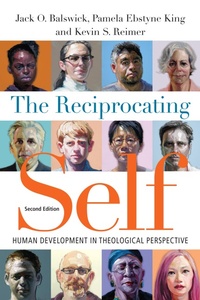
Reciprocating Self
Description

On the basis of a theologically grounded understanding of the nature of persons and the self, Jack O. Balswick, Pamela Ebstyne King and Kevin S. Reimer present a model of human development that ranges across all of life's stages: infancy, childhood, adolescence, young adulthood, middle adulthood, elder adulthood. They do this by drawing on a biblical model of relationality, where the created goal or purpose of human development is to become a reciprocating self--fully and securely related to others and to God.Along the way, they provide a context for understanding individual development issues--concerns, tensions, worries or crises encountered by the self in the context of change. Awareness of these issues is most pronounced atdevelopmental transitional points: learning to talk and walk, beginning to eat unassisted, going to school, developing secondary sexual physical features, leaving home, obtaining full-time employment, becoming engaged and then married, having a childfor the first time, parenting an adolescent, watching children move away from home, retiring, experiencing decline in physical and mental health, and, finally, facing imminent death. Throughout, Balswick, King and Reimer contend that, since God hascreated human beings for relationship, to be a self in reciprocating relationships is of major importance in negotiating these developmental issues.Critically engaging social science research and theory, The Reciprocating Self offers an integrated approach that provides insight helpful to college and seminary students as well as those serving in the helping professions. Those preparing for or currently engaged in Christian ministry will be especially rewarded by the in-depth discussionof the implications for moral and faith development nurtured in the context of the life of the church.
More details
Other editions
Additional editions
Person
Jack O. Balswick (Ph.D., University of Iowa) is senior professor of sociology and family development at Fuller Theological Seminary in Pasadena, California. He has twice received an American Senior Fulbright Scholar Fellowship. He has been associate editor of the Journal of Marriage and Family, Family Relations, Journal for the Scientific Study of Religion and Review of Religious Research. He has authored or coauthored articles in over seventy professional publications and has presented papers at conferences around the world. He is author or coauthor of seventeen books, including Men at the Crossroads, The Family: A Christian Perspective on the Contemporary Home, The Gift of Gender, Social Problems: A Christian Understanding and Response, Relationship-Empowerment Parenting, Authentic Human Sexuality, The Reciprocating Self: Human Development in Theological Perspective and A Model for Marriage: Covenant, Grace, Empowerment and Intimacy.
Pamela Ebstyne King (PhD, Fuller Theological Seminary) is associate professor of marital and family studies and the Peter L. Benson Chair of Applied Developmental Science in the School of Psychology at Fuller Theological Seminary. King's primary academic interests are applied research at the intersection of human thriving and spiritual development. Her research includes studies on environments that promote thriving and the nature and function of spiritual development in diverse adolescents and emerging adults. She has conducted research funded by Biologos Foundation, John Templeton Foundation and Tyndale House. She is coeditor of The Handbook of Spiritual Development in Childhood and Adolescence and coauthor of the inaugural chapter on research on religious and spiritual development in the seventh edition of the Handbook of Child Psychology and Developmental Science. She has served on the editorial boards of Developmental Psychology, Journal of Positive Psychology and Applied Developmental Science. She has also published articles in the Journal on Adolescent Research, Journal of Early Adolescence, New Directions for Child and Adolescent Development, Psychology of Religion and Spirituality, Journal of Psychology and Christianity and Journal of Psychology and Theology. King is a member of the Society for Research on Adolescents, Society for Research on Child Development and Division 36 of the American Psychological Association. In addition to receiving her MDiv and PhD at Fuller, King completed her undergraduate studies at Stanford University and a postdoctoral fellowship at Stanford's Center on Adolescence and was a visiting scholar under the divinity faculty at Cambridge University. She is ordained in the Presbyterian Church (USA).
Kevin S. Reimer (PhD, Fuller School of Psychology) is a program administrator and faculty member in the School of Education, University of California, Irvine. Reimer completed postdoctoral fellowships at the University of British Columbia and Oxford.
Content
Preface Part 1: Toward an Integrated Model of Human Development 1. The Developmental Dilemma 2. The Reciprocating Self: A Trinitarian Analogy of Being and Becoming 3. Reciprocating Relationships 4. The Reciprocating Self and Developmental Theory 5. The Reciprocating Self in Social Context Part 2: Life-Span Stages 6. Infancy: The Emergence of the Reciprocating Self 7. Childhood: The Reciprocating Self Goes to School 8. Adolescence: More Reciprocity Than You Think 9. Emerging Adulthood and Young Adulthood: The Solidifying of the Reciprocating Self 10. Middle Adulthood: The Generativity of the Reciprocating Self 11. Late Adulthood:The Senescing of the Reciprocating Self Part 3: Building the Scaffold: Applications for Ministry 12. Special Issues in Human Development: Morality 13. Differentiated Faith: Spiritual and Religious Development 14. Turning Steeples into Scaffolds: The Reciprocating Religious Community Appendix Bibliography Names Index Subject Index
