

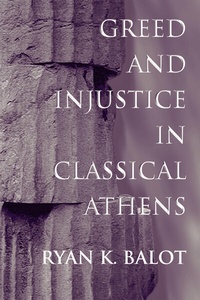
Greed and Injustice in Classical Athens
1st Edition
Published on 12. October 2020
312 pages
978-0-691-22015-4 (ISBN)
Description

In this original and rewarding combination of intellectual and political history, Ryan Balot offers a thorough historical and sociological interpretation of classical Athens centered on the notion of greed. Integrating ancient philosophy, poetry, and history, and drawing on modern political thought, the author demonstrates that the Athenian discourse on greed was an essential component of Greek social development and political history.
Over time, the Athenians developed sophisticated psychological and political accounts of acquisitiveness and a correspondingly rich vocabulary to describe and condemn it. Greed figures repeatedly as an object of criticism in authors as diverse as Solon, Thucydides, and Plato--all of whom addressed the social disruptions caused by it, as well as the inadequacy of lives focused on it. Because of its ethical significance, greed surfaced frequently in theoretical debates about democracy and oligarchy. Ultimately, critiques of greed--particularly the charge that it is unjust--were built into the robust accounts of justice formulated by many philosophers, including Plato and Aristotle. Such critiques of greed both reflected and were inextricably knitted into economic history and political events, including the coups of 411 and 404 B.C.
Balot contrasts ancient Greek thought on distributive justice with later Western traditions, with implications for political and economic history well beyond the classical period. Because the belief that greed is good holds a dominant position in modern justifications of capitalism, this study provides a deep historical context within which such justifications can be reexamined and, perhaps, found wanting.
Over time, the Athenians developed sophisticated psychological and political accounts of acquisitiveness and a correspondingly rich vocabulary to describe and condemn it. Greed figures repeatedly as an object of criticism in authors as diverse as Solon, Thucydides, and Plato--all of whom addressed the social disruptions caused by it, as well as the inadequacy of lives focused on it. Because of its ethical significance, greed surfaced frequently in theoretical debates about democracy and oligarchy. Ultimately, critiques of greed--particularly the charge that it is unjust--were built into the robust accounts of justice formulated by many philosophers, including Plato and Aristotle. Such critiques of greed both reflected and were inextricably knitted into economic history and political events, including the coups of 411 and 404 B.C.
Balot contrasts ancient Greek thought on distributive justice with later Western traditions, with implications for political and economic history well beyond the classical period. Because the belief that greed is good holds a dominant position in modern justifications of capitalism, this study provides a deep historical context within which such justifications can be reexamined and, perhaps, found wanting.
More details
Other editions
Additional editions
Ryan K. Balot
Greed and Injustice in Classical Athens
Book
11/2001
Princeton University Press
€80.80
Shipment within 10-20 days
Person
Ryan K. Balot is Assistant Professor of Classics at Washington University in St. Louis. He has published articles on Chariton, Vergil, and Aristotle.
Content
- Cover Page
- Half-title Page
- Title Page
- Copyright Page
- Contents
- Preface and Acknowledgments
- Abbreviations
- 1. Introduction
- 2. Greed in Aristotle's Political Thought
- Greed and Unfairness in Distribution in Nicomachean Ethics 5
- What Makes Human Beings Greedy?
- Analyzing Greed in the Polis: Revolution, Civic Strife, and Distributive Justice
- Conclusion
- 3. Solonian Athens and the Archaic Roots of Greed
- Homer and Hesiod
- Solon's Reform
- Solon's Critique: The Problem of Acquisition and Unfairness
- 4. Herodotus and the Greed of Imperialism
- Eastern Imperialism
- Greed and Fairness in the Panhellenic League
- The Emergent Imperialism of Athens
- Conclusion
- 5. Thucydides, Greed, and the Breakdown of Political Community
- Revolution at Corcyra: Greed, Leadership, and Civic Trust
- Periclean Athens: Greedy Success
- Human Nature, Democracy, and Greed
- Post-Periclean Disintegration
- Conclusion: The Ethics of Athenian Imperialism
- 6. "Revolution Matters"? Oligarchic Rebellion and Democratic Hegemony in Athens
- Athenian Culture in the Late Fifth Century: Unity and Division
- The Revolution of 411: Speech, Mistrust, and Violence
- The Revolution of 404: Greed and the Thirty
- Responding to the Revolutions: Lysias and Xenophon
- 7. Epilogue: Plato's Republic in Context
- Bibliography
- Index Locorum
- General Index
