

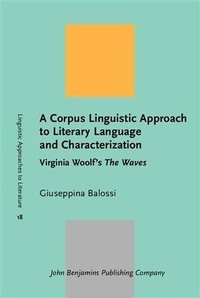
A Corpus Linguistic Approach to Literary Language and Characterization
Virginia Woolf's The Waves
1st Edition
Published on 12. June 2014
XXI, 277 pages
978-90-272-7042-9 (ISBN)
Description

This book focusses on computer methodologies as a way of investigating language and character in literary texts. Both theoretical and practical, it surveys investigations into characterization in literary linguistics and personality in social psychology, before carrying out a computational analysis of Virginia Woolf's experimental novel The Waves. Frequencies of grammatical and semantic categories in the language of the six speaking characters are analyzed using Wmatrix software developed by UCREL at Lancaster University. The quantitative analysis is supplemented by a qualitative analysis into recurring patterns of metaphor. The author concludes that these analyses successfully differentiate all six characters, both synchronically and diachronically, and claims that this methodology is also applicable to the study of personality in non-literary language. The book, written in a clear and accessible style, will be of interest to post-graduate students and academics in linguistics, stylistics, literary studies, psychology and also computational approaches.
More details
Other editions
Additional editions
Giuseppina Balossi
A Corpus Linguistic Approach to Literary Language and Characterization
Virginia Woolf's The Waves
Book
06/2014
John Benjamins Publishing Co
€104.94
Shipment within 10-15 days
Content
- A Corpus Linguistic Approach to Literary Language and Characterization
- Editorial page
- Title page
- LCC data
- Dedication page
- Table of contents
- Acknowledgements
- Foreword
- List of conventions
- List of figures and tables
- List of appendixes
- List of concordances
- 1. Introduction
- 1.1 The issues at stake
- 1.2 The design of this book
- 2. Virginia Woolf's The Waves
- 2.1 Virginia Woolf and the modernist character
- 2.2 Introduction to The Waves
- 2.2.1 Conception
- 2.2.2 Structure
- 2.2.3 Method of characterization
- 2.2.4 Debate over characterization
- 2.2.5 Studies on lexical patterns
- 2.2.6 Psychoanalytic approaches to character
- 3. Literature review
- 3.1 The state of affairs in literary characterization
- 3.1.1 Characters as people and as textual constructs
- 3.1.2 Character typologies
- 3.2 Psychological concepts in the perception of personality
- 3.2.1 Prior knowledge and schema theory
- 3.2.2 History of schema theory
- 3.3 Stylistic approaches to characterization
- 3.3.1 Culpeper's model for characterization: Top-down and bottom-up
- 3.3.2 Cognitive metaphor, mind style and characterization
- 3.4 Studies of language and personality
- 3.5 Conclusion
- 4. Corpus approaches to the study of language and literature
- 4.1 Introduction
- 4.2 Corpus annotation
- 4.3 Techniques employed in corpus analyses
- 4.4 Corpus annotation of literary texts
- 4.4.1 Quantitative stylistic approaches to literary texts
- 4.4.2 Authorial style
- 4.4.3 Characterization
- 4.4.3.1 Characterization in The Waves
- 5. Methodology
- 5.1 Introduction
- 5.2 The narrative framework of The Waves
- 5.2.1 Synchronic and diachronic structure
- 5.2.2 The Waves as e-text: Text annotation and text division
- 5.3 Wmatrix: A software tool for corpus analysis and comparison
- 5.3.1 The CLAWS and USAS taggers and their tagsets
- 5.4 The Waves through Wmatrix
- 5.4.1 Adaptation and revision of POS and USAS tagsets
- 5.4.2 Data layout in Microsoft Excel
- 5.4.3 Post-editing of the soliloquy text
- 5.4.4 Token count of the soliloquy text
- 6. Character differentiation through word-classes
- 6.1 Introduction
- 6.2 Word-class and characters' language
- 6.2.1 Word-classes in the whole soliloquy text and in each character
- 6.2.2 Data comparison and treatment of the LL statistics
- 6.2.3 Characters' word-classes in each phase of life: Significant differences relative to each char
- a. Susan
- b. Jinny
- c. Rhoda
- d. Louis
- e. Neville
- f. Bernard
- 6.2.4 Bernard's word-classes in the final soliloquy
- 6.3 Summary
- 7. Character differentiation: Semantic fields
- 7.1 Introduction
- 7.2 Data comparison and treatment of the LL statistics
- 7.3 The characters' schema of gender dichotomy
- 7.4 The female characters
- 7.4.1 Susan
- a. The Natural World
- b. The House
- c. Home-making activities
- d. Family and Motherhood
- e. Time
- f. The Senses
- 7.4.2 Jinny
- a. The Body
- b. Colours
- c. Movement
- 7.4.3 Rhoda
- a. The Natural World
- b. Movement
- c. Emotions
- f. Colours
- 7.5 The female characters' semantic fields and personality traits
- 7.6 The male characters
- 7.6.1 Louis
- a. Geographical names
- b. People and Relationships
- d. History and Literature
- 7.6.2 Neville
- a. Literature and Philosophy
- b. Academic Interests
- 7.6.3 Bernard
- a. Cognition and Abstraction
- b. Intellectual interests
- 7.7 The male characters' semantic fields and personality traits
- 7.8 Bernard's final summing-up and his dramatic role
- 7.9 Conclusion: The characters' semantic fields and their personality traits
- 7.10 Percival: The other-presented character
- 8. Conclusion
- 8.1 Achievements
- 8.2 Characterization in this study
- 8.3 Reading through the computer
- 8.4 Authorial style versus character voice
- 8.5 Further directions
- References
- Websites
- Appendix A. Log-likelihood calculator
- Appendix B. UCREL semantic tagset and UCREL modified semantic tagset
- Appendix C. ALLCHRS POS and USAS (Data file on CD)
- Appendix D. Each character's statistically significant LL values for the word-classes
- Appendix E. Number of statistically significant differences in each character's life stage
- Appendix F. Susan's significant differences relative to each character
- Appendix G. Jinny's significant differences relative to each character
- Appendix H. Rhoda's significant differences relative to each character
- Appendix I. Louis' significant differences relative to each character
- Appendix J. Neville's significant differences relative to each character
- Appendix K. Bernard's significant differences relative to each character
- Appendix L. Each character's semantic fields in all speaking sections
- Appendix M. Each character's overused semantic fields
- Appendix N. Each character's frequency distribution for the most overused semantic fields
- Author index
- Subject index
