

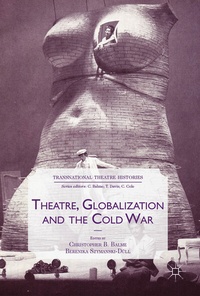
Theatre, Globalization and the Cold War
Description

Reviews / Votes
" Theatre, Globalization, and the Cold War brings together a diverse group of scholars to broaden examples and ultimately understandings of the role of theatrical culture during the Cold War. The transnational focus of this collection places more familiar sites alongside less studied 'battlefields,' in order to consider the many ways that power was contested in and through performance." (Kate Elswit, author of "Watching Weimar Dance")
More details
Other editions
Additional editions
Persons
Christopher Balme holds the Chair in Theatre Studies at the Ludwig Maximilian University of Munich, Germany. His current research interests focus on the legacy of modernism in the globalization of the arts; theatre and the public sphere; and the relationship between media and performance. He is director of the Global Theatre Histories project.
Berenika Szymanski-Düll is Lecturer in Theatre Studies at the Ludwig Maximilian University of Munich, Germany. Her current research interests include international touring theatre in the 19
th
century, theatre and migration and Performance Art in Eastern Europe during the Cold War. She is an associate of the Global Theatre Histories research project.
Content
Introduction; Christopher B. Balme and Berenika Szymanski-Düll.- Part I: Shifting Borders.- 1. A Cold War Battleground ; Charlotte M. Canning.- 2. Spirituals, Serfs, and Soviets; Christopher Silsby.- 3. The Politics of an International Reputation; David Barnett.- 4. 'A tour to the West could bring a lot of trouble...'; Berenika Szymanski-Düll.- 5. Song and Dance Ensembles in Central European Militaries; Václav Smidrkal.- 6. Theatre, Propaganda and the Cold War; Zoltán Imre.- Part II: Institutions and Institutional Imbrications.- 7. MI5 Surveillance of British Cold War Theatre; James Smith.- 8. Creating an International Community during the Cold War; Hanna Korsberg.- 9. The Cultural Cold War on the Home Front; Kyrill Kunakhovich.- Part III: Acting, Artists and Art Between the Battlefronts.- 10. Years of Compromise and Political Servility; Karolina Prykowska Michalak.- 11. 'A Memorable French-Romanian Evening'; Ioana Szeman.- 12. An Eastern Bloc Cultural Figure?; Nikolaos Papadogiannis.- 13. Acting on the Cold War; Anja Klöck.- 14. Checkpoint Music Drama; Sebastian Stauss.- Part IV: Postcolonial Perspectives.- 15. Whose Side Are You On?; Christine Matzke .- 16. 'How close is Angola to us?'; Rikard Hoogland.- 17. Manila and the World Dance Space; meLê Yamomo and Basilio E. Villaruz.- Bilbiography.- Index.
