

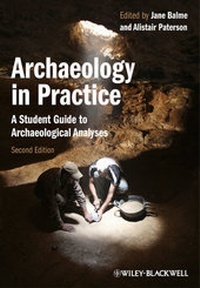
Archaeology in Practice
Description

Reviews / Votes
"Archaeology in Practice is the leading text onoptimal field and laboratory methods and how to link these toresearch questions. Superbly-referenced this is an essentialresource for both students and professionals." Peter Veth, The University of Western AustraliaMore details
Other editions
Additional editions
Persons
Content
Chapter Abstracts xvii
Preface and Acknowledgments xxi
Notes on Contributors xxv
List of Tables xxix
List of Figures xxx
1 Collaborating with Stakeholders 1
Larry J. Zimmerman and Kelly M. Branam
Introduction 1
What and Who Is an Archaeological Stakeholder? 2
Collaboration Comes in Many Forms 4
Learning to Work with Stakeholders: A Discipline's Journey 7
Differing Ways of Knowing the Past 11
True or valid? 11
How can there be different versions of the same past? 12
General Thoughts about How to Consult with Stakeholders 13
Building trust takes time 14
Use ethnography 15
Specific Issues and Concerns 15
Differential power levels 15
Competing claims 15
Informed consent 17
When pasts conflict 18
What do you do if things go wrong? 18
Owning the Past 19
Where to from Here? 19
Acknowledgments 20
Further Reading 20
References 21
2 Stratigraphy 26
Jane Balme and Alistair Paterson
Introduction 26
What Is Stratigraphy? 27
Why Do Archaeologists Study Stratification? 27
How Do Different Layers Occur in Archaeological Sites? 27
Principles (or Laws) of Stratigraphy 29
Sources of disturbance 30
Excavation and Stratigraphy 32
Recording Stratifi cation 33
The Harris Matrix: Interpreting the spatial record 34
Creating Analytical Units 37
Case Study 2.1: Sos Höyük 38
Conclusions 44
Acknowledgments 44
Further Reading 44
Excavation 44
Stratigraphy and formation processes 44
References 44
3 Sediments 47
Anthony Barham and Gary Huckleberry
Introduction 47
Why Study Soils and Sediments? 48
Sediments and Soils - Defi ning Concepts and Terms 50
Field Description and Sampling 51
Broad principles which should be applied during sediment sampling and description 53
Laboratory Techniques 54
Granulometry 55
pH (acidity/alkalinity) 60
Color 62
Organic matter 63
Phosphorus 65
Case Study 3.1: Prehistoric Canals in the American Southwest 67
Case Study 3.2: Kennewick Man, Washington State, United States 72
Conclusions 76
Further Reading 77
References 77
4 Absolute Dating 85
Simon Holdaway
Introduction 85
Chronometry 86
Radiocarbon 86
Dendrochronology 90
Isotopic methods 91
Radiogenic methods 92
Chemical and biological methods 94
Geomorphic methods 95
Limits on Chronometric Techniques 96
Maximum limits 96
Minimum limits 98
Limits on radiogenic techniques 100
Precision 101
From Age Measurement to Chronology 101
Temporal Resolution and Behavioral Variation 103
Fidelity and resolution 104
Bayesian analysis 105
Time averaging 106
Case Study 4.1: Bone Cave 108
Time perspectivism 110
Conclusion 110
Acknowledgments 111
Further Reading 111
References 111
5 Rock Art 118
Jo McDonald
Introduction 118
What Is Rock Art? 118
How is Rock Art Made? 119
Classification 120
How Is Rock Art Recorded? 122
Photography 123
Drawing and sketching 124
Tracing 124
Counting 127
How and Why Is Rock Art Analyzed? 128
Informed Methods 129
Formal (or Structural) Methods 129
Statistical techniques 130
Spatial distribution analysis 130
Information exchange and stylistic heterogeneity 131
Diachronic change 131
Dating Rock Art 132
Relative dating 132
Scientific techniques 135
Gender and Rock Art 135
Case Study 5.1: The Depiction of Species in Macropod Track Engravings 136
Concluding Remarks 142
Resources 142
Key associations and journals 143
Further Reading 143
References 143
6 An Introduction to Stone Artifact Analysis 151
Chris Clarkson and Sue O'Connor
Introduction 151
An overview 151
Analyzing Stone Artifacts 167
Research design 167
Classifying an assemblage of stone artifacts 168
Choosing attributes to record and measure 173
Managing data 176
Measuring extent of reduction 177
Dealing with diffi cult assemblages 187
Archaeometry 191
Determining the type and fl aking properties of stone 192
Sourcing stone artifacts 192
Is 3D the future of lithic analysis? 193
Conclusion 194
Acknowledgments 195
Further Reading 195
References 195
7 Ceramics 207
Linda Ellis
Introduction 207
What Is a "Ceramic?" 209
How Is Pottery Made? 210
Clay preparation 210
Object formation 211
Prefire decoration 211
Firing 212
Postfire treatment 212
Handling of Ceramics during and after Excavation 213
Careful excavating 213
Cleaning ceramics 214
Marking ceramics 214
Repairing ceramics 215
Initiating an Analytical Program for Ceramics 215
Prefatory issues before undertaking an analytical program 216
Quantitative analysis of ceramics 216
Sampling for laboratory analysis 219
How to begin analysis and select an appropriate analytical method 220
Areas of Ceramics Research and Their Analytical Approaches 221
Technology studies 224
Identifying the people producing and using ceramics 225
Dating of ceramics 226
Sourcing of ceramics 227
Usewear and use-life studies of ceramics 228
Conclusion 229
Resources 229
References 229
8 Residues and Usewear 232
Richard Fullagar
Introduction 232
Functional Analysis 233
Methodology, Experiments, and Procedures 234
Microscopes 238
Artifact Cleaning 239
Plant Residues Found on Artifacts 241
Starch 241
Raphides 242
Phytoliths 242
Resin, gums, waxes, and other exudates 243
Animal Residues Found on Artifacts 243
Hair and feathers 243
Blood 243
Bone 245
Shell 245
Usewear 245
Scarring or edge fracturing 246
Striations 246
Polish 249
Edge rounding 249
Beveling 249
Postdepositional damage 250
Hafting traces 250
Residues on Grinding Stones and Potsherds 250
Case Study 8.1: Starch Grains Analysis of Residues on Grinding Stones 251
Case Study 8.2: Gas Chromatography-Mass Spectrometry (GC-MS) Analysis of Archaeological Residues (by Elyse Beck and Peter Grave) 252
Discussion and Conclusion 253
Acknowledgments 255
Further Reading 255
References 255
9 Animal Bones 264
Terry O'Connor and James Barrett
Introduction 264
Look Before You Dig 265
Sampling and Recovery 269
Bagging and Tagging 277
Working Facilities 279
Making the Record 282
Identification: Whose Bone Is This? 283
What Has Happened to These Bones? 285
Who Was This Animal? 286
Preparing for the Research Phase 291
And Finally 293
References 294
10 Human Remains 300
Charlotte Roberts
Introduction: Why Study Human Remains and How It Has Developed 300
Ethics and Human Remains 304
Taphonomy, funerary context, and excavation and their effect on analysis and interpretation 306
Care of human remains during and after excavation 307
Detection 308
Excavation 308
Cleaning the remains once excavated 310
Curation of human remains 311
The starting point: basic analysis and interpretation 312
Sex and age at death 313
Paleodemography 316
Normal and Abnormal Variation 317
Normal variation 317
Abnormal variation 320
Methods 322
Studies of the Health of Populations 323
Specific Studies of Disease 324
Macroscopic 324
Biomolecular 324
Using Multiple Methods to Answer Questions on Past Health 326
Conclusion 328
Resources 328
References 329
11 Plant Remains 336
Wendy Beck and Emilie Dotte-Sarout
Introduction: A Scene (by Wendy Beck) 336
Macroscopic Plant Remains 337
What Can Plant Remains Contribute to Archaeology? 338
The relationship between people and plants 338
Plants and technology 339
Plants and regional subsistence 339
Archaeological theories and plants 340
What Are the Problems (and Solutions) for Identifying and Interpreting Macroscopic Plant Remains? 341
Technical problems in analyzing macroplants and their solutions 341
Archaeological sources 341
Ethnobotanical and ethnoarchaeological sources 341
What Kinds of Methods Can Be Effectively Used to Retrieve and Analyze Plant Remains? 342
Basic plant classification 344
Archaeological retrieval and identification of seeds, nuts, and fruits (carpology) 346
Wood and charcoal (anthracology) 346
More problems in the analysis of plant remains 346
Case Study 11.1: Plant Remains from Kawambarai Cave, Near Coonabarabran, Eastern Australia (by Wendy Beck and Dee Murphy) 349
Conclusion 354
Further Reading 355
References 355
12 Shell Middens and Mollusks 361
Sandra Bowdler
Introduction 361
Background 363
The Creation of Middens 363
The Identification of Middens 364
Field Procedures 366
Dating Middens 370
Laboratory Procedures 370
Hand Sorting into Components 371
Shellfish Analysis 372
Identification of Shellfish and Other Species 373
Further Analysis 378
Shell Artifacts 379
Fish Remains 379
Interpretation 379
Acknowledgments 380
Resources 380
References 381
13 Artifacts of the Modern World 385
Susan Lawrence
Introduction 385
Cataloging Artifacts 387
Domestic Ceramics 388
Clay Tobacco Pipes 392
Bottle Glass 394
Glass tools 398
Beads and Buttons 398
Metal Containers 399
Firearms 400
Building Materials 400
Cemeteries and Gravestones 403
Artifact Analysis 403
Case Study 13.1: Kelly and Lucas' Whaling Station, Adventure Bay, Tasmania 407
Conclusion 409
Resources 409
Further Reading 409
References 410
14 Historical Sources 415
Barbara J. Little
Introduction 415
Archaeology and Historical Sources 417
Preparing for research 417
Identifying sources 419
Verify, evaluate, and discriminate 422
Case Study 14.1: Scales of History and Historical Archaeology 423
What Are the Relationships between Documents and Archaeological Evidence? 427
Identification 427
Complement 428
Hypothesis formation and testing 429
Contradiction 429
Confronting myths 429
Creating context 430
Making an archaeological contribution to history 431
Acknowledgments 432
Resources 432
Archives 432
General 432
Oral history 433
Published resources 433
References 433
15 Writing the Past 436
Peter White
Introduction 436
First Decisions 436
What do I want to write about? 437
Who is my audience? 437
Structure 438
Aims 438
Background 438
Methods 439
Results 439
Conclusions 439
An abstract summarizes the text 439
References 440
Acknowledgments 440
Writing 440
Language 442
Writing for Publication 444
Audience 444
Start afresh 444
Follow instructions 444
Think about illustrations and tables 444
Reference efficiently 446
Read your proofs carefully 447
Conclusion 447
Acknowledgments 447
Further Reading 447
References 448
Appendix: Getting Things Right 449
SI units 449
Radiocarbon dates 449
Referencing 449
Proofing symbols 450
Index 451
Notes on Contributors
Jane Balme is a Professor in Archaeology at the University of Western Australia. She has been teaching undergraduate and graduate students in Australian universities for 20 years. Areas of research and publication include the archaeology of hunter–gatherer societies (especially subsistence) and Australian Indigenous archaeology.
Anthony Barham is convenor of the Masters of Archaeological Science Program at the Australian National University, having previously lectured in Geoarchaeology at the Institute of Archaeology, University College London. His research and teaching is cross-disciplinary and international in focus, studying sediments and stratigraphy on diverse urban development and mine sites, tells, middens, and Holocene shorelines. He has long-standing career foci in applied geoarchaeological practice in archaeological mitigation, coastal geoarchaeology, and the role of Quaternary stratigraphic architectures in determining the preserved archaeological record.
James Barrett is Deputy Director of the McDonald Institute for Archaeological Research and Reader in Medieval Archaeology at the University of Cambridge, United Kingdom. His particular research interests are the “long” Viking Age, political economy, migration, and the comparative study of maritime societies. Recent publications include Being an Islander, based on his work at Quoygrew, Orkney.
Wendy Beck is an Associate Professor in Archaeology at the University of New England in New South Wales. Her recent research and teaching interests include hunter–gatherer subsistence, especially plant food resources, and Indigenous and community archaeology and archaeological education. Her publications include articles in Economic Botany, Journal of Archaeological Science, and Australian Aboriginal Studies, and she coedited the book Plants in Australian Archaeology.
Sandra Bowdler is Emeritus Professor of Archaeology at the University of Western Australia. She has long been interested in coastal archaeology and hence midden analysis, having published an earlier paper of which this is a revised version (“Sieving seashells: midden analysis in Australian archaeology,” in G. E. Connah (ed.) Australian Archaeology: a Guide to Field Techniques, 1983). She is also the author of Hunter Hill, Hunter Island which describes her research in Tasmania, and numerous articles on her research at Shark Bay in Western Australia.
Kelly M. Branam, PhD, is an Associate Professor of Anthropology at Saint Cloud State University (SCSU). In addition to teaching undergraduate cultural anthropology courses, she teaches and works with graduate students in SCSU's Cultural Resource Management Master's program. Her ethnographic dissertation research on Crow Indian politics instigated research concerning the contentious relationship between the Yellowtail Dam, the Bighorn Canyon National Recreation Area (NRA) (which was created as a result of the dam), and the Crow Indian community. She has been an instructor for several different archaeological field projects that have taken place in the Bighorn Canyon NRA. These field projects bring archaeologists, anthropologists, students, and tribal community members together for collaboration on cultural resource preservation.
Chris Clarkson is a Senior Lecturer and QEII Fellow in the School of Social Science, The University of Queensland. He is an expert in lithic analysis and works in various regions, including Australia, Africa, India, and Southeast Asia. His current research revolves around understanding the dispersal of modern humans out of Africa to Arabia, India, Asia, and Australian, as well as behavioral and cognitive similarities and differences between modern humans and Neanderthals. Chris is also working on developing better quantitative methods of lithic analysis and testing hypotheses about the evolution of technology through archaeology, theory, and experiment.
Emilie Dotte-Sarout is an Archaeobotanist at the University of Western Australia. She completed her cotutelle PhD in 2010 at the Australian National University and Sorbonne University. She researches the relationships between people and forests in the Pacific through the analysis of wood charcoal macroremains. These are directly related to issues of landscape changes, arboricultural practices, or plant introduction and domestication. She has also been working on enhancing resources on the anatomy of woody taxa from Australasia and promoting the development of anthracology in the region. Results of her doctoral research have recently been published as book chapters or articles in various volumes related to Pacific Archaeology.
Linda Ellis is Senior Curator of the University Museum and Professor/Founding Director of the Museum Studies Program at San Francisco State University. Her books include Archaeological Method and Theory: An Encyclopedia. Areas of research and publication include laboratory methods in archaeology, museum professional practices, and archaeology of Eastern Europe from prehistory to Late Antiquity.
Richard Fullagar is Honorary Principal Research Fellow in the Centre for Archaeological Science, School of Earth and Environmental Science, University of Wollongong, Australia, and a Director of Scarp Archaeology. He has recently published papers in Science, Quaternary International, Archaeology in Oceania, and Antiquity on early utilization of starchy plants in Papua New Guinea and China, stone technology, and Australian prehistory. Current interests include initial colonization of Australia, megafaunal extinctions, and the history of plant food processing.
Simon Holdaway is a Professor in the Department of Anthropology, The University of Auckland. His research interests include the arid zone and coastal archaeology of Australia, the Neolithic of Egypt, and the historical archaeology of New Zealand. He has written extensively on stone artifact analysis and human environmental interaction.
Gary Huckleberry is an Adjunct Research Associate, Department of Geosciences, University of Arizona. His specialties are geoarchaeology and geomorphology, and he has published in several journals, including American Antiquity, Journal of Field Archaeology, Geology, and Quaternary Research. He is coeditor of Geoarchaeology: An International Journal.
Susan Lawrence is an Associate Professor in Archaeology at La Trobe University, Melbourne, and a past president of the Australasian Society for Historical Archaeology. She is the author (with Peter Davies) of An Archaeology of Australia Since 1788. Other publications include Dolly's Creek: Archaeology and History of a Victorian Goldfields Community and Archaeologies of the British.
Barbara J. Little is an archaeologist with the US National Park Service in Washington, DC, and Adjunct Professor at the University of Maryland. Her interests include public benefits of archaeology and citizen engagement via heritage. Her recent publications include the books Historical Archaeology: Why the Past Matters and Archaeology as a Tool of Civic Engagement, coedited with Paul A. Shackel.
Jo McDonald has been recording Australian rock art for over 30 years. While being a career consultant, she has also held a research position at the Australian National University. She was Principal Investigator on the Canning Stock Route Project (rock art and Jukurrpa) and is now an ARC Future Fellow, comparing desert rock art in Australia and North America. She has published widely on information-exchange theory, gender, and rock art management, and has been involved in national and World Heritage nominations for rock art provinces. She is the Director of the Centre for Rock Art Research + Management at the University of Western Australia, and holds the endowed Rio Tinto Chair in Rock Art Studies.
Sue O'Connor is an Australian Research Council Laureate Fellow in the Australian National University's College of Australia and the Pacific, researching modern human dispersal, adaptation, and behavior en route to Australia. Her research interests in Australia and Island Southeast Asia are reflected in her publications and books East of Wallace's Line Studies of Past and Present Maritime Cultures of the Indo-Pacific Region (with P. Veth) and 30,000 Years of Aboriginal Occupation, Kimberley, North West Australia.
Terry O'Connor is Professor of Archaeological Science at the University of York, United Kingdom. His books include The Archaeology of Animal Bones, Environmental Archaeology, Principles and Methods (with J. G. Evans), and volumes in the Archaeology of York series. Interests and publications range across zooarchaeology, particularly bone taphonomy and human–animal behavioral coevolution.
Alistair Paterson is a Professor of Archaeology and Head of the School of Social Sciences at the University of Western Australia. His research and teaching covers culture contact, historical archaeology in maritime and terrestrial settings, European colonization, historical rock art, and archaeological and historical methodology. He is the author of A Millennium of Cultural Contact (Left Coast, 2011), and The Lost Legions: Culture Contact in Colonial Australia (AltaMira, 2008). He is past President of the Australian Archaeological Association (2005–2007), and has been involved with editing for, and...
