

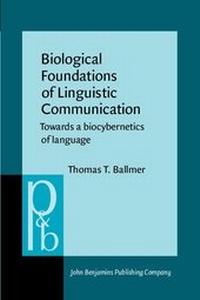
Biological Foundations of Linguistic Communication
Towards a biocybernetics of language
1st Edition
Published on 1. January 1982
X, 161 pages
978-90-272-8058-9 (ISBN)
Description

This is the second of two volumes - the first volume being Waltraud Brennenstuhl's Control and Ability (P&B III:4) - treating biocybernetical questions of language. This book starts out from an investigation of the (neuro-)biological relevancy of natural language from the point of view of grammar and the lexicon. Furthermore, the basic mechanisms of the self-organization of organisms in their environments are discussed, in so far as they lead to linguistic control and abilities.
More details
Other editions
Additional editions
Thomas T. Ballmer
Biological Foundations of Linguistic Communication
Towards a biocybernetics of language
Book
01/1982
John Benjamins Publishing Co
€72.08
Shipment within 10-15 days
Content
- BIOLOGICAL FOUNDATIONS OF LINGUISTIC COMMUNICATION Towards a Biocybernetics of Language
- Editorial page
- Tilte page
- Copyright page
- PREFACE
- Table of contents
- 1. LINGUISTICS AND BIOLOGY
- Part I: LANGUAGE AND BIOLOGICAL STRUCTUFOE
- 2. NEUROBIOLOGY, GRAMMAR AND LEXICON
- 2.1. Two Kinds of Linguistics
- 2.2 Grammar and Neurology
- 2.3. A Methodically Well-founded Ordering Procedure for Linguistic Information
- MODELS
- MODEL GROUPS
- 2.4. Brain Structures
- 2.5. The Correlation between Verb Thesaurus Structure and the Stages of Development of the Central Organ
- 2.6. A Geometro-Dynamical Approach to Explanation
- 2.6.1 Introductory Remarks on a General Theory of Dynamic Systems
- 2.6.2 The Nature of the Cerebral Structure
- 2.6.3 The Nature of the Verb Thesaurus Structure
- 2.6.4 Two Aspects of the Same Matter
- 2.6.5 Language and Brain, an Empirical Hypothesis
- Part II: THE EVOLUTION OF COGNITION AND COMMUNICATION
- 3.DYNAMICS OF ACTION AND PERCEPTION: BLASTEMATICS AND PRORHEMATICS Towards a Procedural Biolinguistics
- 3.1. Language and Linguistics
- 3.2. On the Limits of Linguistics
- 3.3. A Research Programme
- 3.4. Contextual Evolution of Communicative Abilities
- 3.4.1 Evolution
- 3.4.2 (Linguistic) Abilities
- 3.5. The Geometrizer, a Prototypical Example
- 3.6. A Prospect of the Blastematic Enterprise
- 3.7. Geometrizer, Blastematics and Prorhematics
- 3.8. Refining, Extending and Going Beyond the Geometrizer
- 3.8.1 On Refining the Geometrizer
- 3.8.2 On Extending the Geometrizer
- 3.8.3 Going Beyond the Geometrizer
- 3.8.3.1 Structuring Substantial Evolution: A Lexico-Semantic Task
- (i) The Evolution of Organisms and Processes
- (ii) The Structure of the Set of Processes
- 3.8.3.2 Towards a Blastematic Foundation of Linguistic Phenomena
- (i) Introductory Remarks
- (ii) How to Proceed
- (iii) From Grasping to Action and Linguistic Communication
- (iv) Some Further Notes on Grasping
- (v) Grasping and Perception
- 3.9. Approaching Prorhematics
- 3.9.1 Blastematic State Sequences and Blastematic Situation Sequences
- 3.9.2. Stage Analyses of Action, Perception and Linguistic Communication
- a. Some Stages of the Evolution of Action in the Infant
- b. Some Stages Leading to the Linguistic Action of Asking (for Help)
- c. Some Stages Leading to the Free Creation of Wishes
- d. The Development of Reference
- (i) Some Stages of the Development of the Act of Pointing in the Infant
- (ii) Some Stages of the Development of Pointing at Non-Present Objects in the Infant
- e. Some Stages of the Developing Memory
- (i) Three Stage Version:
- (ii) A More Refined Version: Memory of Objects -& Existence of Objects
- f. Development of Learning
- g.Some Stages of Language Development
- (i) Language Copying
- ii) Language Creation
- h. Development of 'Exodus ', Goal Directed Dislocation
- i. Dislocational Adaption: Evolution of 'Liber-imperialsm'
- j. A Possible Evolution of Verbal Interaction
- k. Standard Proceeding of Process and Action Sequences
- 3.9.3. Logical and Bio-Logical Blastematics
- 4. PHILOSOPHICAL AND METHODOLOGICAL ISSUES IN BIOLIN-GUISTICS
- 4.1. Two Philosophical Issues
- 4.1.1 Continuity vs. Discontinuity
- 4.1.2 Body and Mind
- 4.1.2.1. Some Preliminary Clarifications
- 4.1.2.2 Some Puzzles of Body and Mind
- (i) Why do I believe in an s-mind (personal mind)?
- (ii) S-mind is more than . . .
- (iii) Are other s-minds empirically detectable?
- (iv) What does follow from a physical conception of s-mind?
- (v) The causality problem o f physical s-mind. (Causality Contradiction of Body and Soul).
- (vi) Analternativephysical conception of s-minds
- (vii) Blastematics and s-minds
- (viii) The true philosopher's objection
- 4.2. Two Approaches to Knowledge: Philosophy and Wissenschaft
- 4.3. A Prions, Logics and Induction
- 4.3.1 A Prioris
- 4.3.2 Logics
- 4.3.3 Induction
- 4.4. Blastematics and Philosophy, a Summary
- 4.5. The Evolutionary Basis of Blastematics
- 4.5.1 Historical Considerations
- 4.5.2 Substantial Evolution Theory
- 4.5.3 Heuristic Use of the Verb thesaurus and an Argument against Circularity of a Blastematically Based Theory of Evolution
- 4.5.4 Substantial vs. Punctual Evolution Theory
- 4.5.5 Elucidation of the Heuristic Force of the Verbthesaurus Structure
- 4.6. Logic and Induction,Again
- NOTES
- REFERENCES
- INDEX OF SUBJECTS
