

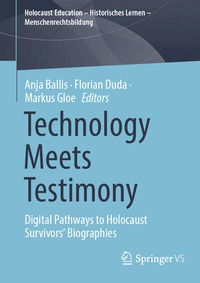
Technology Meets Testimony
Description

The "Technology Meets Testimony" network, funded by the DFG, merges history, education, computer science, and media studies. Running from June 2020 to August 2024, this international collaboration spans Germany, the USA, and the UK. The project aims to preserve and present Holocaust survivor testimonies through interactive digital 3D formats. Central to the project are testimonies from survivors like Pinchas Gutter, whose testimony was captured with 32 cameras and processed with advanced speech recognition. These testimonies allow meaningful engagement with the past. The book is divided into four chapters: Media Technology and Testimony, Educational Use in Schools and Universities, Museum and Archival Applications, and Survivors' Perspectives. These sections examine the design, implementation, and impact of 3D testimonies; evaluate their effectiveness in classrooms; discuss the role of moderators and technological setups in archives; and feature reflections on the creation process and significance of preserving survivors' stories through technology. This interdisciplinary approach addresses critical questions about preserving and presenting Holocaust testimonies, best practices for creating engaging digital experiences, and how different audiences learn from these resources. "Technology Meets Testimony" bridges the gap between survivors and future generations, setting a precedent for using technology to preserve historical narratives.
More details
Other editions
Additional editions
Persons
Anja Ballis is Professor of German Education and teaches at the LMU Munich.
Florian Duda is a research associate at the LMU Munich.
Markus Gloe is Professor of Political Education and teaches at the LMU Munich.
Content
Introduction.- Media Perception, Production and Research.- School and Higher Education.- Museum Context.- Survivor's Perspective - Insights & Analyses.
