

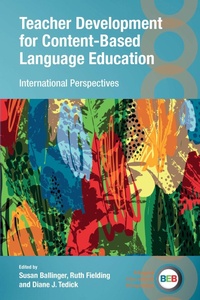
Teacher Development for Content-Based Language Education
International Perspectives
Published on 10. September 2024
384 pages
978-1-80041-061-9 (ISBN)
Description

Provides a much-needed exploration of professional development for teachers working with content and language.
This book fills a large gap in our understanding of how to prepare teachers for the challenging but increasingly popular task of integrating content and language instruction. It brings together findings on content-based teacher education from Africa, Asia, Australia, Europe and North America in order to inform researchers and teacher educators and enable them to play a critical role in the continued success of such programs.
It offers a solid grounding in theories and applications of content-based approaches with empirical studies investigating teacher identity, materials design, use of cognitive discourse functions and best practices for teacher education. Responding to the growing popularity of content-based programs and the shortage of qualified teachers for these contexts, this book promotes teacher-researcher collaboration and provides support for trainee teachers, in-service teachers and course leaders.
This book fills a large gap in our understanding of how to prepare teachers for the challenging but increasingly popular task of integrating content and language instruction. It brings together findings on content-based teacher education from Africa, Asia, Australia, Europe and North America in order to inform researchers and teacher educators and enable them to play a critical role in the continued success of such programs.
It offers a solid grounding in theories and applications of content-based approaches with empirical studies investigating teacher identity, materials design, use of cognitive discourse functions and best practices for teacher education. Responding to the growing popularity of content-based programs and the shortage of qualified teachers for these contexts, this book promotes teacher-researcher collaboration and provides support for trainee teachers, in-service teachers and course leaders.
Reviews / Votes
Altering perspectives on how we effectively learn languages in these fast-changing times is driving innovation on how we prepare educators with the knowledge, skills, and confidence to teach using integrative practices. Drawing on an expanding evidence base of effective practice, this book provides us with insights on how to build meaningful changes into the professional development of teachers through innovative forms of teacher education. * David Marsh, Marsh Education Design, Finland * This book successfully bundles the collective efforts of researchers and teacher educators from across the globe towards shaping teacher preparation and development for language-content-integrated education. Many powerful examples of professional learning and research will inspire readers from diverse multilingual contexts. Congratulations to the editors! * Christiane Dalton-Puffer, University of Vienna, Austria * This comprehensive volume admirably brings together a range of international research exploring the development needs of teachers in the ever-increasing number of instructional settings that involve content and language integration. The powerful examples of professional learning and research in these contexts provide a rich and timely contribution to the teacher education community and an indispensable resource for moving forward. * Roy Lyster, McGill University, Canada *More details
Series
Language
English
Place of publication
Bristol
United Kingdom
Target group
College/higher education
Product notice
Reflowable
ISBN-13
978-1-80041-061-9 (9781800410619)
Copyright in bibliographic data and cover images is held by Nielsen Book Services Limited or by the publishers or by their respective licensors: all rights reserved.
Schweitzer Classification
Other editions
Additional editions
Susan Ballinger | Ruth Fielding | Diane J. Tedick
Teacher Development for Content-Based Language Education
International Perspectives
Book
09/2024
Multilingual Matters
€57.40
Shipment within 10-20 days
Susan Ballinger | Ruth Fielding | Diane J. Tedick
Teacher Development for Content-Based Language Education
International Perspectives
E-Book
09/2024
Multilingual Matters
€24.49
Available for download
Persons
Susan Ballinger is Associate Professor in the Department of Integrated Studies in Education at McGill University, Canada. Her research interests include language awareness, peer interaction and cross-linguistic pedagogy and she is General Editor of the Journal of Immersion and Content-Based Language Education.
Ruth Fielding is Associate Professor in Languages and TESOL Teacher Education at Monash University, Australia. Her research examines multilingual identity, language teacher identity, bilingual education in Australia and intercultural approaches to language education.
Diane J. Tedick is Professor Emeritus of Second Language Education at the University of Minnesota, USA. Her research interests include student language development in immersion education and immersion/dual language teacher education and professional development.
Ruth Fielding is Associate Professor in Languages and TESOL Teacher Education at Monash University, Australia. Her research examines multilingual identity, language teacher identity, bilingual education in Australia and intercultural approaches to language education.
Diane J. Tedick is Professor Emeritus of Second Language Education at the University of Minnesota, USA. Her research interests include student language development in immersion education and immersion/dual language teacher education and professional development.
Content
Contributors
Acknowledgements
Do Coyle: Foreword
Susan Ballinger, Diane J. Tedick and Ruth Fielding: Introduction: A Proposal for Change in Content and Language Integrated Teacher Education
Part 1: Practices in Content-Based Teacher Education
Chapter 1. Tom Morton and Ana Llinares: Building Teachers' Knowledge of Cognitive Discourse Functions to Integrate Content and Language
Chapter 2. Diane J. Tedick, Corinne S. Mathieu and Danielle Dupuis: Learning Content and Language Integration: Assessing the Effectiveness of In-Service Professional Development for Immersion Teachers
Chapter 3. Laurent Cammarata, Sylvie Blain and Martine Cavanagh: Teaching Preparation for the Integration of Language and Literacy in the Disciplines: Challenges and Possibilities for Canadian French Immersion
Chapter 4. Vasiliki Spiliotopoulos: Faculty Engagement and Content-Based Language Education: An Appreciative Inquiry Approach to French Teacher Education in Western Canada
Part 2: Teachers' Perspectives on Professional Development
Chapter 5. Peichang (Emily) He: The Impact of CLIL Teacher Professional Development on Teacher Change in Asian Contexts: An Awareness-Knowledge-Practice-Research Model
Chapter 6. T.J. O Ceallaigh, Muiris O Laoire and Maire Ui Chonghaile: Triggering Teacher Identity Reconfiguration in Secondary Immersion
Chapter 7. Susan Ballinger, Austin Learning, Fred Genesee, Caroline Erdos and Andreanne Langevin: Professional Development and Teacher Content-Language Awareness in Canadian French Immersion
Chapter 8. Ruth Fielding and Lesley Harbon: Teacher Perception of the Link Between Professional Learning and Professional Identities and Confidence in Integrating Content and Language
Chapter 9. Nhlanhla Mpofu and Mncedisi C. Maphalala: South African Content Teachers' Experiences: Integrating English Across the Curriculum as a Continuous Professional Development Practice
Chapter 10. Ulla Fuerstenberg, Margit Reitbauer and Petra Kletzenbauer: Creating a Bilingual Space: Translanguaging as a Pedagogical Choice for Tertiary CLIL
Part 3: Teacher-Researcher Collaborations
Chapter 11. Angel M. Y. Lin, Peichang (Emily) He, Michael Kai-yip Tsang and Wai Yin Tse: Professional Co-Development of CLIL Teachers and Teacher Educators in Collaborative Action Research: Thematic-Pattern-Based 'Concept + Language Mapping'
Chapter 12. Marianne Turner: Increasing the Knowledge Base of Teacher Educators through Teacher-Researcher Collaboration
Chapter 13. Silvia Rieder-Marschallinger: Creating Content-and-Language-Integrative Materials for the Bilingual History Classroom through Design-Based Research: The Role of Teacher-Researcher Collaboration
Chapter 14. Corinne S. Mathieu: Redesigning Pedagogical Materials for Content and Language Integration: A Materials Perspective for Secondary Dual Language and Immersion Teacher Professional Development
Chapter 15. Limin Yuan and Yuen Yi Lo: Promoting CLIL Teacher Development through a Materials-Driven Model of Teacher-Researcher Collaboration: A Case Study
Index
Acknowledgements
Do Coyle: Foreword
Susan Ballinger, Diane J. Tedick and Ruth Fielding: Introduction: A Proposal for Change in Content and Language Integrated Teacher Education
Part 1: Practices in Content-Based Teacher Education
Chapter 1. Tom Morton and Ana Llinares: Building Teachers' Knowledge of Cognitive Discourse Functions to Integrate Content and Language
Chapter 2. Diane J. Tedick, Corinne S. Mathieu and Danielle Dupuis: Learning Content and Language Integration: Assessing the Effectiveness of In-Service Professional Development for Immersion Teachers
Chapter 3. Laurent Cammarata, Sylvie Blain and Martine Cavanagh: Teaching Preparation for the Integration of Language and Literacy in the Disciplines: Challenges and Possibilities for Canadian French Immersion
Chapter 4. Vasiliki Spiliotopoulos: Faculty Engagement and Content-Based Language Education: An Appreciative Inquiry Approach to French Teacher Education in Western Canada
Part 2: Teachers' Perspectives on Professional Development
Chapter 5. Peichang (Emily) He: The Impact of CLIL Teacher Professional Development on Teacher Change in Asian Contexts: An Awareness-Knowledge-Practice-Research Model
Chapter 6. T.J. O Ceallaigh, Muiris O Laoire and Maire Ui Chonghaile: Triggering Teacher Identity Reconfiguration in Secondary Immersion
Chapter 7. Susan Ballinger, Austin Learning, Fred Genesee, Caroline Erdos and Andreanne Langevin: Professional Development and Teacher Content-Language Awareness in Canadian French Immersion
Chapter 8. Ruth Fielding and Lesley Harbon: Teacher Perception of the Link Between Professional Learning and Professional Identities and Confidence in Integrating Content and Language
Chapter 9. Nhlanhla Mpofu and Mncedisi C. Maphalala: South African Content Teachers' Experiences: Integrating English Across the Curriculum as a Continuous Professional Development Practice
Chapter 10. Ulla Fuerstenberg, Margit Reitbauer and Petra Kletzenbauer: Creating a Bilingual Space: Translanguaging as a Pedagogical Choice for Tertiary CLIL
Part 3: Teacher-Researcher Collaborations
Chapter 11. Angel M. Y. Lin, Peichang (Emily) He, Michael Kai-yip Tsang and Wai Yin Tse: Professional Co-Development of CLIL Teachers and Teacher Educators in Collaborative Action Research: Thematic-Pattern-Based 'Concept + Language Mapping'
Chapter 12. Marianne Turner: Increasing the Knowledge Base of Teacher Educators through Teacher-Researcher Collaboration
Chapter 13. Silvia Rieder-Marschallinger: Creating Content-and-Language-Integrative Materials for the Bilingual History Classroom through Design-Based Research: The Role of Teacher-Researcher Collaboration
Chapter 14. Corinne S. Mathieu: Redesigning Pedagogical Materials for Content and Language Integration: A Materials Perspective for Secondary Dual Language and Immersion Teacher Professional Development
Chapter 15. Limin Yuan and Yuen Yi Lo: Promoting CLIL Teacher Development through a Materials-Driven Model of Teacher-Researcher Collaboration: A Case Study
Index
