

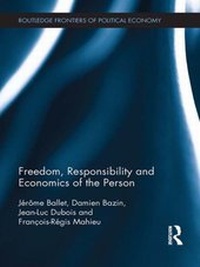
Freedom, Responsibility and Economics of the Person
1st Edition
Published on 31. July 2013
192 pages
978-1-135-13999-5 (ISBN)
Description

The capability approach has developed significantly since Amartya Sen was awarded the Nobel Prize in Economics in 1998. It is now recognised as being highly beneficial in the analysis of poverty and inequality, but also in the redefinition of policies aimed at improving the well-being of individuals.
The approach has been applied within numerous sectors, from health and education to sustainable development, but beyond the obvious interest that it represents for the classical economics tradition, it has also encountered certain limitations. While acknowledging the undeniable progress that the approach has made in renewing the thinking on the development and well-being of a population, this book takes a critical stance. It focuses particularly on the approach's inadequacy vis-a-vis the continental phenomenological tradition and draws conclusions about the economic analysis of development. In a more specific sense, it highlights the fact that the approach is too bound by standard economic logic, which has prevented it from taking account of a key 'person' dimension - namely, the ability of an individual to assume responsibility. As a result, this book advocates the notion that if the approach is used carelessly in relation to development policies, it can cause a number of pernicious effects, some of which may lead to disastrous consequences.
Due to its multidisciplinary nature, this book will be of interest to those working in the fields of economics, philosophy, development studies and sociology.
The approach has been applied within numerous sectors, from health and education to sustainable development, but beyond the obvious interest that it represents for the classical economics tradition, it has also encountered certain limitations. While acknowledging the undeniable progress that the approach has made in renewing the thinking on the development and well-being of a population, this book takes a critical stance. It focuses particularly on the approach's inadequacy vis-a-vis the continental phenomenological tradition and draws conclusions about the economic analysis of development. In a more specific sense, it highlights the fact that the approach is too bound by standard economic logic, which has prevented it from taking account of a key 'person' dimension - namely, the ability of an individual to assume responsibility. As a result, this book advocates the notion that if the approach is used carelessly in relation to development policies, it can cause a number of pernicious effects, some of which may lead to disastrous consequences.
Due to its multidisciplinary nature, this book will be of interest to those working in the fields of economics, philosophy, development studies and sociology.
Reviews / Votes
"This book and its arguments deserves reading and attention, not just from the philosophically inclined in economics but also from those hoping to better understand the often overlooked complexities of economic and moral behavior." - John B. Davis, Journal of Economic Inequality"[The authors] traverse quite a path in this volume, crisscrossing positive and normative domains in philosophy, economics and politics...This is a densely argued book which will repay reading and discussion." - Ravi Kanbur, Journal of Economic Methodology
"In sum, the book does provide interesting material for discussion for anyone concerned with issues of agency and responsibility, and the reduction of unjust situations in a globalized world." - Oscar Garza, Journal of Human Development and Capabilities
"[T]he phenomenological reconsideration outlined in this book sheds a new light on whether the dialogue between sciences can indeed prove lucrative for economics. This is a welcome and important contribution to the debate...More importantly, Ballet, Bazin, Dubois and Mahieu re-diagnose the methodological problem of economics: by underscoring the irreducible complexity of the person, they show how the 'representative agent', the mathematical models, or the quantitative predictions of economic interactions are highly problematic." - Carmen Elena Dorobat, Journal of Philosophical Economics
"In developing an alternative to the mainstream account of economic action, this book is to be warmly welcomed. The book usefully engages with a wide range of literature and issues, including Sen's capability approach, questions of intentionality, freedom and responsibility, and the status of rights and duties. The book also provides examples of cases where individuals appear to behave in ways that the standard economic model seems unable to adequately explain." - Stephen Parsons, Review of Political Economy
More details
Series
Language
English
Place of publication
London
United Kingdom
Publishing group
Taylor & Francis Ltd
Target group
College/higher education
Illustrations
8 s/w Abbildungen, 2 s/w Tabellen, 8 s/w Zeichnungen
2 Tables, black and white; 8 Line drawings, black and white; 8 Illustrations, black and white
File size
1,54 MB
ISBN-13
978-1-135-13999-5 (9781135139995)
Copyright in bibliographic data and cover images is held by Nielsen Book Services Limited or by the publishers or by their respective licensors: all rights reserved.
Schweitzer Classification
Other editions
Additional editions
Jerome Ballet | Damien Bazin | Jean-Luc Dubois
Freedom, Responsibility and Economics of the Person
Book
11/2016
1st Edition
Routledge
€73.00
Shipment within 10-20 days
Jerome Ballet | Damien Bazin | Jean-Luc Dubois
Freedom, Responsibility and Economics of the Person
Book
07/2013
1st Edition
Routledge
€231.30
Shipment within 15-20 days
Persons
Jerome Ballet is Senior Lecturer in Economics at the University of Versailles Saint Quentin-en-Yvelines, France, and Researcher at the Institute of Research for Development, France.
Damien Bazin is Assistant Professor in Economics at the University of Nice Sophia Antipolis (GREDEG), France.
Jean-Luc Dubois is Research Professor at the Institute of Research for Development, France, and he teaches at the Catholic University of Paris, France.
Francois-Regis Mahieu is Emeritus Professor of Economics at the University of Versailles Saint Quentin-en-Yvelines, France.
Damien Bazin is Assistant Professor in Economics at the University of Nice Sophia Antipolis (GREDEG), France.
Jean-Luc Dubois is Research Professor at the Institute of Research for Development, France, and he teaches at the Catholic University of Paris, France.
Francois-Regis Mahieu is Emeritus Professor of Economics at the University of Versailles Saint Quentin-en-Yvelines, France.
Content
1. Introduction 2. Freedom and the Capability Approach 3. Freedom and Responsibility 4. Person and Responsibility 5. Methodology of Person-Centred Economics 6. Illustrations of the Economics of the Person 7. Vulnerability, Identity and Responsibility 8. Fallibility and Fragility 9. From the Economics of the Person to the Responsibilities of Institutions and the Social Precautionary Principle
